Bright Data (brightdata.com) sold residential proxies at $8 a gigabyte on 12 October 2026, or $4 for the first three months with the code RESIGB50. Since 7 July 2026 that network has been open only to registered companies that pass a review by a person. We priced nine other residential networks on the same day. For 100 GB in one month, DataImpulse charged $100 and Decodo $275, against $800 at Bright Data's list price. The comparison table shows all nine and who each one will sell to.
The company behind Bright Data: its history, owners and connections
Why people leave Bright Data in 2026
The largest change came on 7 July 2026. Bright Data's documentation says its residential proxies "are available only to verified companies that pass a human-reviewed KYC (Know Your Customer) check". A freelancer, or a team without a registered company, can no longer buy residential traffic there.
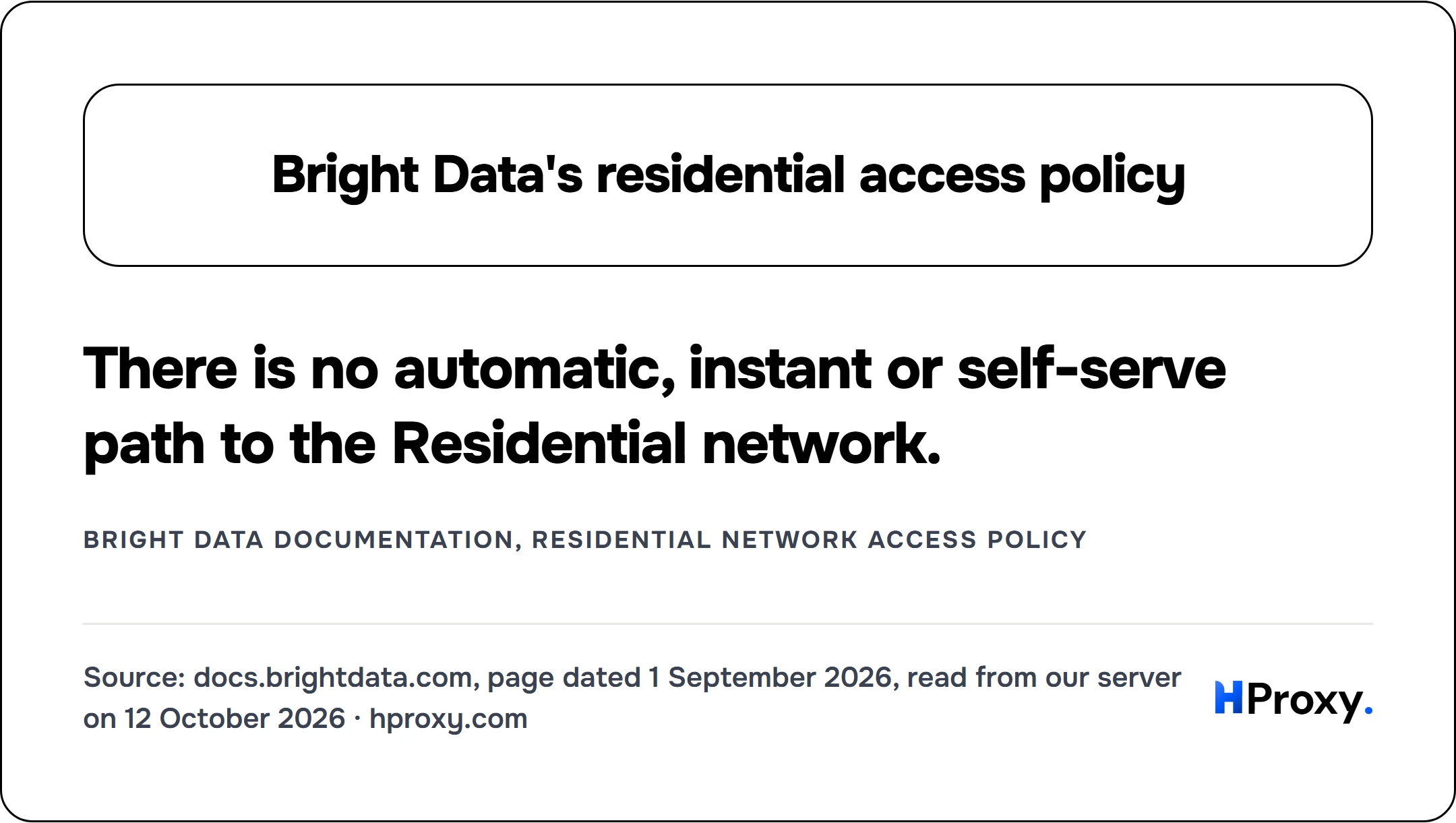
There is no automatic, instant or self-serve path to the Residential network.
The second reason is the bill. Pay as you go costs $8 a gigabyte at list price, and the coupon that halves it lasts three months. The smallest monthly plan costs $499, charged on the 1st of each month.
The contract adds two hard edges. It calls subscription fees "non-cancelable and non-refundable". The pricing FAQ says that an unused monthly commitment does not roll over into the next month.
Two smaller gaps matter to some buyers. Crypto is not on its payment list: its FAQ names PayPal, Payoneer, Alipay, Google Pay, wire transfers and credit cards. Its mobile price page last showed a price in an archived copy of 13 April 2026. That address now forwards to the general price list, which shows no mobile price.
Its own pages also disagree on who may apply. The documentation says a personal-email account "cannot be approved". Its price page FAQ still describes a review that "may include a quick intro video call and some verification of your company or personal information". We read both on 12 October 2026; only the documentation carries a date.
What Bright Data charges, read on 12 October 2026
Bright Data residential prices, 12 October 2026
| Plan | List per GB | With coupon | Billed |
|---|---|---|---|
| Pay as you go | $8.00 | $4.00 | no plan |
| 141 GB a month | $7.00 | $3.50 | $499 a month |
| 332 GB a month | $6.00 | $3.00 | $999 a month |
| 798 GB a month | $5.00 | $2.50 | $1,999 a month |
| Over 1 TB | custom | custom | by contract |
brightdata.com residential price page, read from our server on 12 October 2026
Each monthly fee matches its allowance at the coupon rate. 141 GB at $3.50 comes to $493.50, close to the $499 fee. At the $7 list rate the same 141 GB would cost $987, and the page does not say what the plan includes once the coupon ends.
The other networks need no KYC. A static ISP address costs $1.80 a month shared and $3.50 dedicated at 10 addresses, falling to $1.30 and $2.50 at 1,000. Datacenter addresses cost $1.40 and $2.20 at 10, and $0.90 and $1.30 at 1,000. The Web Unlocker and the search results API cost $1.50 per 1,000 requests with no plan.
A new account gets its first deposit matched "dollar for dollar, up to $500".
How Bright Data's price moved from 2022 to 2026
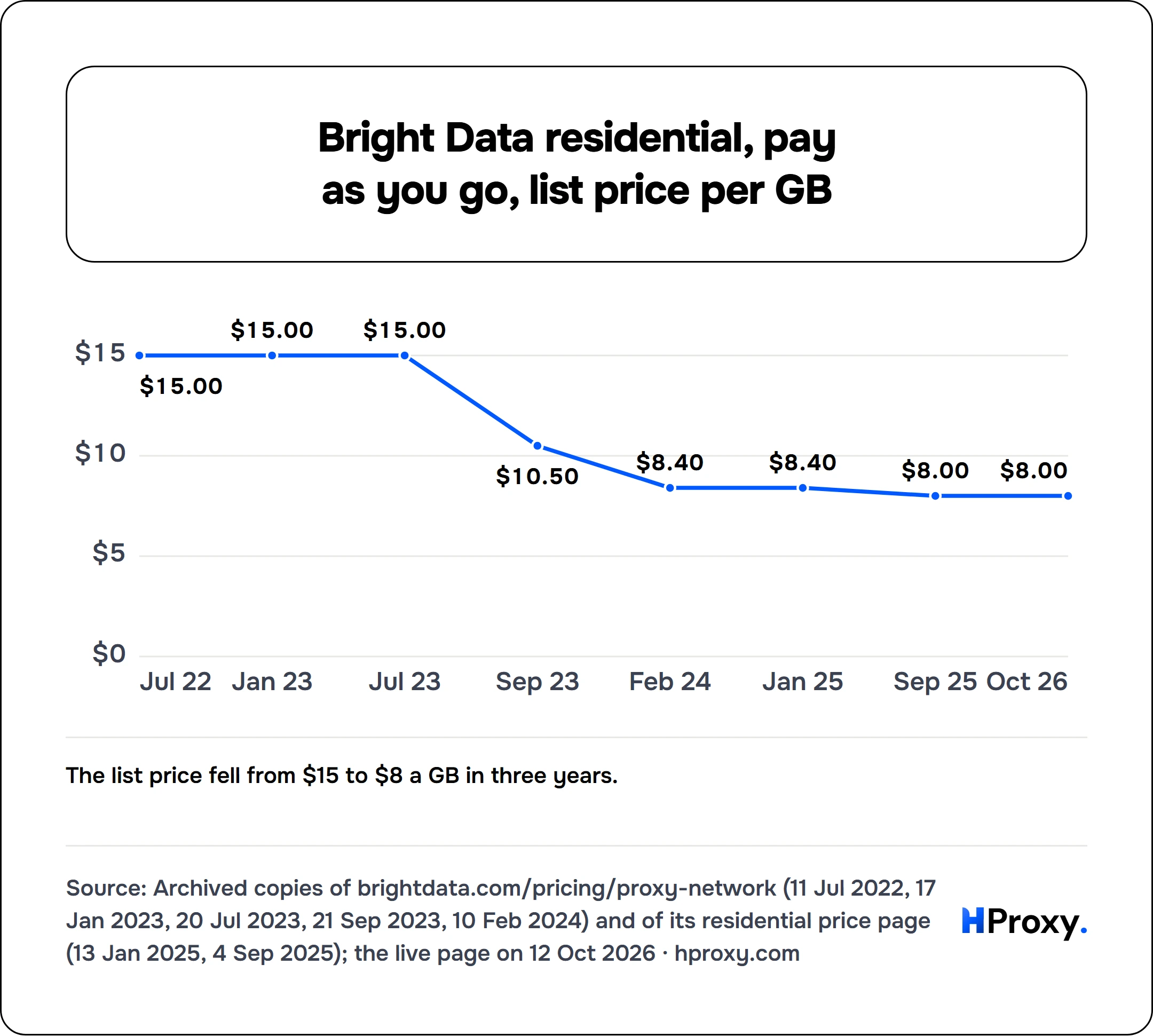
Archived copies of the price page show $15 a gigabyte with no commitment from July 2022 to July 2023. By 21 September 2023 the rate was $10.50, and by 10 February 2024 it was $8.40. The copy of 4 September 2025 shows $8, and it is the first copy we read with the coupon printed beside it.
The monthly plans fell further than the list price. In July 2022 the smallest plan cost $500 a month and priced residential traffic at $11.25 a gigabyte. Today the $499 plan prices it at $7 at list, or $3.50 while the coupon runs.
Who can still buy residential proxies there
The documentation sets out the rule in five steps, as we read it on 12 October 2026:
- Sign up for a registered company and verify a company email domain. Accounts on Gmail, Outlook or iCloud are not eligible.
- Add funds to the balance. The KYC form is not available in the trial or playground modes.
- Send details about the business and its scraping use case, with a company registration document. Bright Data promises an update "within 48 hours".
- Use the network for the approved use case only. Requests to other domains or categories are blocked with an "Access denied" error.
- Residential zones created on or before 7 July 2026 keep working, and customers verified before then keep their access.
Without that approval, Bright Data still sells ISP and datacenter proxies and the Web Unlocker. Its FAQ calls them "alternatives, not a limited or trial Residential mode".
Nine alternatives, priced the same day
We priced the nine residential networks whose records we read in full for our company pages. Every price below comes from each seller's own pages, read from our server on 12 October 2026. The rules come from the same pages, read between 26 September and 12 October 2026. Prices exclude VAT where a seller adds it.
Bright Data and nine alternatives, residential, 12 October 2026
| Provider | Smallest purchase | Lowest published rate |
|---|---|---|
| Bright Data | $8 a GB, no plan; $4 for three months with RESIGB50 | $2.50 a GB on the $1,999 plan, coupon months |
| Oxylabs | $30 a month for up to 5 GB, $6 a GB | $2.50 a GB from 1,000 GB, $2,500 a month |
| Decodo | $4 a GB, no plan | $2 a GB at 1 TB a month |
| Webshare | $3.50 for 1 GB on a monthly plan | $1.40 a GB, 3,000 GB for $4,200 a month |
| SOAX | $5 a GB, no plan, United States tier | from $0.85 a GB on the $3,000 plan |
| DataImpulse | $1 a GB, from a $5 top-up | $0.80 a GB above 1 TB |
| NodeMaven | $8.50 for 2 GB a month; a $3.50 trial | $2.20 a GB at 1,000 GB a month |
| Rayobyte | $3.50 a GB, pay as you go | $0.70 a GB from 1,000 GB |
| 9Proxy | $15 for 5 GB | $0.68 a GB at 10,000 GB |
| Proxy-Cheap | $1.50 a GB from 3 GB | $0.78 a GB from 51 GB |
Each seller's price page, read from our server on 12 October 2026
| Provider | Open to a person | No ID check before buying | Pay as you go |
|---|---|---|---|
| Bright Data | no | no | yes |
| Oxylabs | yes | no | no |
| Decodo | yes | yes | yes |
| Webshare | yes | yes | no |
| SOAX | yes | no | partly |
| DataImpulse | yes | yes | yes |
| NodeMaven | yes | yes | yes |
| Rayobyte | yes | no | yes |
| 9Proxy | yes | yes | yes |
| Proxy-Cheap | yes | yes | yes |
| HProxy | yes | yes | yes |
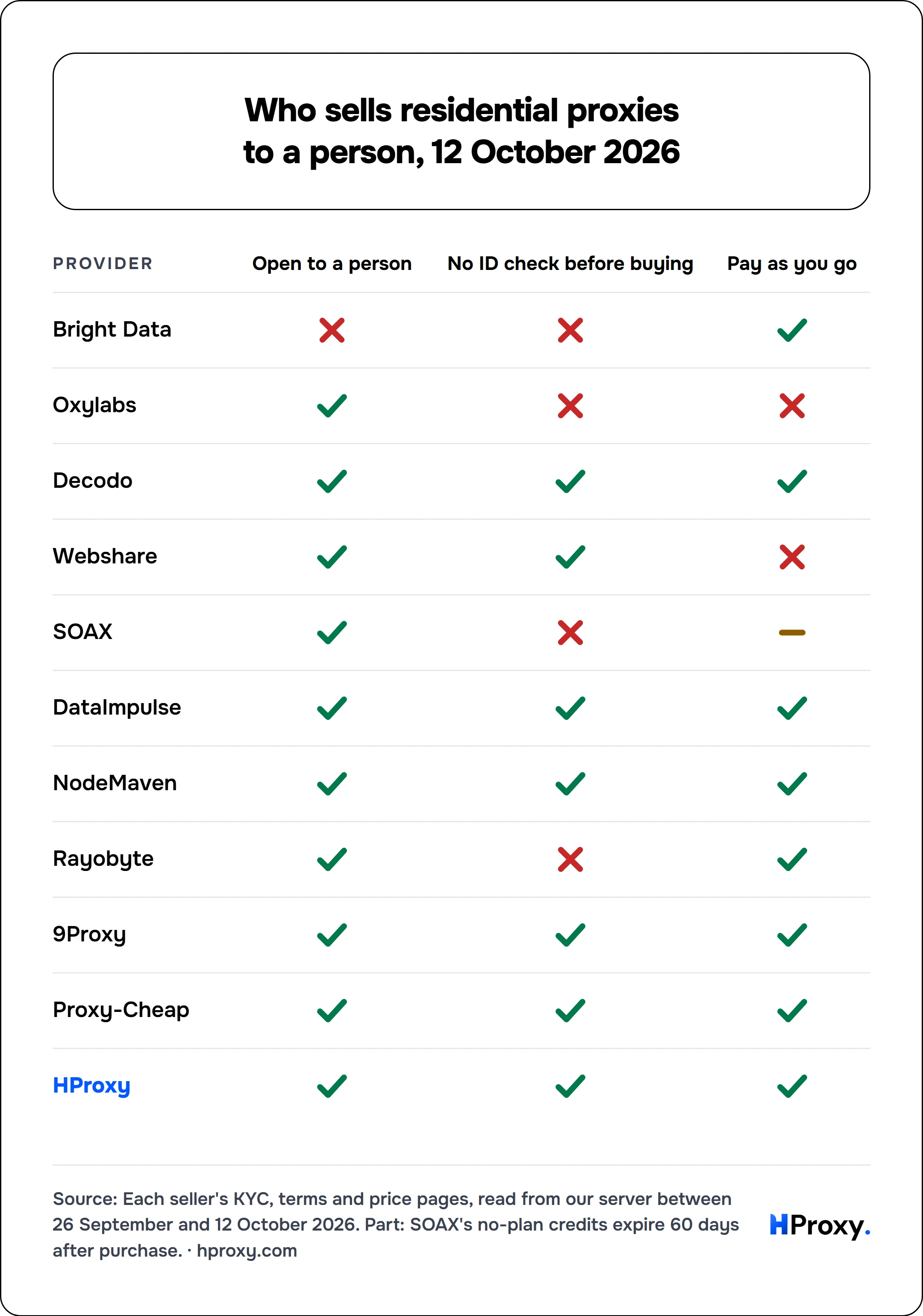
Six of the nine sell to anyone and ask for an ID only in some cases. Oxylabs, SOAX and Rayobyte check every customer before the first residential purchase, as Bright Data does. Unlike Bright Data, none of the three requires a company.
What 100 GB a month costs at each
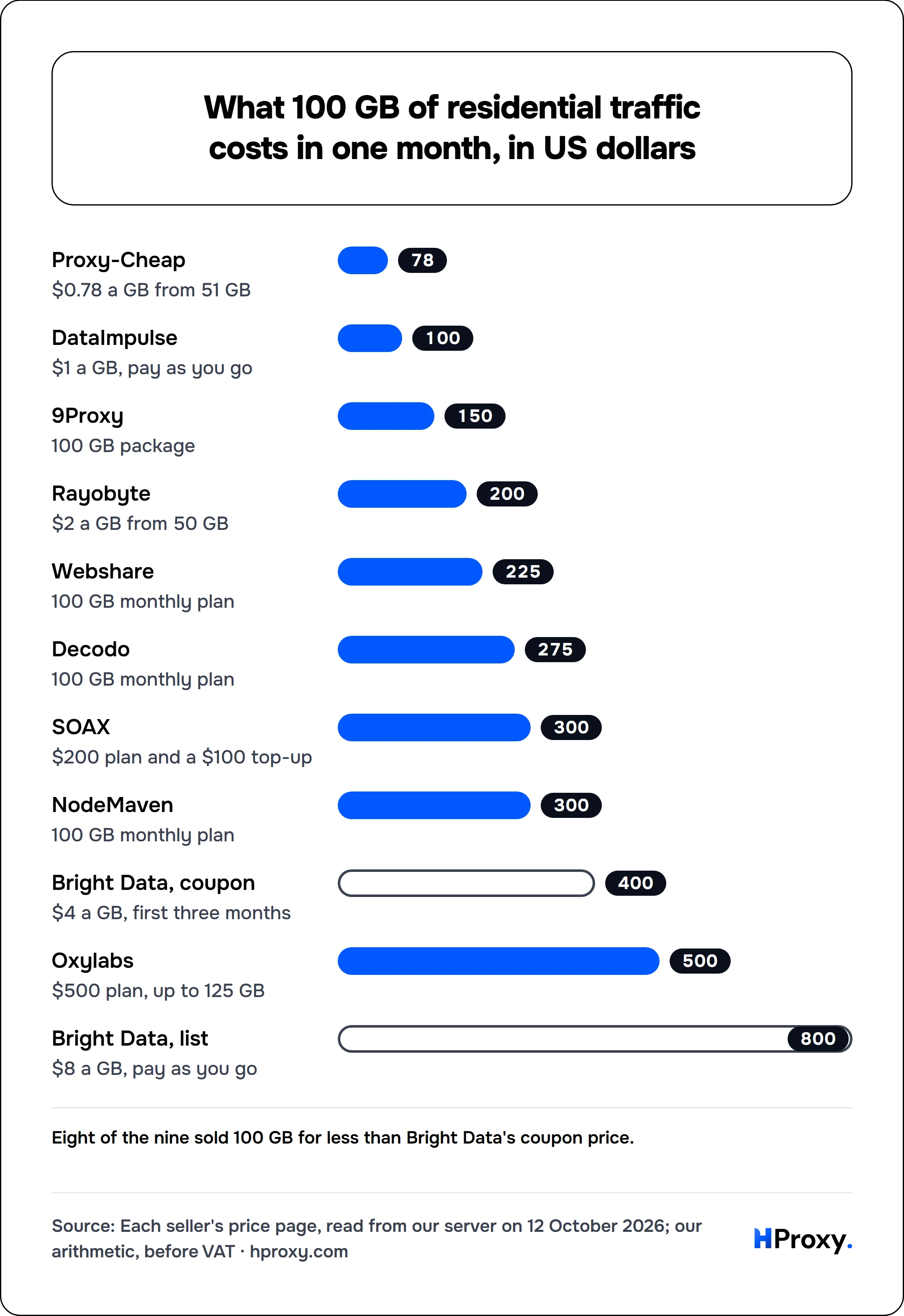
We took the cheapest route each price page offers to 100 GB of residential traffic in one month. The buyer is a new customer in the United States. For Decodo and Webshare that is a 100 GB monthly plan, for SOAX its $200 plan plus a $100 top-up at $3 a gigabyte, the total its own calculator shows. Oxylabs has no plan between 20 GB and 125 GB, so 100 GB needs the $500 plan, and the unused 25 GB expire after a month.
Three caveats change the order for some readers. Decodo, SOAX and Oxylabs add VAT where it applies. SOAX prices the United States in its dearest tier, and cheaper countries cost less. Proxy-Cheap's $0.78 rate starts at 51 GB. Its FAQ capped top-ups at 50 GB a month when we read it on 10 October 2026, so ask before you order 100 GB there.
Every big name cut its entry price, Bright Data the least
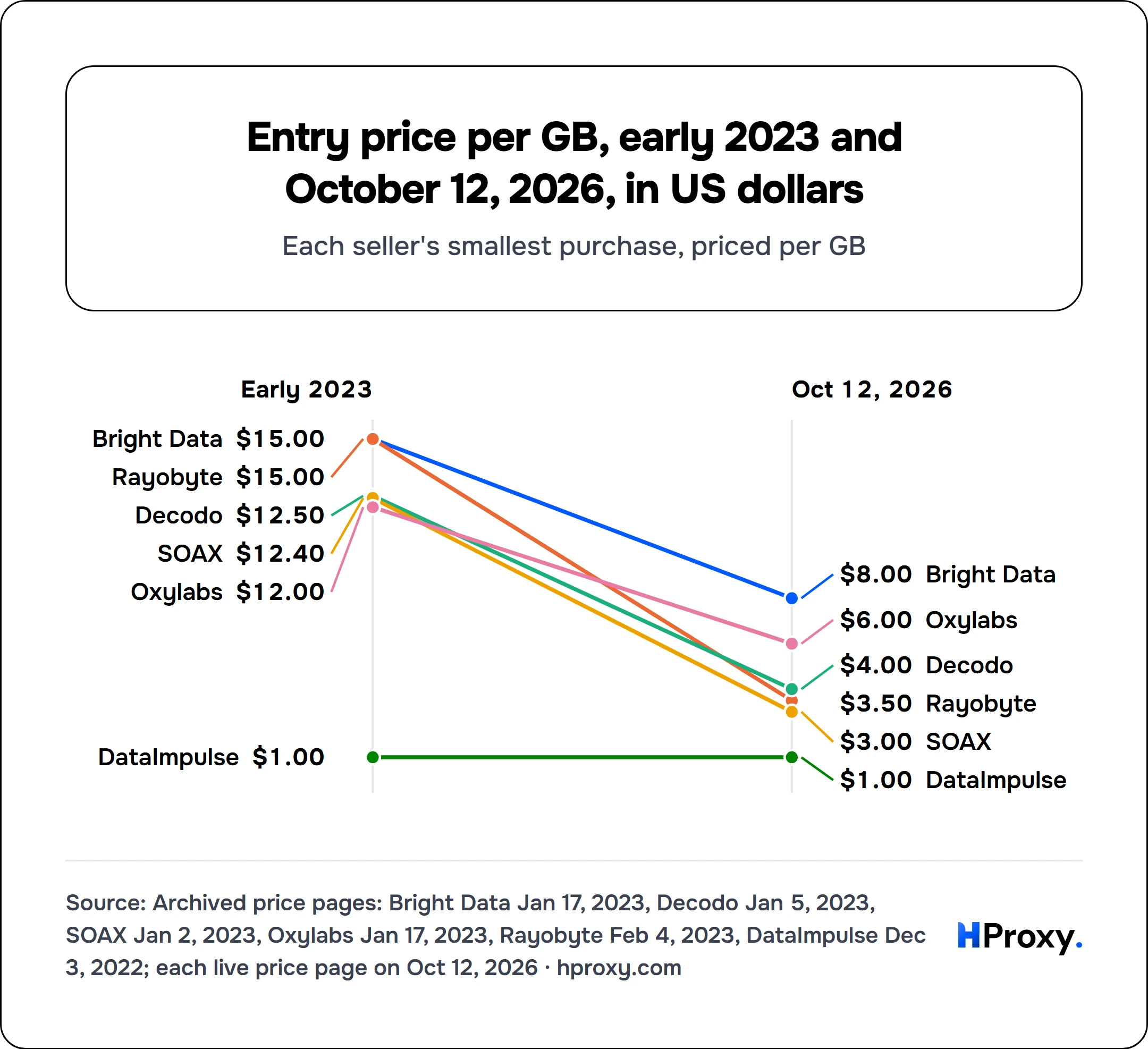
Four of the six cut their entry price by half or more since early 2023. Rayobyte went from $15 to $3.50 a gigabyte and SOAX from $12.40 to $3. Bright Data's list price fell by 47%, from $15 to $8, and its answer to the rest of the market is a coupon that ends after three months. DataImpulse charged $1 a gigabyte when the archive first captured its shop in December 2022, and it still does.
Who stands behind the alternatives
Leaving Bright Data does not always mean leaving the circle of its largest rival. Tesonet, a company builder in Vilnius, lists Oxylabs ("Year founded: 2015"), Webshare ("Investment year: 2022") and Decodo ("Investment year: 2024") on its own portfolio page. Oxylabs announced on 20 September 2022 that it had bought Webshare. On 25 March 2026 Oxylabs announced that Decodo's chief executive, Vytautas Savickas, was becoming chief executive of the Oxylabs group.
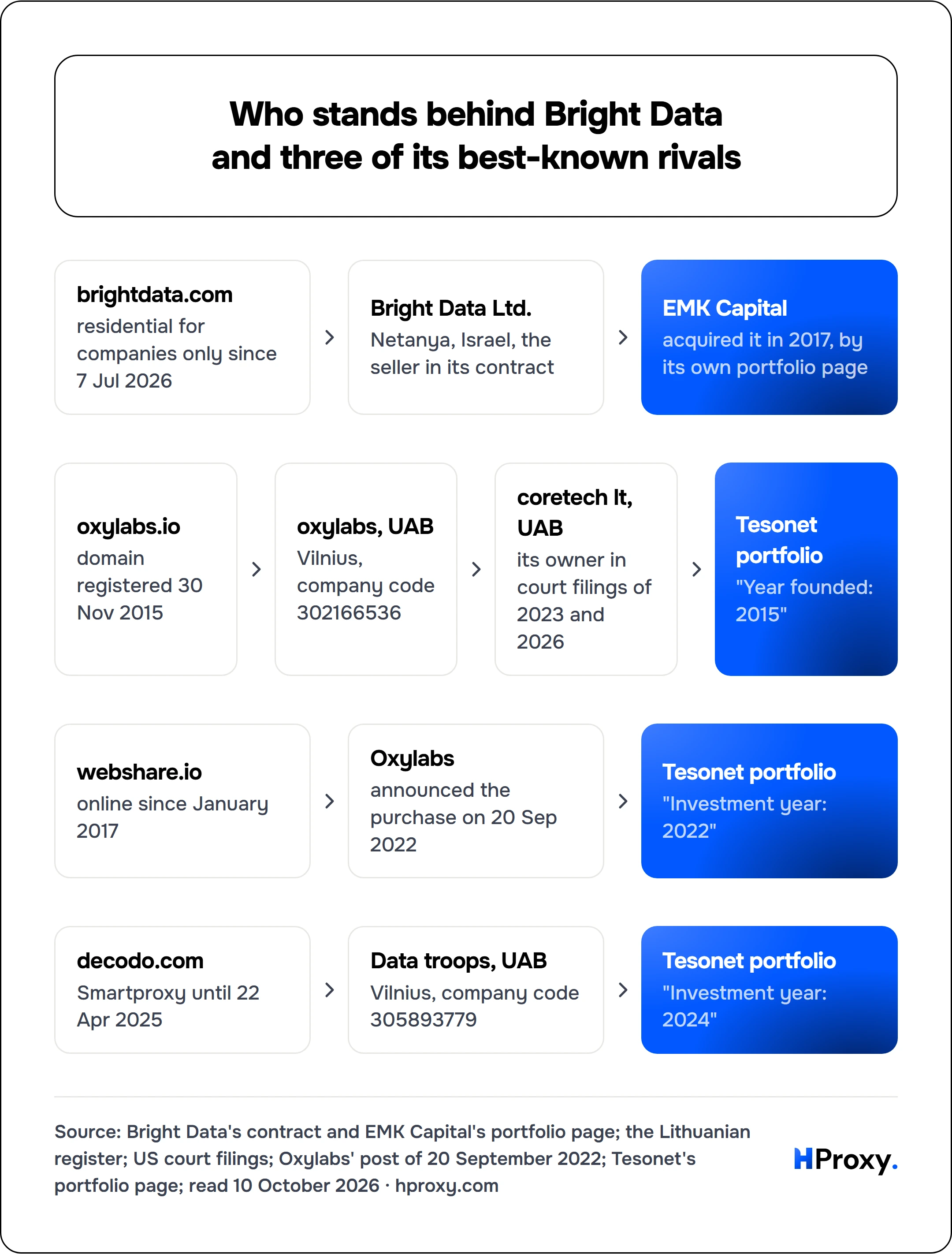
- brightdata.comresidential for companies only since 7 Jul 2026
- Bright Data Ltd.Netanya, Israel, the seller in its contract
- EMK Capitalacquired it in 2017, by its own portfolio page
- oxylabs.iodomain registered 30 Nov 2015
- oxylabs, UABVilnius, company code 302166536
- coretech lt, UABits owner in court filings of 2023 and 2026
- Tesonet portfolio"Year founded: 2015"
- webshare.ioonline since January 2017
- Oxylabsannounced the purchase on 20 Sep 2022
- Tesonet portfolio"Investment year: 2022"
- decodo.comSmartproxy until 22 Apr 2025
- Data troops, UABVilnius, company code 305893779
- Tesonet portfolio"Investment year: 2024"
Bright Data and Oxylabs have faced each other in court since 2018, over patents, a product name and an antitrust claim. The other six sellers on this page stand on their own, as far as their records show:
| Provider | Who the records name |
|---|---|
| SOAX | SOAX LTD, England and Wales, 11828506; its largest holder held 34.0% in June 2026 |
| DataImpulse | Softoria LLC of Florida signs its terms; Bytemarket OÜ of Estonia signed them until early 2024 |
| NodeMaven | NodeMaven FZ LLC, Ras Al Khaimah, since July 2025; no owner named in any record we read |
| Rayobyte | Blazing SEO, LLC, formed in Colorado in 2015 by Neil Emeigh; Rayobyte since 2022 |
| 9Proxy | ConnectWise Limited, "a Hong Kong-based company" in its terms; no company number on its pages |
| Proxy-Cheap | no company in its contract; its marks belong to UAB Lietparkas of Vilnius |
Our ownership hub follows these companies further.
The nine, one by one
Oxylabs
Oxylabs sold one subscription for all its products on 12 October 2026. The smallest plan cost $30 a month and bought residential traffic at $6 a gigabyte, up to 5 GB. The $500 plan bought up to 125 GB at $4, and plans from $2,500 a month lowered the rate to $2.50. A new account gets a $5 credit to test with.
Its rules are the strictest on this page after Bright Data's. "Every customer has to answer a KYC questionnaire to get access to our solutions," its KYC page says, and it reports that 75% are approved. Plan traffic expires one calendar month after purchase, and self-service purchases are non-refundable. Its price page adds: "We do not accept Bitcoins." Our Oxylabs company page has its records.
Decodo, formerly Smartproxy
Decodo charged $4 a gigabyte with no plan on 12 October 2026. Its monthly plans ran from 3 GB for $11.25 to 100 GB for $275, and enterprise plans reached $2 a gigabyte at 1 TB a month, all before VAT.
A person can buy without an identity check, though mailing, business and streaming targets open only after one. A first purchase can be refunded within 14 days while use stays under its limit of 20% of the traffic or 1 GB, unless it was paid in crypto. It takes cards, PayPal, Alipay, Google Pay, Apple Pay and crypto. At half of Bright Data's list price, it is the closest like-for-like swap for a small team. Our Decodo company page traces its Tesonet ties.
Webshare
Webshare sold rotating residential traffic on monthly plans on 12 October 2026. The 1 GB plan cost $3.50, half of its $7 list price, and the rate fell to $1.40 a gigabyte on the 3,000 GB plan at $4,200 a month. A refund needs a request within two days of the payment.
It lists cards, Google Pay and Apple Pay, and its residential page says there are no plans to add other methods. Some targets stay blocked until a short KYC procedure. Oxylabs owns it, by Oxylabs' own announcement of 2022. Our Webshare company page has the rest.
SOAX
SOAX charged $5 a gigabyte without a plan in its dearest tier, which includes the United States, on 12 October 2026. Plans of $200, $500, $1,500 and $3,000 a month lowered the rate to $3, $2.20, $1.50 and from $0.85, all before VAT. Credits bought on a monthly plan expire 60 days after they are added.
Its KYC and KYB policy makes identity verification "a condition of access to the paid Platform", before any purchase. Payments are generally non-refundable, and the price page lists major cards. SOAX counts data in both directions, "including partial responses, retries, and interrupted connections". Our SOAX company page names its holders.
DataImpulse
DataImpulse charged $1 a gigabyte with no plan on 12 October 2026, from a $5 first top-up, and $0.80 above 1 TB. Its page answers the usual question in two words: "Does the traffic expire? No." Below 51 GB it is the cheapest rate on this page.
The rules cut both ways. State, city, ZIP and ASN targeting count at twice the rate. Government, banking and payment sites have been blocked since December 2023 and open only after an identity check. The 7-day refund covers a first Intro purchase only, and never a crypto payment. Our DataImpulse company page traces the group behind it.
NodeMaven
NodeMaven sold residential and mobile traffic from one balance on 12 October 2026. Pay as you go cost $5 a gigabyte at 2 GB and $3.45 at 100 GB. Monthly plans ran from 2 GB for $8.50 down to $2.20 a gigabyte at 1,000 GB, and a trial cost $3.50 for 750 MB. Unused traffic rolls over on both kinds of plan.
Its help center says: "At the moment, KYC is not required to use our services." Its terms of 23 July 2026 allow identity checks at any time. They also call subscriptions non-refundable, while a help article of December 2025 promises pro-rated refunds. It takes crypto. Our NodeMaven company page has the contract history.
Rayobyte
Rayobyte sold Premium Residential traffic pay as you go on 12 October 2026: $3.50 a gigabyte up to 49 GB, $2 from 50 GB, $1.50 from 250 GB and $0.70 from 1,000 GB. Its Scale plans start at $100 a month for 6,600 GB. They come without targeting, and only for verified businesses after a compliance review.
Every buyer passes a check first. "All residential proxy users must complete a short trial and application process before we sell them residential IPs," its KYC page says, and the trial is 50 MB. That KYC asks for use-case details and personal information, such as a passport, through Sumsub. Our Rayobyte company page has its networks and filings.
9Proxy
9Proxy sells residential proxies by the address or by the gigabyte. On 12 October 2026, 5 GB cost $15, 100 GB $150 and 1,000 GB $800, and the enterprise package of 10,000 GB came to $0.68 a gigabyte. Gigabytes stay valid for 180 days.
Every purchase is final under its refund policy. Its terms say an unverified account may see card payments paused until verification is done. It takes crypto, cards, Google Pay and Alipay. Our 9Proxy company page has what the records show, and our 9Proxy alternatives page has its full price tables.
Proxy-Cheap
Proxy-Cheap sold rotating residential traffic at $1.50 a gigabyte from 3 GB on 12 October 2026, $1.20 from 4 GB and $0.78 from 51 GB. Each rate is shown as 50% to 70% off a list price. Its own FAQ calls the product pay as you go, and its product table says the traffic expires.
A refund is possible while no more than 20% of the traffic has been used. Its refund policy adds that when a KYC check is required and not completed, nothing is refunded. It takes cards, PayPal, Alipay and crypto through CoinGate. Our Proxy-Cheap company page has the records.
Where Bright Data is still the stronger choice
Some buyers should stay. These are the points where its offer goes further than any seller on this page:
- ZIP code targeting on residential traffic, next to country, state, city and ASN, at no extra charge.
- Managed tools billed per request: the Web Unlocker and a search results API.
- Company paperwork: a master agreement, billing through the AWS Marketplace, and a 2024 court ruling in its favour on scraping public pages.
- Dedicated static ISP addresses in bulk, at $2.50 each a month for 1,000.
- A claimed pool of "400M+" residential IPs. Nobody audits these numbers, ours included.
Where HProxy fits
We sell residential traffic too, so read this section as a seller's claim you can check on our own pages. Residential Lite costs $0.50/GB for one gigabyte, with country targeting, and the rate falls to $0.44/GB at 2,000 GB+. Residential Premium adds state, city and ISP targeting by AS number, at $1.49 for one gigabyte. You need no monthly plan, and the balance has no expiry date.
We ask for no documents at sign-up or at an ordinary checkout, as our compliance page explains. Card payments are screened, and we ask for identification when one looks wrong. We take cards and 32 crypto assets and networks, listed on our payment options page. Unspent balance, and residential traffic with no gigabyte routed yet, can be refunded within 14 days under our refund policy.
At 100 GB in one month, Lite costs at most $50 at the one-gigabyte rate. We offer no ZIP targeting and no unblocking API, so a buyer who needs either should look above. The full ladder is on our residential price table, and the carriers Premium can target are on our ISP targeting page. HProxy vs Bright Data sets the two price ladders side by side.
Which one to pick
- One person, or a team without a registered company: Bright Data's residential network is closed to you. DataImpulse is the cheapest pay-as-you-go rate here below 51 GB, and its traffic never expires. Decodo costs four times as much a gigabyte but refunds a first purchase within 14 days.
- 100 GB or more a month, at the lowest bill: Proxy-Cheap at $0.78 a gigabyte, if it accepts the order size. Otherwise DataImpulse at $1, or 9Proxy's 100 GB package at $150.
- A company that wants a large network and a contract: Oxylabs starts at $30 a month against Bright Data's $499 plan. It checks every customer too, and its traffic expires after a month.
- ZIP targeting, an unblocking API or AWS billing: stay with Bright Data.
- Leaving because of the checks: SOAX is the weakest fit. It verifies your identity before any purchase, and its plan credits expire 60 days after you buy them.
- The dearest route to 100 GB after Bright Data's list price: Oxylabs, at $500 a month for 125 GB, with whatever you leave unused gone a month later.
To test before paying in full, Oxylabs gives new accounts a $5 credit, Decodo a 3-day trial of 100 MB, Rayobyte a 50 MB trial and NodeMaven 750 MB for $3.50. Our free proxy checker tests any HTTP or SOCKS proxy you get, with no sign-up.
What we could not find out
We did not buy proxies from any of these sellers or go through a KYC, so nothing on this page measures speed or success on a target. Pool sizes are the sellers' own claims. Bright Data's pages do not say what its plans include once the coupon ends. The Rayobyte pages we read do not list its payment methods. Decodo and Rayobyte do not say on their price pages whether pay-as-you-go traffic expires. Proxy-Cheap's 100 GB price assumes it accepts a single order above its 50 GB monthly top-up cap. Prices and rules in this market change often, and this page is due for a check by 12 January 2027.
Sources
- Bright Data: residential, ISP, datacenter, Web Unlocker and search results API price pages, and the residential price page's FAQ. Read 12 October 2026.
- Bright Data documentation: "Residential network access policy" and "Residential products FAQ", both dated 1 September 2026. Read 12 October 2026.
- Bright Data, Master Service Agreement, last updated 16 June 2026. Read 26 September and 12 October 2026.
- Internet Archive: brightdata.com/pricing/proxy-network, captures of 11 July 2022, 1 November 2022, 17 January 2023, 20 July 2023, 21 September 2023, 27 November 2023 and 10 February 2024; the residential price page, 13 January 2025 and 4 September 2025; the mobile price page, 13 April 2026. Read 10 and 12 October 2026.
- Oxylabs: residential price page and its FAQ, KYC page, Self-Service Subscription Agreement section 3.7.3. Read 26 September and 12 October 2026.
- Decodo: residential price page and FAQ, refund policy, help article on ID verification. Read 26 September and 12 October 2026.
- Webshare: residential price page and FAQ, help center articles on payments, refunds and KYC. Read 26 September and 12 October 2026.
- SOAX: price page and FAQ, KYC / KYB Policy, Billing and Refund Policy. Read 26 September and 12 October 2026.
- DataImpulse: residential proxy page, terms of service, blocked websites documentation, privacy policy. Read 26 September, 10 October and 12 October 2026.
- NodeMaven: price page, terms of 23 July 2026, help center articles on KYC and refunds. Read 27 September, 10 October and 12 October 2026.
- Rayobyte: price page, residential proxy page, KYC and Compliance page. Read 10 and 12 October 2026.
- 9Proxy: price page data, homepage FAQ, terms of service, refund policy, payment documentation. Read 26 September, 10 October and 12 October 2026.
- Proxy-Cheap: residential proxy page, price page and FAQ, refund policy, AT&T proxy page. Read 27 September, 10 October and 12 October 2026.
- Archived price pages of Oxylabs (17 January 2023), Smartproxy (5 January 2023), SOAX (2 January 2023), Rayobyte (4 February 2023) and DataImpulse (3 December 2022), as recorded for our company pages. Read 10 and 11 October 2026.
- Tesonet, portfolio page; Oxylabs, announcement of 20 September 2022; EMK Capital, portfolio page; the Lithuanian register; US court filings naming coretech lt, UAB. Read 10 October 2026.
- HProxy: our price catalogue, compliance page, refund policy and payment options page. Read 12 October 2026.