Explainer
Plain-English explainers from HProxy on how proxies and web scraping really work: residential vs datacenter, rotation, anonymity levels and more.
65 articles
Explainer
Shared vs Dedicated Proxies: What the Price Difference Buys
Shared vs dedicated proxies from sellers' own price lists: a dedicated IP cost 1.7 to 7 times a shared one, what each grade name means, and when to pay more.
October 26, 2026 · 5 min read
Explainer
Proxy Server Address: What It Is and How to Find Yours
A proxy server address is a host and a port, sometimes with a scheme and a login. Where each system keeps it, and which setting each program really reads.
October 23, 2026 · 9 min read
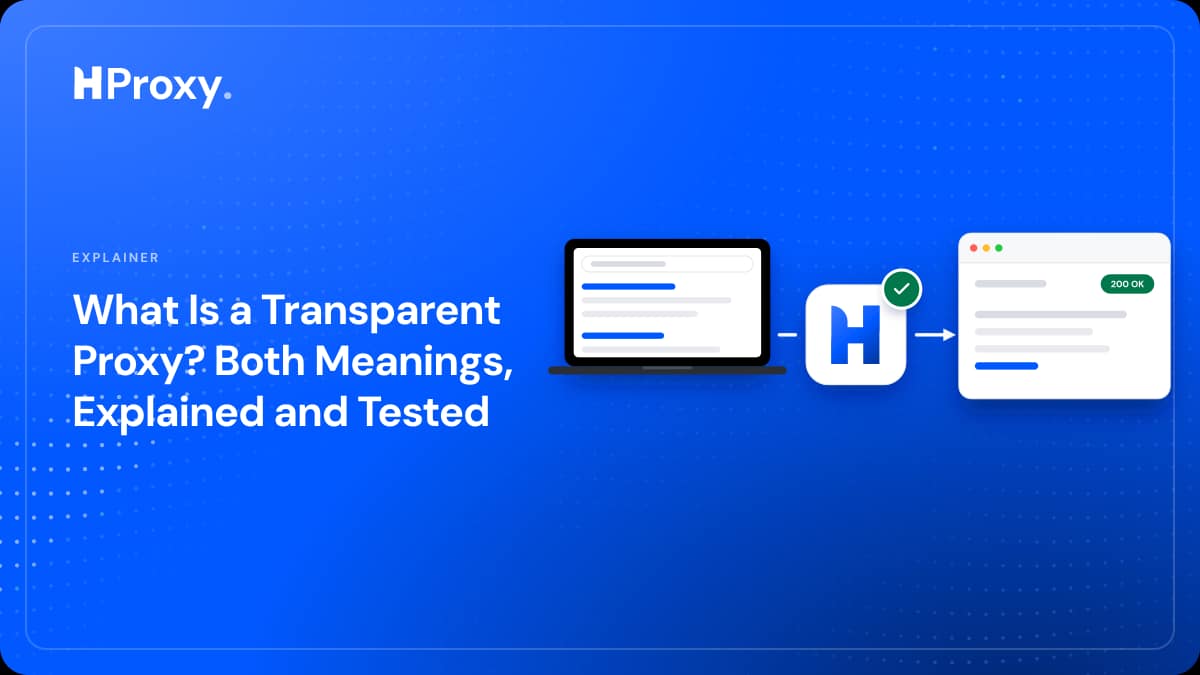
Explainer
What Is a Transparent Proxy? Both Meanings, Explained and Tested
A transparent proxy is either a proxy your network puts in your path or a proxy that passes your address on. How each works, how to tell, and a local test.
October 23, 2026 · 9 min read
Explainer
ISP vs Residential Proxies: What Each One Is, What It Costs and Which to Use
ISP proxies are fixed home-provider addresses run from data centers, and residential proxies rotate through real homes. Real prices, and when to use each.
October 22, 2026 · 6 min read
Explainer
Mobile vs Residential Proxies: Price, Detection and Which to Buy
Mobile proxies vs residential proxies: a carrier address is shared by many users, a home address by one household. Prices at 64 sellers, detection, and a clear pick.
October 22, 2026 · 7 min read
Explainer
Residential VPN vs Residential Proxy: What Each One Gives You and What It Costs
A residential VPN puts one device behind one home address, and a residential proxy sends chosen apps through many. Real prices, sources, and which to pick.
October 22, 2026 · 9 min read
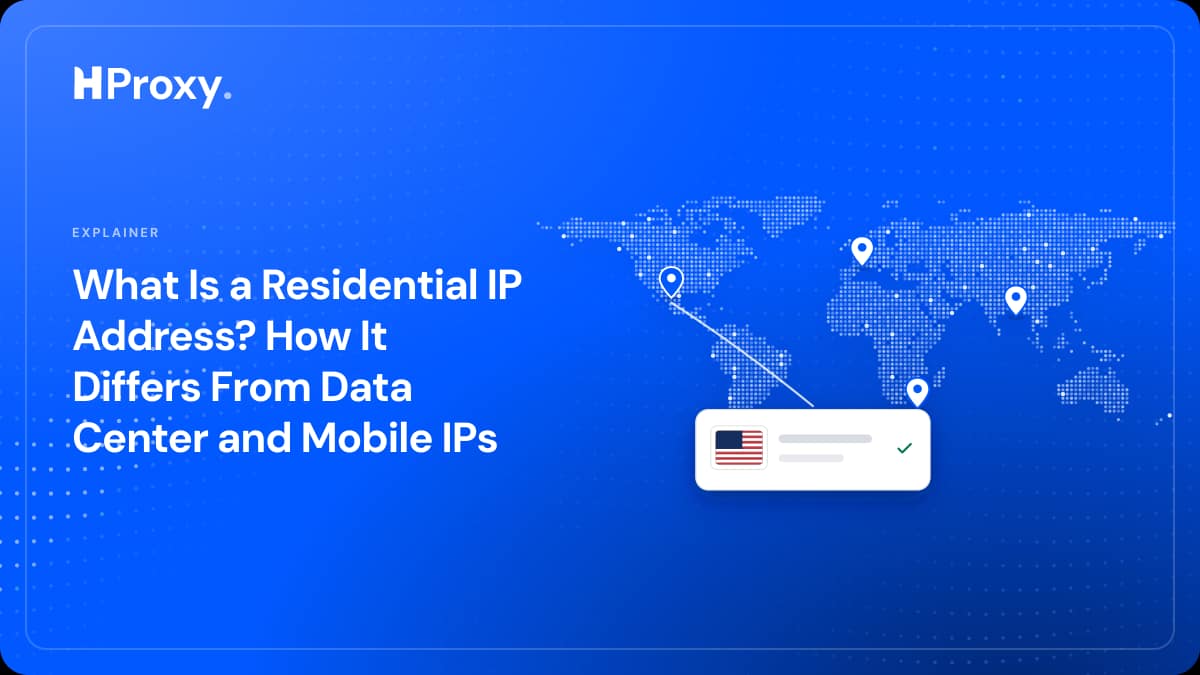
Explainer
What Is a Residential IP Address? How It Differs From Data Center and Mobile IPs
A residential IP address is one a home internet provider assigns to its customers. Why it changes, how IP databases label it, and how to get one elsewhere.
October 22, 2026 · 7 min read
Explainer
What is ixBrowser (ixbrowser.com)? The free antidetect browser, by its own team
ixBrowser is a free antidetect browser for Windows and macOS: unlimited profiles, each with its own fingerprint and proxy. A guest post by the ixBrowser team.
October 16, 2026 · 5 min read
Explainer
BrowserScan explained: what each check means when you use a proxy
What BrowserScan checks, what its authenticity score and warnings mean with a proxy, and the fixes that changed the score in our 15 runs on October 11, 2026.
October 11, 2026 · 7 min read
Explainer
How to check if an IP is residential: ASN, reverse DNS and a free checker
Five ways to check whether an IP is residential, from the ASN to reverse DNS and cloud ranges, and how often each one answered for 791 real addresses.
October 11, 2026 · 8 min read
Explainer
CreepJS explained: reading your fingerprint report with a proxy
What CreepJS checks, what its FP ID, WebRTC section and headless percentages mean, and what a proxy changed in our 14 runs on October 11, 2026.
October 11, 2026 · 10 min read
Explainer
Dynamic pricing explained: why prices change by location and how to compare them
Dynamic pricing explained with real data: a day of electricity prices that moved 17.5 times over, one app priced 22 times higher in one country, and the rules.
October 11, 2026 · 7 min read
Explainer
HTTP cookies explained: how they work and why they matter when scraping
What an HTTP cookie is, what each Set-Cookie attribute does, which cookies 100 top sites set on a first visit, and why one cookie links requests across proxies.
October 11, 2026 · 7 min read
Explainer
IP address in the wrong location: why it happens and how to fix it
Why your IP address shows the wrong city or country: where sites get the location, six causes, and the fixes that work, tested on 400 ranges on October 11, 2026.
October 11, 2026 · 9 min read
Explainer
IP scrambler explained: what it claims and what actually changes your IP
An IP scrambler is a rotating proxy under another name. We sent 8 requests through 8 proxies: the address changed, the TLS fingerprint, user agent and cookie did not.
October 11, 2026 · 5 min read
Explainer
Is web scraping legal? What courts, laws and site terms actually say
Is web scraping legal? What US courts held in hiQ and Van Buren, what the GDPR and EU copyright law say, and what 20 big sites allow in their terms and robots.txt.
October 11, 2026 · 8 min read
Explainer
Reverse proxy vs load balancer: what each does and when you need both
A reverse proxy stands in for a site; a load balancer spreads requests over servers. Most web load balancers are reverse proxies. With a working demo and the headers of 100 top sites.
October 11, 2026 · 6 min read
Explainer
WebSocket vs HTTP: the difference and what changes behind a proxy
How a WebSocket starts as HTTP and becomes a two-way channel, what one message costs on each, and why wss:// passed 8 of 12 free proxies while ws:// passed 3.
October 11, 2026 · 6 min read
Explainer
Concurrency vs parallelism in web scraping: requests, threads and proxies
Concurrency overlaps waiting, parallelism runs work on several cores. We timed both on 100 pages in Python: threads and asyncio for fetching, processes for parsing.
October 10, 2026 · 7 min read
Explainer
Fake IP address: what it means, what works and what does not
A site sees the address its connection comes from, so a made-up IP never gets a reply. The four things called a fake IP, which one works, and which addresses to use in examples.
October 10, 2026 · 6 min read
Explainer
IP whitelisting for proxies: what it is and how to set it up
What IP whitelisting means for a proxy, which public address the proxy checks, why NAT and IPv6 break it, and what a miss returns. Tested on October 10, 2026.
October 10, 2026 · 13 min read
Explainer
Public vs private IP address: the difference and what a proxy changes
A private IP works only inside its own network, and a public IP is the one websites see. The ranges, three edge cases from our test, and what a proxy changes.
October 10, 2026 · 9 min read
Explainer
SOCKS5 UDP explained: how UDP ASSOCIATE works and which proxies support it
How a SOCKS5 proxy relays UDP with UDP ASSOCIATE, byte by byte, and how many proxies really do it: 17 of 575 public SOCKS5 proxies on October 10, 2026.
October 10, 2026 · 10 min read
Explainer
TCP vs UDP for proxies: which apps need UDP and which proxies carry it
TCP vs UDP explained with one DNS lookup sent both ways and measured, which apps really need UDP, and which proxy types carry each. Tested on October 10, 2026.
October 10, 2026 · 8 min read
Showing 1 to 24 of 65
Proxies that don't die mid-job
Residential, ISP, datacenter and mobile, verified by the same engine that runs tens of millions of checks. They read as a real device and hold up under load. Pay as you go, and your balance never expires. $0.44/GB is the 2,000 GB+ rate; a single gigabyte is $0.50/GB, with no minimum order.
129M+ proxy checks run · 100+ countries · HTTP / HTTPS / SOCKS · re-checked every few minutes · no signup
HProxy.
Honest guides and comparisons on proxies, scraping and staying unblocked, from the team that runs the network.