 Compared against Bright Data
Most "HProxy vs Bright Data" comparisons are written by one of the two companies, so they end predictably. This one is written by us, and we are still going to tell you when Bright Data is the right call, because pretending otherwise would waste your time. It comes down to one question: do you need an enterprise data-collection platform, or do you need good residential IPs without paying enterprise prices for them?
Is HProxy a good Bright Data alternative?
For most buyers, yes. HProxy sells the same residential IPs at $0.44/GB versus Bright Data's roughly $8/GB pay-as-you-go rate, with no sales call. Bright Data still wins for enterprises that need its scale, its scraping platform, and compliance paperwork. If you just need clean residential proxies without the enterprise bill, HProxy covers it.
The short version
- Price: HProxy residential is $0.44/GB, pay as you go. Bright Data residential is around $8/GB on pay-as-you-go. That is roughly a 12x difference for the same gigabyte.
- Model: HProxy is self-serve with no monthly commitment and a balance that never expires. Bright Data is built around plans, contracts, and a KYC process.
- Network: Bright Data is bigger and has more enterprise tooling. HProxy is leaner and focused on selling clean IPs cheaply.
- Independence: Bright Data is owned by EMK Capital (formerly Luminati, out of the Hola network). HProxy is independent.
If you are a large team that needs compliance paperwork and a scraping platform, the Bright Data section below is written for you. If you need residential proxies that work and do not want to talk to a salesperson, the pricing section is the whole story.
Bright Data pricing vs HProxy: the part that decides it
| HProxy | Bright Data | |
|---|---|---|
| Residential, per GB | $0.44 | ~$8.00 |
| Billing model | Pay as you go | Monthly plans / contracts |
| Monthly commitment | None | Common on higher tiers |
| Balance expiry | Never expires | Plan-based |
| Onboarding | Self-serve | KYC, often a sales call |
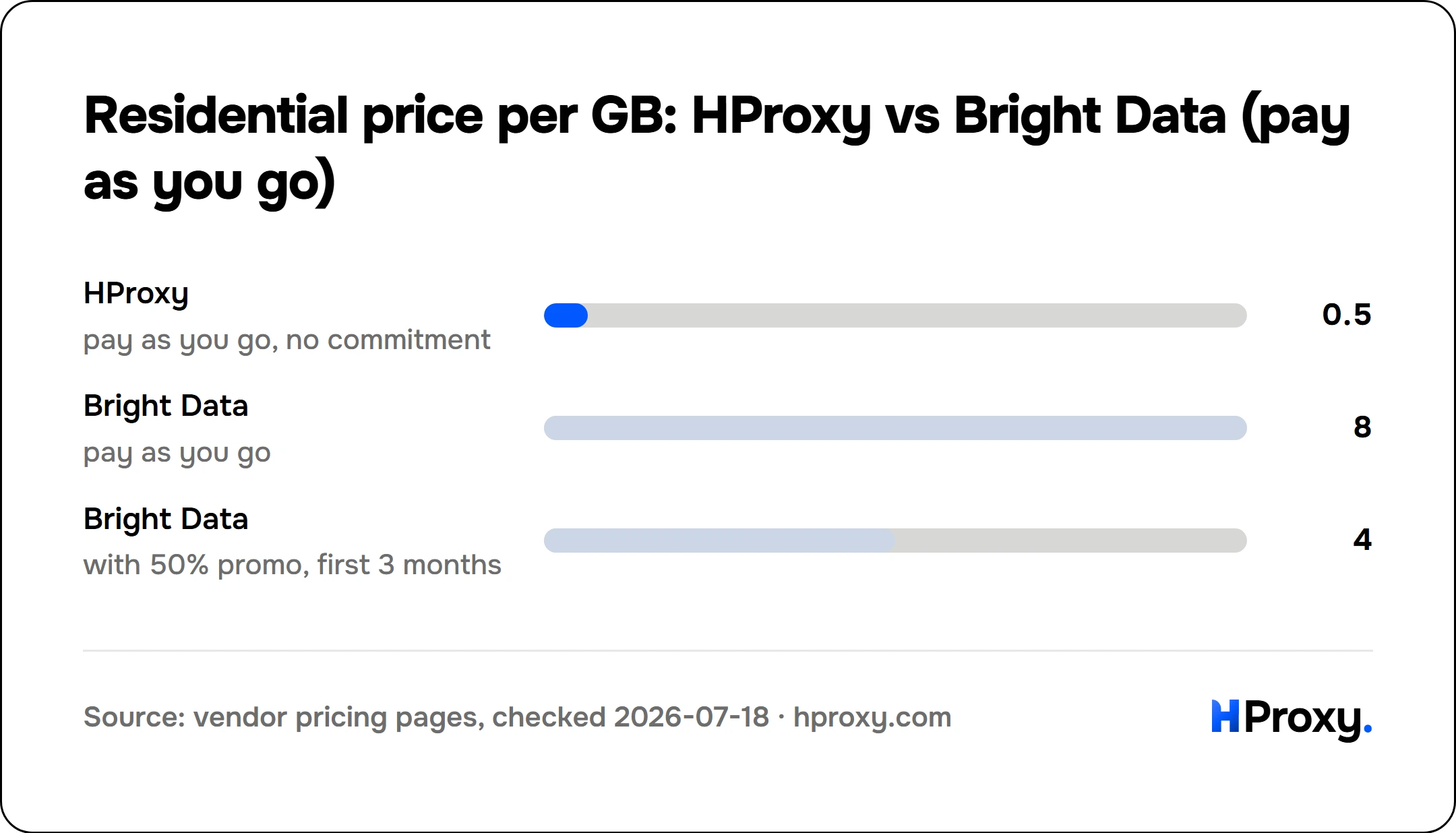
The gap is not small, and it is not a promotional trick. Residential bandwidth is the main cost in this business, and Bright Data prices it as a premium enterprise product with the tooling and compliance to match. HProxy prices the same residential bandwidth as a commodity you top up like credit. On a 50 GB month that is roughly $33 versus $400 for the same kind of traffic. Commit to one of Bright Data's monthly plans and their per-GB falls toward $3, but that means a monthly commitment and a minimum, while our $0.44 is pay as you go with nothing to sign and a balance that never expires.
Bright Data's residential pricing, as their own page listed it on 10 August 2026, so the per-GB figure is not something you have to take on our word:
| Bright Data residential | Monthly commitment | Regular per-GB | First 3 months, code RESIGB50 |
|---|---|---|---|
| Pay as you go | None | $8.00 | $4.00 |
| $499/mo, 141 GB | $499 | $7.00 | $3.50 |
| $999/mo, 332 GB | $999 | $6.00 | $3.00 |
| $1,999/mo, 798 GB | $1,999 | $5.00 | $2.50 |
| Enterprise, 1 TB+ | Custom | Custom | Custom |
Two things that table makes plain. The low per-GB rates are not pay as you go, they are monthly commitments: reaching $2.50/GB means signing up for $1,999 every month whether you pull 798 GB or not. And those numbers lean on a standing 50% new-customer promo (code RESIGB50) that halves the rate for three months and then reverts, so the $8/GB entry point is really about $4 for a fresh account before it doubles back. Measured against Bright Data's deepest advertised rate, the $2.50/GB that needs both a $1,999 monthly commitment and the promo still running, HProxy's flat $0.50/GB is close to five times cheaper with nothing to sign, and against the pay-as-you-go entry rate it is sixteen times cheaper, the gap in the table above. Our $0.44 is not a teaser and there is no month-four jump.
To name it in the plainest terms, this is the starting-price trap the rest of the market runs too. Bright Data's residential page leads with rates as low as $2.50/GB, but that number needs both a $1,999 monthly commitment and the promo still running. The rate a new account actually starts at, with nothing signed, is $8/GB pay as you go, or $4 while the three-month promo lasts. Our $0.44/GB is the advertised rate and the starting rate at once, because there is no ladder to climb to reach it.
The pay-as-you-go part matters as much as the per-GB number. If your scraping is bursty (heavy one week, quiet the next) a monthly commitment means paying for gigabytes you never use. A balance that does not expire means a paused project does not torch prepaid credit.
Where Bright Data genuinely wins
This is the part the marketing comparisons leave out, so here it is straight.
Network scale
Bright Data operates one of the largest IP pools in the industry, across residential, ISP, datacenter and mobile (we break down those types in rotating vs static residential proxies), with very deep country and city coverage. If you need millions of concurrent IPs in obscure locations, that scale is real.
Enterprise tooling
Beyond raw proxies, Bright Data sells a whole platform: a web unlocker, a scraping IDE, prebuilt datasets, and SERP tools. If you want to buy the finished data instead of building the scraper, that ecosystem is a genuine product HProxy does not try to replicate.
Compliance and paperwork
Bright Data's KYC process is friction, but for a large company with a legal team it is also a feature: signed contracts, a compliance trail, an account manager. Some buyers need that to get proxies approved internally. If you are doing that vetting yourself instead, how to vet a proxy provider lists what to check before you trust a pool.
If those three things describe you, Bright Data earns its price. Do not let a cheaper competitor talk you out of tooling you actually need.
Where HProxy wins as a Bright Data alternative
Price, obviously
Roughly sixteen times cheaper per gigabyte for residential is the headline and it does not go away.
No enterprise overhead
Self-serve signup, top up a balance, start. No sales call, no minimum. You can be running in minutes. Our FAQ sets out how activation, billing and refunds actually work.
Pay as you go that respects your usage
No monthly commitment, and the balance never expires, so you pay for what you actually pull.
Independence
HProxy is not part of a proxy conglomerate. Bright Data sits under EMK Capital and traces back through Luminati to the Hola network, and several of the other big names are commonly owned too. We mapped the whole ownership landscape, the Tesonet cluster included, in who owns your proxy provider. If buying from an independent vendor matters to you, that is a real difference.
The same jobs, done
For the actual work most people buy residential proxies for (scraping, price monitoring, ad verification, managing accounts across regions) HProxy's residential IPs do the job. The enterprise platform is not required to get clean residential traffic.
Who should pick which
Pick Bright Data if you are an enterprise that needs its scale, its scraping/unlocker tooling, prebuilt datasets, or a formal compliance and contract process, and the budget is there for it.
Pick HProxy if you want residential (or ISP, datacenter, mobile) proxies that work, at $0.44/GB pay as you go, without a sales call, a monthly commitment, or a 12x markup for tooling you are not going to use. That covers the large majority of scraping, monitoring and multi-region tasks.
The mistake we see most often is a small or mid-size team buying the enterprise platform, using it as a plain proxy, and paying the enterprise price for it. If that is you, you are the exact person this comparison is for.
Try it before you decide
You do not have to take our word on the network. Test HProxy's free proxy checker and the live free proxy list to see the infrastructure, then start on residential at $0.44/GB pay as you go when you are ready. If you are choosing proxies for a scraping project specifically, our complete guide to proxies for web scraping walks through which type fits which target, Bright Data or otherwise. If you are price-shopping the market first, our cheapest residential proxies in 2026 roundup lines the real rates up side by side.
Frequently asked questions
Is HProxy cheaper than Bright Data?
Is Bright Data better than HProxy?
Who owns Bright Data?
Does Bright Data require KYC or a sales call?
Can I just try HProxy without a subscription?
Does Bright Data's discount make it as cheap as HProxy?
Side by side
HProxy vs Bright Data, on one page
Their published rates against ours, family by family, with the units matched so the comparison means something.