Residential Premium
FlagshipStarting at
$1.00/ GB
Real Indian household IPs, aimed down to a state, a city or a single ISP. Sticky sessions up to 24 hours, SOCKS5 with UDP, and a block list for what you want to avoid.
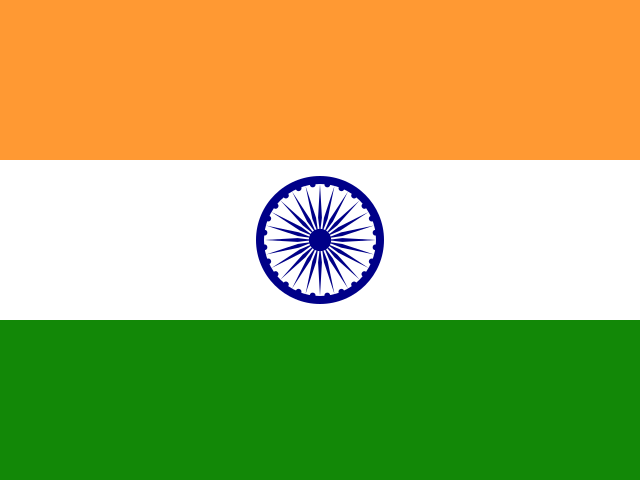 India Proxies
Real Indian IP addresses with targeting down to the city, from a network of millions across 150+ countries that we verify around the clock. No subscription, pay as you go, and a balance that never expires. From $0.44/GB.
Just need a few free ones? Browse the live free Indian list.
Dedicated Indian IPs
Prices come from the live catalog. The dedicated IP cards are confirmed against it before they render, and residential targets India per GB when you generate.
Starting at
Real Indian household IPs, aimed down to a state, a city or a single ISP. Sticky sessions up to 24 hours, SOCKS5 with UDP, and a block list for what you want to avoid.
Starting at
The same Indian household network at the lowest per-GB rate, targeted by country rather than by city. Rotating or sticky, pay per GB, balance never expires.
Starting at
Dedicated Indian IPs registered to consumer ISPs, held for weeks or months. The stability of a server with a residential footprint.
Starting at
Dedicated Indian IPv4 and IPv6 addresses for volume work where raw speed matters more than a residential footprint.
Starting at
Real 4G and 5G carrier IPs on genuine carrier networks, billed per GB, rotating or sticky. The highest-trust footprint there is, and the hardest to distinguish from a phone.
How you use them
Rotating Indian proxies
A line generated with country IN exits from a different Indian address on every request. Ask for count: 10 and each worker gets its own line.
How it worksSticky Indian proxies
Add stickyMinutes and the line holds one Indian address for 3 to 1,440 minutes on Premium, or for as long as you keep using it on Lite.
How it worksSOCKS5 Indian proxies
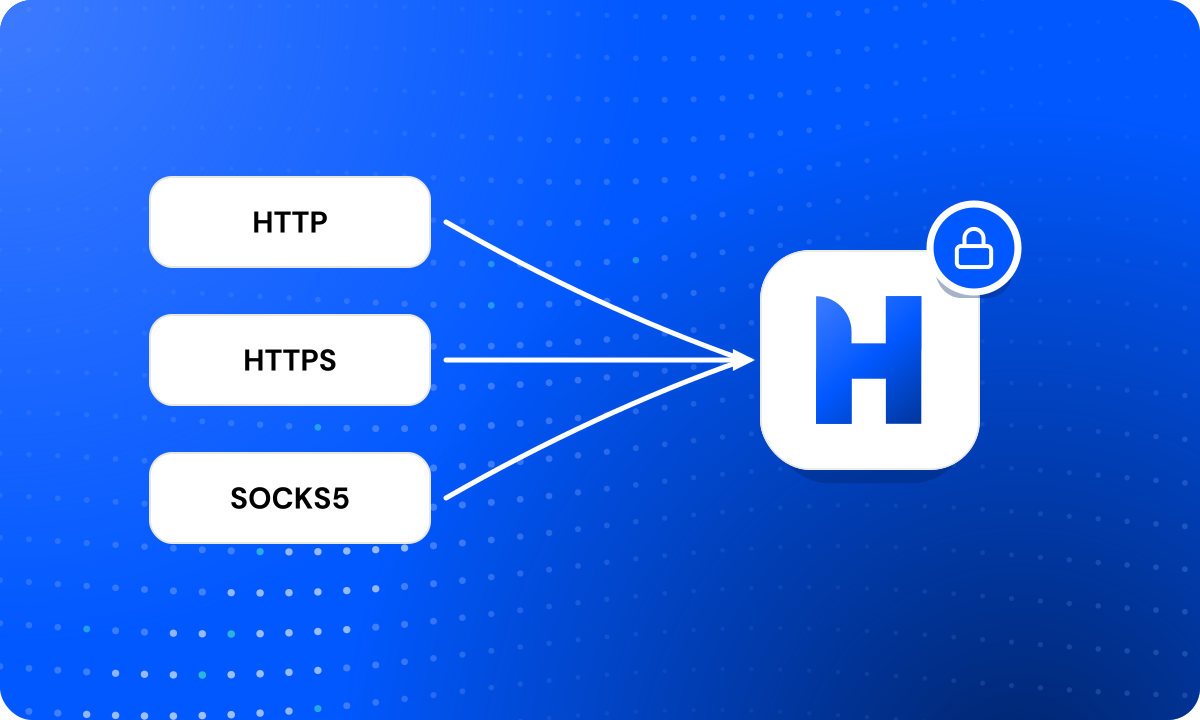
Every line answers SOCKS5 as well as HTTP, with the same credentials; Premium adds a UDP relay with udp: true.
How it worksPin one Indian carrier
Premium lines can be pinned to one network by its AS number. These are the India carriers the gateway lists today; each has its own page.
Residential Premium
Lite reaches India by country and rotates. Premium turns every one of these on, from the same balance.
ISP targeting
13,800+ networks
State or city
26,000+ cities
Sticky sessions to 24 hours
3 min to 24 h
Device OS
4 platforms
Exclusions
Country, state, city, network
IP whitelist
150 IPs per plan
SOCKS5 with UDP
HTTP, HTTPS, SOCKS5, UDP
Per-plan statistics
30-day window
Coverage
322,716 listed places, cities down to villages, in a country of 1353 million people, 36 states, the capital is New Delhi. Every one of them is a page and a targeting request.
 KarnatakaWest BengalMadhya Pradesh
 DelhiAndhra PradeshRajasthanKeralaTelanganaBiharPunjabJharkhandHaryanaOdishaChhattisgarhAssam
 Jammu and KashmirUttarakhandPuducherryGoaChandigarhTripuraManipurHimachal PradeshMeghalayaMizoramNagalandDadra and Nagar Haveli and Daman and DiuArunachal PradeshAndaman and NicobarSikkimLadakhLakshadweep
Working around India instead? China, Nepal, Myanmar, Bhutan, Pakistan, Bangladesh border it.
The 12 biggest listed cities marked.
India on the world map.
A mobile-first country
India connects to the internet on its phones. There are on the order of 1.3 billion wireless subscriptions against roughly 48 million fixed lines, and the fixed base is shrinking month over month. That ratio changes what a proxy even is here. In Germany or the US a residential IP and a mobile IP are two different products on two different networks; in India the overwhelming majority of consumer internet access is a mobile-network address on Jio or Airtel, so the two categories substantially collapse into one. A page that treated India like a Western fixed-line market would be describing a country that barely exists.
The practical read: for most India-facing work the mobile pool is the residential pool, and which of the big carriers an address rides matters more than the residential-versus-datacenter label you would reach for elsewhere, which is what the dedicated mobile and residential plans below are built around.
What an "Indian IP" even is
India is the first country on this list that directly regulates infrastructure like ours. A 2022 government directive requires providers of data-center, cloud, VPN and VPN-like services to keep years of subscriber records, and it is still in force. The visible market response is the interesting part: several large consumer-VPN companies pulled their physical Indian servers rather than comply, and now serve Indian-looking IPs from equipment outside the country. That means an "Indian IP" in this market is not automatically a box sitting in Mumbai; it can be India-registered address space announced from elsewhere.
We are not going to hand-wave that. Where an address actually routes is a question you answer by measuring, not by trusting a label, which is the whole reason our free list reports the live pool as our engine sees it rather than a headline number. If you need genuinely in-country behaviour for a job, that is a spec to verify against the measured data, not an assumption to make from a flag.
The work, and the law that is still arriving
India is one of the largest e-commerce markets on earth, so the bulk of Indian-IP work is retail and marketplace monitoring across Flipkart, Amazon.in, Myntra, JioMart and Meesho, plus search tracking where an Indian IP is what returns Indian results now that google.co.in redirects to google.com like every Google country domain. Cricket-driven streaming is its own surge, though be careful with the famous concurrent-viewer records you will find in search, most of them are from 2019 and a predecessor service, not from JioHotstar as it runs today. The automated side of any of this can take an Indian exit through our scraper APIs.
On the law: India passed a data protection act, but its substantive obligations are not in force yet. The rules were notified in late 2025 with a phased schedule that puts the main compliance duties in 2027, so anyone telling you the DPDP Act governs your Indian data collection today is ahead of the calendar. That does not make anything a free pass. Our terms require you to respect Indian law and each site's rules, and to treat personal data and anything behind a login as the serious question it is, whichever commencement date applies.
Trust
Same network, same team and same terms behind every page on this site, India included.
114 reviews on Trustpilot, 92% of them five-star. The badge links to the live profile, judge for yourself.
Live chat sits on every page, bottom right. Ask about India targeting before you pay and a person from the team that runs the network answers, whatever the hour.
Pay as you go, no subscription, and a balance that never expires. Not ready to spend? The free India list is public and measured around the clock.
FAQ
Our live free list shows the current count from our verification engine, with the networks and cities behind it. It refreshes every few minutes, so it reflects the pool as it stands rather than a number set once.
India is overwhelmingly mobile: there are on the order of 1.3 billion wireless subscriptions against roughly 48 million fixed lines. Because most consumer internet access is a mobile-network IP on carriers like Jio and Airtel, the residential and mobile categories largely become one thing here, which is different from the split you see in Western markets.
Residential plans support city-level targeting inside India, so a session can exit in Mumbai, Delhi, Bengaluru or wherever a task needs, subject to what is live in that area at the time.
All four, each confirmed against the live catalog before it shows here: dedicated mobile 4G and 5G on Indian carriers, rotating residential, static ISP, and datacenter IPv4 and IPv6. Mobile carries more weight in India than almost anywhere else, for the reason above.
Not necessarily, and it is worth knowing why. India regulates VPN and similar providers with heavy logging rules, and several large ones responded by serving Indian-looking IPs from outside the country. So India-registered address space is not automatically hosted in India. Where an address routes is something to verify against the measured pool rather than assume from the label.
India's data protection act is passed but its substantive obligations are phased in and mostly land in 2027, so it does not yet govern collection the way people often assume. That is not a free pass: this is context rather than legal advice, and anything personal or behind a login is a question for a lawyer.
Or talk to us at support@hproxy.com
