
9Proxy (9proxy.com) is trading. On 26 September 2026 its site and price list answered from our server and sold residential proxies two ways: by the IP, from $24 for 100 IPs, and by the gigabyte, from $15 for 5 GB. The brand belongs to ConnectWise Limited of Hong Kong, and BeeProxy merged into it in December 2025. Two rules decide most bills there: every purchase is final, and gigabytes expire after 180 days. If either rules it out, the alternatives table prices five other residential networks on the same day.
The company behind 9Proxy, with its history, owners and connections, is on our 9Proxy company page.
The record, with dates
| date | what happened |
|---|---|
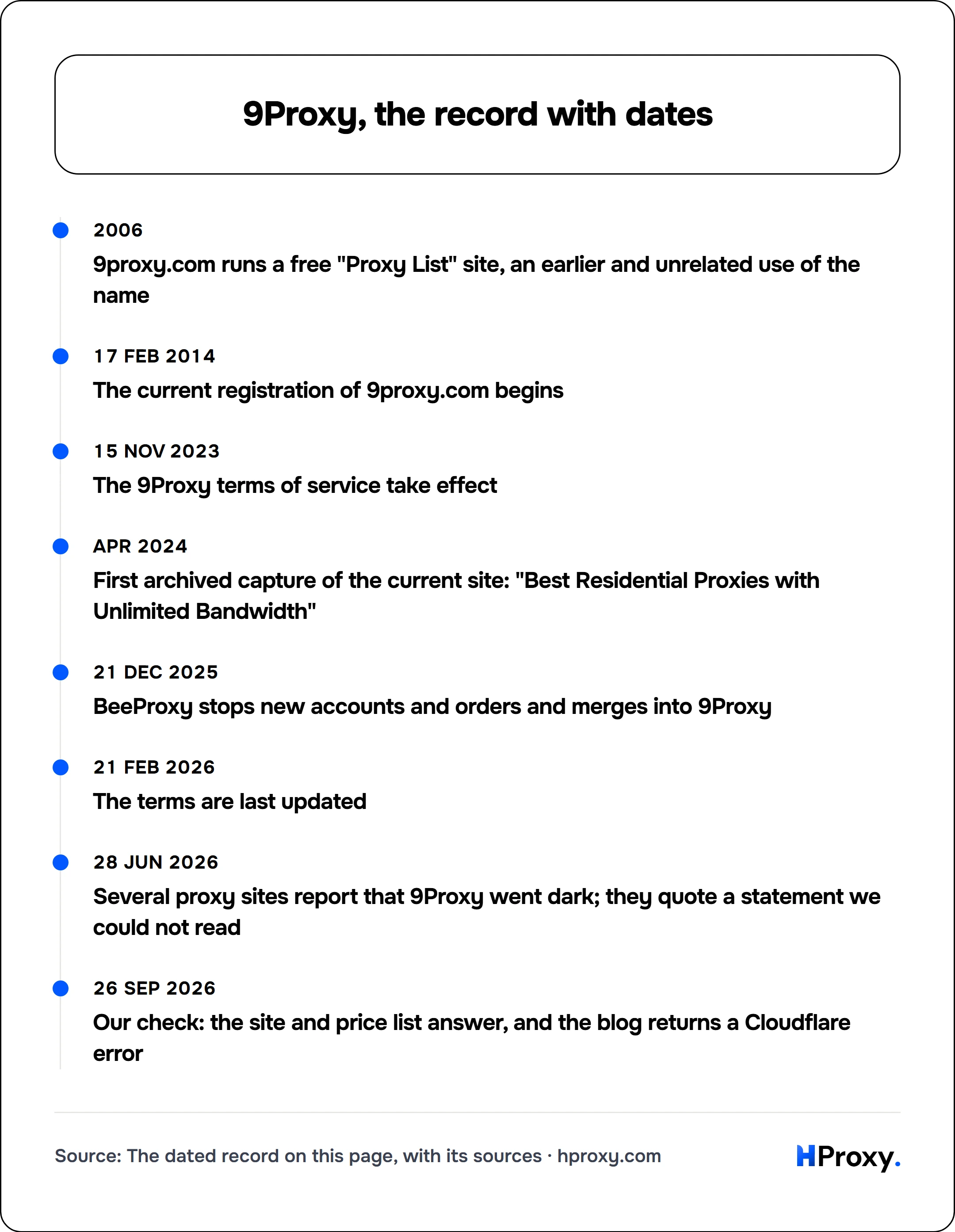
| 2006 | 9proxy.com runs a free "Proxy List" site, an earlier and unrelated use of the name |
| 17 February 2014 | the current registration of 9proxy.com begins |
| 15 November 2023 | the 9Proxy terms of service take effect |
| April 2024 | first archived capture of the current site: "Best Residential Proxies with Unlimited Bandwidth" |
| 21 December 2025 | BeeProxy stops new accounts and orders and merges into 9Proxy |
| 21 February 2026 | the terms are last updated |
| 28 June 2026 | several proxy sites report that 9Proxy went dark; they quote a statement we could not read |
| 26 September 2026 | our check: the site and price list answer, and the blog returns a Cloudflare error |
2006
9proxy.com runs a free "Proxy List" site, an earlier and unrelated use of the name
17 Feb 2014
The current registration of 9proxy.com begins
15 Nov 2023
The 9Proxy terms of service take effect
Apr 2024
First archived capture of the current site: "Best Residential Proxies with Unlimited Bandwidth"
21 Dec 2025
BeeProxy stops new accounts and orders and merges into 9Proxy
21 Feb 2026
The terms are last updated
28 Jun 2026
Several proxy sites report that 9Proxy went dark; they quote a statement we could not read
26 Sep 2026
Our check: the site and price list answer, and the blog returns a Cloudflare error
Sources: the Internet Archive, the Verisign registry, the 9Proxy terms and migration guide, and our own checks on 26 September 2026.
What 9Proxy sells, and what it costs
9Proxy sells residential proxies only, in its own words "exclusively". It offers two models and a bundle of both. By the IP, you pay for each address you switch on and then use it with unlimited traffic while it stays online. By the gigabyte, you pay for traffic and generate as many lines as you like.
Its price list, as the pricing page carried it on 26 September 2026:
| package by IP | price | per IP |
|---|---|---|
| 100 IPs | $24 | $0.24 |
| 500 IPs | $72 | $0.144 |
| 1,000 IPs + 500 extra | $126 | $0.084 |
| 5,000 IPs | $360 | $0.072 |
| 15,000 IPs | $720 | $0.048 |
| 50,000 IPs | $1,438 | $0.029 |
| 500,000 IPs, business | $8,625 | $0.018 |
| package by GB | price | per GB |
|---|---|---|
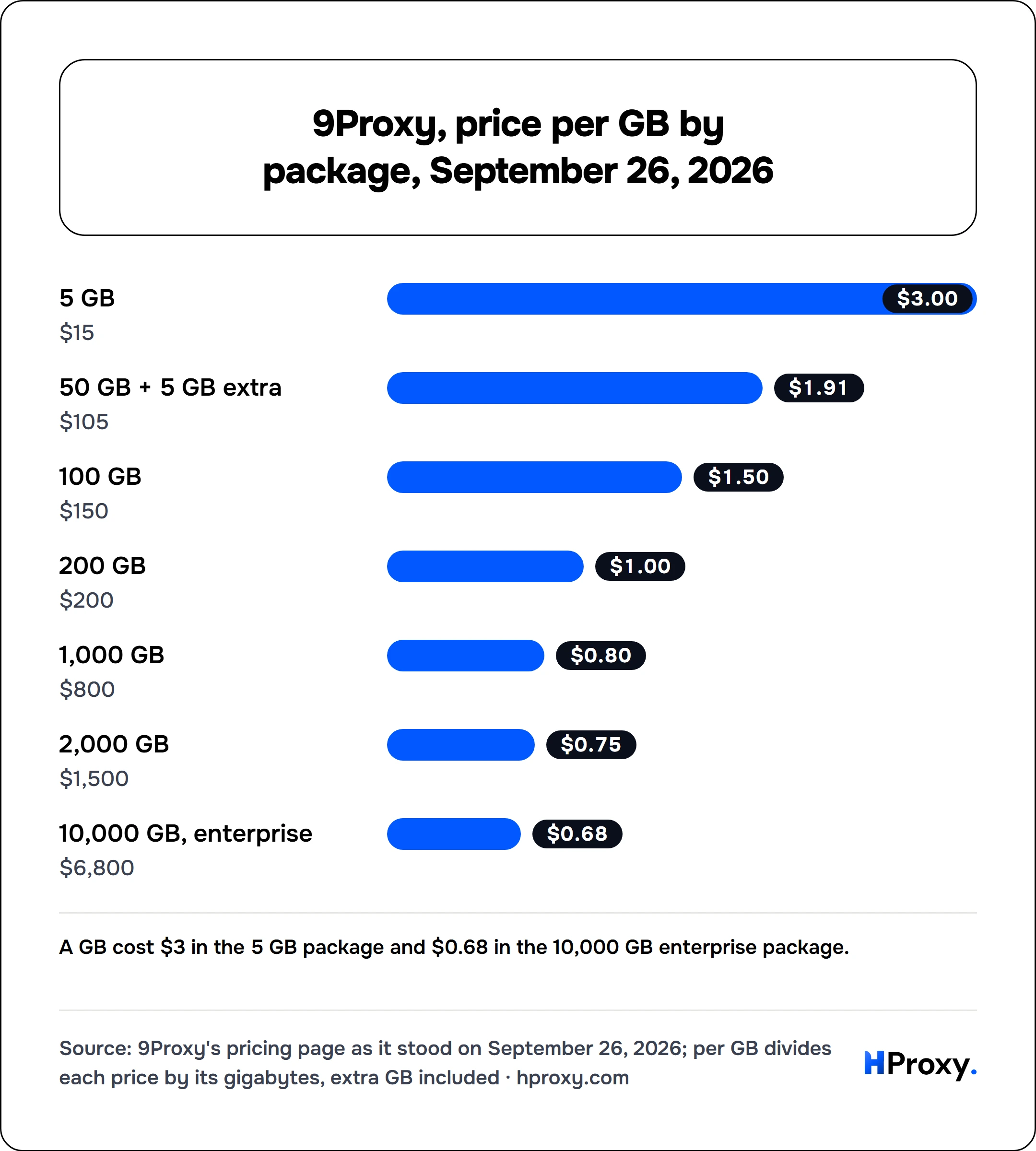
| 5 GB | $15 | $3.00 |
| 50 GB + 5 GB extra | $105 | $1.91 |
| 100 GB | $150 | $1.50 |
| 200 GB | $200 | $1.00 |
| 1,000 GB | $800 | $0.80 |
| 2,000 GB | $1,500 | $0.75 |
| 10,000 GB, enterprise | $6,800 | $0.68 |
Six more packages sit between those rows: 2,500 IPs for $210, 25,000 for $863, and business packages of 100,000 and 200,000 IPs for $2,300 and $4,140. Enterprise GB packages of 3,000 and 6,000 GB cost $2,160 and $4,200. Bundles run from $30 for 5 GB and 100 IPs to $720 for 500 GB and 5,000 IPs.
Most packages show a crossed-out standard price next to the real one: $3 a GB, and $0.10 to $0.24 an IP. The headline "Starting at $0.018/IP" needs the 500,000-IP package, which is $8,625 paid up front.
How the two models work
The IP model runs through the 9Proxy desktop app for Windows, macOS or Linux. An IP is used up only when you forward it to a local port, and unused IPs "never expire". Once switched on, an address stays online "for several hours up to ~24 hours", because it is a real home device. In the app you filter by country, state, city, ZIP code or ISP.
The GB model needs no app. You create lines in the dashboard with a username and password or with a whitelisted IP. Lines can target a country, state, city or ISP, and the ISP can be a name or an AS number. A sticky line keeps its address for the minutes you set, and the documentation names no maximum.
Both models run on HTTP and SOCKS5, and the FAQ adds that they are "fully compatible with TCP and UDP connections". The same FAQ says the IPs are "shared residential IPs from real user devices" with a low sharing ratio. 9Proxy claims "20M+ real residential IPs across 90+ countries", with 572,600 in the United States by its own count.
The fine print that decides the bill
- No refunds. The refund policy of 9 June 2025 says "all purchases and deposits are final and non-refundable".
- One repair path. A proxy that does not work gets replaced if you report it "within 60 seconds of first use".
- Gigabytes expire. Unused GB "remain valid for 180 days", and only enterprise plans can have unlimited validity.
- IPs do not expire. An unused IP stays in the balance until you switch it on.
- The wallet keeps value, with limits. Wallet funds do not expire while the account is active, but they are "non-refunded and non-withdrawable", and a suspended account may lose them.
- Payment: cryptocurrency with a 5 percent bonus, local payment methods, cards, Google Pay, Alipay and the wallet.
The terms name ConnectWise Limited, "a Hong Kong-based company", as the business behind the 9Proxy brand. The GB guide asks you to have "verified your account" before you create proxies. We found no public KYC page: its /kyc-policy address shows "Page Not Found".
Is 9Proxy back online?
People ask it often, in searches such as "is 9proxy back online" and "is 9proxy still down". The short answer, as of 26 September 2026: its site and price list answered normally from our server, while blog.9proxy.com returned a Cloudflare 522 error.
The longer answer has a gap in it. Several proxy sites reported that 9Proxy went dark from 28 June 2026 and came back in July. They quote a 9Proxy post about a "service disruption", one of them with the note "purchases still paused" on 15 July. We could not read that post ourselves: Facebook refused our server, the forum copy sits behind a challenge page, and the Internet Archive holds no copy.
Two things we can show. The 9Proxy site still ships a notice that reads "New orders are temporarily paused while we continue working on full service recovery". We cannot see from outside whether a buyer is shown it today. The Internet Archive also holds no capture of 9proxy.com between 10 June and 26 September 2026.
BeeProxy is part of 9Proxy now
The 9Proxy migration guide, archived on 12 December 2025, announced that "BeeProxy is officially merging into 9Proxy." From 21 December 2025 there were no new BeeProxy accounts or orders, and remaining balances and active packages moved across. The guide itself now returns a 404 error, and beeproxy.com redirects to 9proxy.com. The full story is on our BeeProxy page.
What customers report
The only Trustpilot page for 9proxy.com in the Internet Archive dates from 28 April 2025 and shows 4.4 from 55 reviews. The live page refused our server on 26 September 2026, so we hold no current score. We have not tested the 9Proxy network ourselves.
Where 9Proxy is the stronger choice
Some jobs fit the 9Proxy model better than ours:
- Heavy traffic on one address. An IP package gives unlimited bandwidth for as long as the IP stays online. We sell residential traffic by the GB only.
- IPs that wait. Unused 9Proxy IPs never expire, so a buyer can stock up and switch them on later.
- ZIP code filters in its app. Our Premium pool, at $1.49 for one GB, targets by country, state, city and ISP, not by ZIP code.
- Large targeted volumes. At 1,000 GB and more, 9Proxy sells traffic with state, city and ISP targeting for $0.80 down to $0.68 a GB. Our Premium pool costs $1.00 per GB at 1,000 GB+, as our residential price table shows.
- Payment options: crypto with a bonus, local methods and Alipay.
Where HProxy is different
| 9Proxy, 26 September 2026 | HProxy | |
|---|---|---|
| smallest purchase by GB | $15 for 5 GB, $3 a GB | $0.50/GB for 1 GB of Lite, country targeting |
| largest published discount by GB | $0.68 a GB at 10,000 GB, enterprise | $0.44/GB at 2,000 GB+ on Lite |
| how long GB lasts | 180 days, unlimited on enterprise | the balance never expires |
| ISP targeting | GB plans, by name or AS number | Premium, by AS number: $1.49 for one GB |
| ZIP code targeting | in the IP app | no |
| sticky sessions | minutes you set, no published maximum | Premium: 3 minutes to 24 hours |
| setup | per-IP proxies need a desktop app | every line works in any HTTP or SOCKS5 client |
| other proxy types | residential only | also static ISP ($2.70/IP per month), datacenter and mobile ($1.50 per GB) |
| payment | crypto, local methods, cards, Google Pay, Alipay | card, Alipay, crypto and local wallets such as Pix |
Both networks aim traffic at one ISP, so the feature itself is not the difference. What differs is how long a purchase lasts, what the smallest one costs, and whether you need an app. Our Premium pool picks the carrier by its AS number, such as AS 7922 for Comcast, at $1.49 for one GB. The carriers on offer are listed on the ISP targeting page.
Five alternatives, priced the same day
Every rate below comes from each vendor pricing page, read from our server on 26 September 2026. A rate you cannot reach is not a price.
| provider | entry rate | lowest published rate | worth knowing |
|---|---|---|---|
| DataImpulse | $1 per GB: 5 GB for $5, for new users | $0.80 per GB at 1 TB for $800 | its page says "Traffic Never Expires" |
| Evomi | $0.99 per GB pay as you go, from 15 GB | $0.49 per GB on the 100 GB plan at $49 a month | pay-as-you-go data has no expiry |
| Webshare | $3.50 for 1 GB a month, half a $7 list price | $1.40 per GB: 3,000 GB for $4,200 a month | monthly traffic does not roll over |
| Decodo | $4 per GB, pay as you go | $2 per GB at 1 TB a month, enterprise plan | prices plus VAT |
| HProxy | $0.50/GB for 1 GB of Lite, country targeting | $0.44/GB at 2,000 GB+ | Premium adds state, city and ISP targeting: $1.49 for one GB |
The table compares traffic sold by the GB, so the 9Proxy IP packages with unlimited traffic have no direct match in it. For per-GB buyers, the questions are expiry and the smallest package. Our pages on DataImpulse and Decodo go into each in more detail.
Which one to pick
- You burn a lot of traffic on a few addresses: 9Proxy IP packages fit, if addresses that last hours rather than days are fine.
- You buy traffic, then pause for months: 9Proxy gigabytes expire after 180 days, while our balance and DataImpulse traffic do not.
- You need one carrier or one city, per GB: 9Proxy and HProxy Premium ($1.49 for one GB) both target by ISP, so compare them at your own volume.
- You cannot afford to lose a prepaid balance: start small anywhere. 9Proxy itself advises "starting with smaller packages".
Before you move a large balance, start small and test what you get with our free proxy checker. It checks HTTP and SOCKS proxies with no sign-up.
The limits of this record
We did not buy 9Proxy proxies, so nothing here measures its network. The pool sizes are its own claims, the Trustpilot figure is from April 2025, and the June outage rests on reports we could not check against a first-hand statement. We also cannot see whether new orders are open today. Prices and rules change fast, so every figure here carries the day it was read, and this page is due for a check by 26 December 2026.
Sources
- 9Proxy, pricing page and its package data, homepage and FAQ. Read 26 September 2026.
- 9Proxy documentation: "Overview", "Residential Proxy by IPs", "Residential Proxy by GB", "Proxy Generation", "Making Requests". Read 26 September 2026.
- 9Proxy, Terms of Service, last updated 21 February 2026, and Refund Policy, last updated 9 June 2025. Read 26 September 2026.
- 9Proxy, "BeeProxy to 9Proxy Migration Guide", archived 12 December 2025. Read 15 September 2026.
- Internet Archive: 9proxy.com captures from 2006, 2014, 2024 and 2025, and the capture index for 2026. Read 26 September 2026.
- Verisign, registry record for 9proxy.com. Read 26 September 2026.
- Trustpilot, review page for 9proxy.com, archived 28 April 2025. Read 26 September 2026.
- ProxyRadar, "Is 9Proxy Down in 2026?", updated 22 July 2026, and ipcook, "9Proxy Not Working?", 28 August 2026, as reports of the outage. Read 26 September 2026.
- DataImpulse, Evomi, Webshare and Decodo residential pricing pages. Read 26 September 2026.
- HProxy, our product catalogue, documentation and compliance page. Read 26 September 2026.