Proxy-Hub (proxy-hub.com) sells private datacenter proxies and static residential ISP proxies, and says it was founded in 2008. On 27 September 2026 its site showed automated readers only a Cloudflare check, while its WordPress server answered behind it. The shop looks alive, but its current prices were out of reach, so the prices below come from February 2026 and August 2025. For the comparison, jump to the alternatives table.
Proxy-Hub at a glance
| what we found | |
|---|---|
| status, 27 September 2026 | site behind a Cloudflare check, server answering |
| online since | 2012, domain registered 3 January 2012 |
| operator | "Proxy-Hub"; no company name or address found |
| products | private proxies, dedicated or shared by 3; static residential ISP |
| private proxies, February 2026 | 10 shared for $12 a month, 10 of your own for $24 |
| residential ISP, August 2025 | 5 for $19 a month |
| bandwidth | unlimited |
| refunds | money back within 3 days of a first order |
| renewal | monthly, until you cancel in writing |
The name is common. Search suggestions for "proxy hub" also bring up Android apps, Docker registry proxies and sites on Google Sites, and this page covers proxy-hub.com only.
What Proxy-Hub sells
Its main line is private datacenter proxies with servers in the USA, Canada, France, Germany, the UK, the Netherlands and other countries. You buy them in packages of 10 to 2,000, either dedicated to you or semi-dedicated, which means shared with at most two other customers.
Each package promised unlimited bandwidth, non-sequential IPs across several subnets and dead-proxy replacement. Its homepage offered fresh IPs every month or the same ones if you prefer, 100 threads per IP and 99 percent uptime, with a control panel, an API and a Chrome and Firefox extension.
The pitch targets SEO tools such as Scrapebox and GSA, social media, classified ads, scraping, and "Ticket & Shoe Proxies". By November 2023 it also sold static residential ISP proxies from the US and Europe, over HTTP, HTTPS and SOCKS5 with UDP.
What Proxy-Hub charged
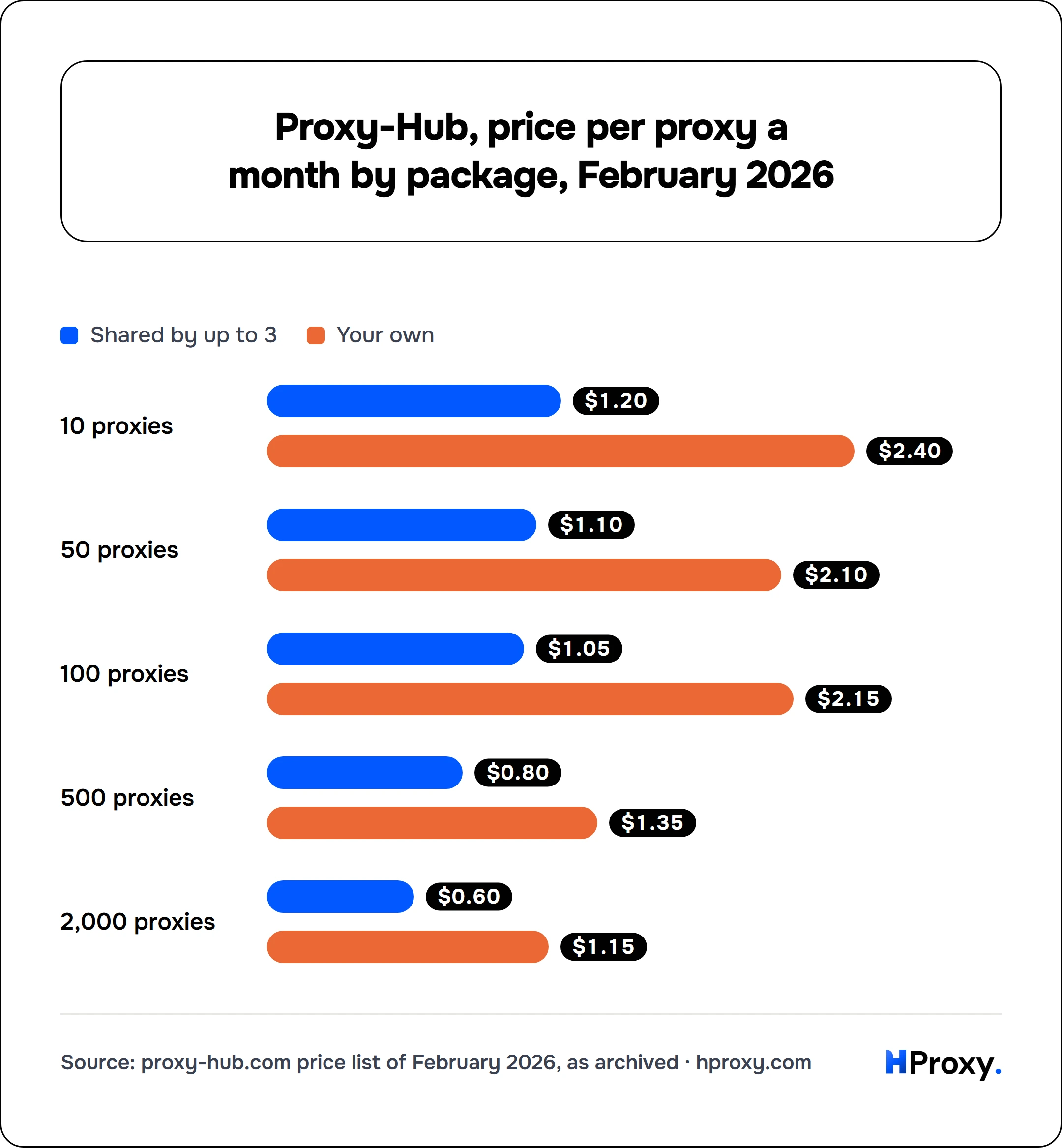
These prices come from its buy page as archived on 17 February 2026.
| package | shared by up to 3 | your own |
|---|---|---|
| 10 proxies | $12 a month, $1.20 each | $24 a month, $2.40 each |
| 50 proxies | $55, $1.10 each | $105, $2.10 each |
| 100 proxies | $105, $1.05 each | $215, $2.15 each |
| 500 proxies | $400, $0.80 each | $675, $1.35 each |
| 2,000 proxies | $1,200, $0.60 each | $2,300, $1.15 each |
- Shared by up to 3
- Your own
Its static residential ISP proxies, as archived on 5 August 2025, cost $19 a month for 5, $34 for 10, $94 for 30, $145 for 50 and $275 for 100. That is $3.80 down to $2.75 per address, and IP authorisation was not available on them.
Its prices stood still for nine years. In December 2014, 10 shared proxies cost $10 and 10 of your own $20, and the November 2023 page showed the same. By February 2026 the small packages had risen to $12 and $24, while the packages of 250 and more kept their prices.
The fine print
A short money-back window. Its refund policy promises a fix or a full refund if you report within three days of a first order that the proxies do not work for your purpose. Later orders carry no such promise.
Plans renew on their own. Its terms put you on a month-to-month plan that renews automatically unless you give written notice to cancel.
Terms written for businesses. The terms describe the customer as a legal business entity, used only by its employees or agents, and ask for billing details and card data.
Two locations per user name. Its FAQ of December 2024 allows one user name from at most two locations at a time.
An old FAQ. That FAQ still lists Payza, Moneybookers and PayPal as payment methods and says "All Proxies are HTTP Proxies". The 2026 buy page shows card payment through Stripe, and the residential page offers SOCKS5, so ask before you rely on either.
Who you deal with. The pages name the seller only as Proxy-Hub, with an email address, live chat and Discord. Most names in its February 2026 testimonials already appeared on its homepage in December 2013.
Where Proxy-Hub is stronger
Low prices at volume. At 2,000 proxies a month, a shared IP cost $0.60 and one of your own $1.15 in February 2026.
A shared option. Shared proxies cost about half as much as ones of your own, for tasks that do not need a private IP.
Unlimited bandwidth, many threads. No traffic cap on any package, and 100 threads per IP on its feature list.
A long record. The same shop and pitch since at least 2013, with prices unchanged from 2014 to 2023.
A money-back test. Three days to try a first order and ask for your money back.
Where HProxy differs
We sell proxies too, so read this part as the account of a competitor. Every HProxy fact here comes from our own product code and pages.
One address, no package. Our datacenter IPv4 starts at one dedicated address, with unlimited bandwidth, at $1.58/IP for a month. Our static ISP starts at one address too, at $2.70/IP for a month.
Residential by the gigabyte. Lite targets by country at $0.50/GB for one gigabyte. Premium, our pool with state, city and ISP targeting, costs $1.49/GB for one gigabyte and $1.00/GB from 1,000 GB+. Purchased gigabytes have no scheduled expiry date.
Renewal is your choice. Auto-renew is a switch on each address that you turn on yourself, paid from your balance. We take cards, Alipay and thirty-two crypto options.
Where we are behind. We sell no shared IPs and no volume ladder like its $0.60 per shared IP at 2,000. For thousands of IPs on a monthly plan, compare its volume prices with ours in the table below.
The alternatives, side by side
One private address for a month. The Proxy-Hub rows are its last readable prices from February 2026; every other figure comes from the page of each vendor, read on 26 September 2026.
| provider | smallest buy | per address, one month | note |
|---|---|---|---|
| Proxy-Hub, shared | 10 for $12 | $1.20 | shared by up to 3, February 2026 |
| Proxy-Hub, dedicated | 10 for $24 | $2.40 | February 2026 |
| Oxylabs ISP | 10 for $16 | $1.60 | shared by up to 3 users |
| ProxyScrape datacenter | 5 for $9.50 | $1.90 | $1.00 each at 1,000 |
| ArnProxy IPv4 | 1 address | $1.50 | US price |
| HProxy IPv4 | 1 address | $1.58/IP | dedicated datacenter |
| HProxy ISP | 1 address | $2.70/IP | dedicated, consumer ISP range |
For one or two addresses, ArnProxy and HProxy sell single IPs without a package. For hundreds of shared IPs, its volume ladder ran down to $0.80 each at 500 and $0.60 at 2,000. Our reviews of Oxylabs, ProxyScrape and ArnProxy cover those vendors in full.
Who Proxy-Hub suits
It suits a business that runs SEO tools or social accounts on many datacenter IPs, pays monthly by card, and wants unlimited bandwidth at a low price per address.
It suits you less if you need one or two IPs, residential traffic by the gigabyte, targeting below the country, or a plan that ends without a written cancellation.
Before you commit
Open the shop in a normal browser and compare its live prices with the February 2026 table above. Use the three-day money-back window on a small first order, and note how to cancel before the first renewal. Our proxy checker shows whether an address answers, how fast, and from where, whoever sold it.
More comparisons on our blog: ProxyCheck.io, Proxychecker, Proxycin, ProxyCrawl, Proxydancu and Proxydeals.
The limits of this review
We did not test the Proxy-Hub network, and its live site showed us only a Cloudflare check, so every Proxy-Hub price and rule here comes from archived pages, dated where they appear. Prices may have changed since. Trustpilot refused our reader, Scamadviser rates the domain "average to good", and we found no independent review we could read.
Every figure here carries the day it was read or archived, and this page is due for a check by 27 December 2026.
Sources
- Proxy-Hub, proxy-hub.com, checked 27 September 2026, including its robots file and response headers.
- Internet Archive, captures of the Proxy-Hub homepage from December 2013 to February 2026, its buy page from 2014, 2021, 2023 and February 2026, its residential page of August 2025, and its FAQ, refund policy, terms and contact pages of 2024 and 2025.
- Verisign, registry record for proxy-hub.com, and its public DNS records. Read 27 September 2026.
- Chrome Web Store, the Proxy Switch by Proxy-Hub.com listing. Read 27 September 2026.
- Scamadviser and Trustpilot pages about proxy-hub.com. Read 27 September 2026.
- Oxylabs, ProxyScrape and ArnProxy, price pages. Read 26 September 2026.
- HProxy, our own product records, price table and terms.