People arrive at a proxy provider comparison for one of two reasons: the price moved, or the thing stopped working. This page assumes you are in one of those two positions with Proxycin and wants to be useful in ten minutes rather than impressive in thirty.
What we can and cannot tell you about Proxycin
The company behind the name sits at proxycin.com.
A price is missing here on purpose. We have not captured a sourced rate for Proxycin recently enough to publish one, and a stale number in this market is a wrong number.
Look for the tier you would actually land in, not the one at the bottom of the table, and find the expiry and failed-request clauses before the rate impresses you.
How Proxycin presents itself
On 9 September 2026 their homepage carried the title "Residential Rotating Proxy, 13.6M+ Konut IP, Proxycin". In the description they hand to search engines: "Proxycin residential rotating proxy: 13.6M+ konut IP, 195 ülke, rotating ve sticky oturum, $3.5/GB kullandıkça öde. Mobil ve datacenter da mevcut."
Reading the same page for the things buyers actually ask about:
The product lines named on that page are residential, datacenter, SOCKS5 and IPv6. Support is advertised as around the clock. We found no separate pricing page linked from the homepage, which usually means the price arrives by quotation.
Nothing there has been tested. It is a record of what the page said on the day, which is the honest limit of what a page like this can offer without a measurement.
Longevity, on the public record
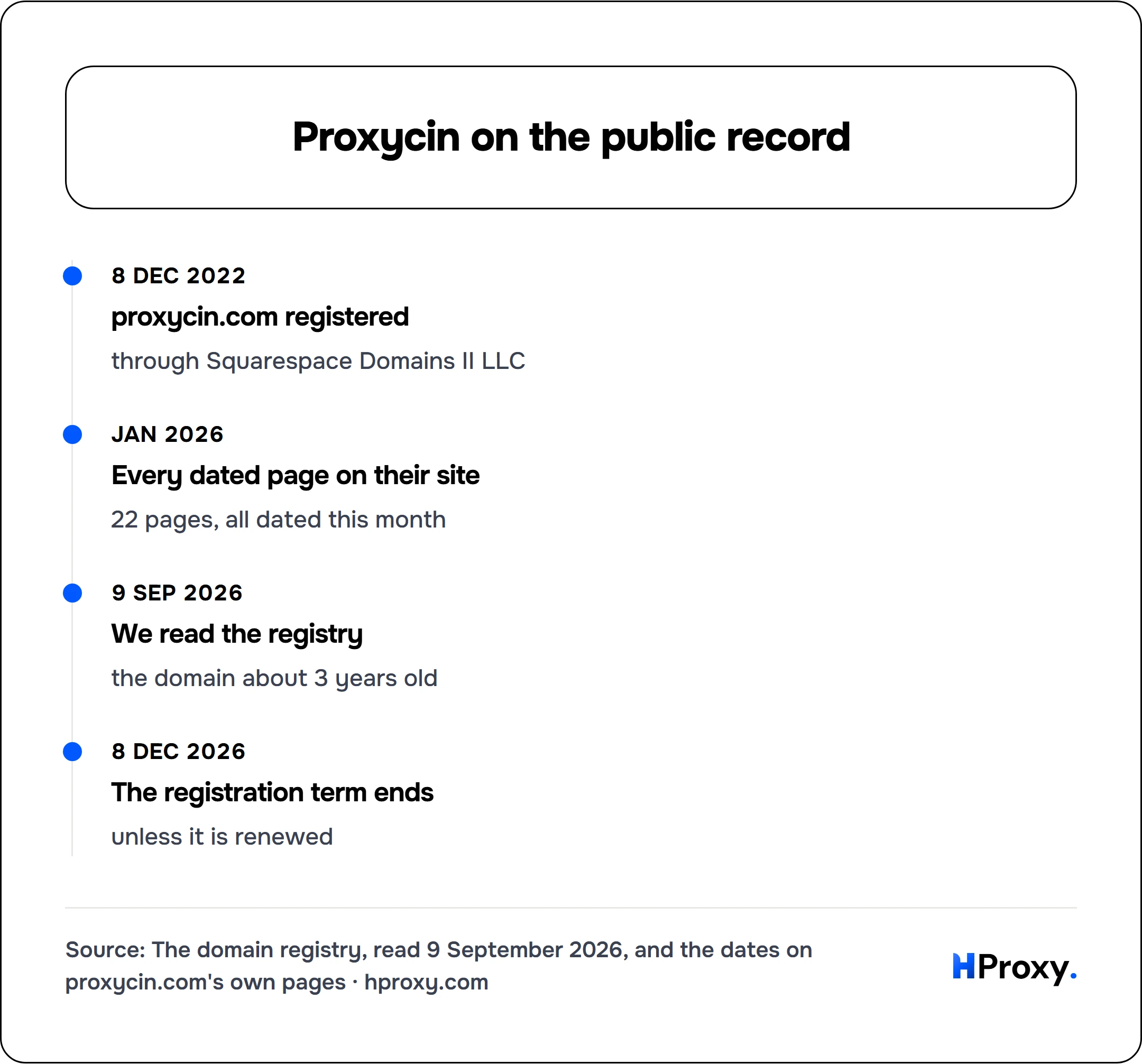
The domain was registered on 8 December 2022, through Squarespace Domains II LLC, which makes it about 3 years old. Those dates come from a registry query on 9 September 2026. Their registration is booked through 8 December 2026.
8 Dec 2022
proxycin.com registered
through Squarespace Domains II LLC
Jan 2026
Every dated page on their site
22 pages, all dated this month
9 Sep 2026
We read the registry
the domain about 3 years old
8 Dec 2026
The registration term ends
unless it is renewed
Age is not quality. A long registration does not make a network good, and a new one does not make it bad. What it does rule out is the shortest-lived pattern in this market, which is a site that appears, sells, and is gone inside a year.
The shape of their site
A crawl of 22 pages returned 4 location pages.
Read it as a map of what they emphasise. It is our count, from our crawler, on the date shown, and it is the only figure on this page that neither of us can dispute.
What the timestamps show
Our crawl of their site found 22 pages carrying a date. The oldest is from January 2026 and the newest from January 2026. 22 of them carry a date inside the last twelve months.
Recent dates prove somebody is still at the keyboard. They prove nothing about the network, which is what the test at the end of this page is for.
Where published figures stop being useful
The country total, and the country you use
Ask for the pool size in your country rather than in total, and expect the answer to be vague. Where it is not published, the ten minute test at the end of this page settles it for a few dollars.
Match the units before anything else
Half this market prices bandwidth and half prices addresses. A per-address plan is cheap for heavy traffic through few exits and ruinous for light traffic through many, and the reverse holds for per-gigabyte plans.
Threads, not gigabytes, are often the ceiling
A plan with generous traffic and a low thread limit is a slow plan. Find both numbers before you size anything, because the smaller of the two is your actual ceiling.
A comparison that admits what it cannot say
The rows that matter, with our own answers stated plainly:
| Question to ask | Proxycin | HProxy |
|---|---|---|
| Entry price | Not verified by us, read their page | From $0.44/GB, pay as you go |
| Does unused balance expire? | Worth confirming in writing before you commit | Never |
| Minimum commitment | Not published clearly, ask before paying | None |
| Identity checks | On their own terms page | Card orders are screened, and verification is sometimes requested |
| Targeting | Their terms page answers this | Country, city and ISP |
| Free way to evaluate | Check the current terms, this one moves | Free proxy list and proxy checker |
We would rather show an incomplete table than a confident wrong one. Anything we could not source is left for you to read at the source, with the date you read it.
A test worth more than this comparison
Do this once and you will never need a comparison page for this decision again.
- Start with the smallest purchase each vendor allows, so the test costs less than the decision it replaces.
- Use your own scraper and your own target. A benchmark against a neutral site measures nothing you will experience.
- Measure what came back correctly and what it consumed, then divide the spend by the successes.
- Push a sample of exit addresses through an independent checker and confirm the country and connection type are what was advertised.
- Buy the one that won on your target, and diarise a re-test in three months.
The other names that come up
Other providers in the same bracket, priced and dated the same way:
- TorGuard alternatives
- TornadoProxies alternatives
- Tracemyip alternatives
- TradeProxy alternatives
- TrafficMonetizer alternatives
The competing offer, for completeness
HProxy suits buyers who want to add funds, send traffic and stop thinking about it. Residential from $0.44 per GB, no commitment, nothing expiring. Buyers who need procurement paperwork and a named account manager are better served elsewhere, and we would rather say so here than waste your afternoon.