ProxyDancu (proxydancu.com) is a Vietnamese shop for proxies and cloud servers, aimed in its own words at the MMO (make money online) community. It has sold proxies since March 2021, prices everything in Vietnamese dong, and takes payment in dong only. On 27 September 2026 its Vietnam residential proxies started at 5,500 dong a day. For the comparison, jump to the alternatives table.
ProxyDancu at a glance
| what we found on 27 September 2026 | |
|---|---|
| status | live, orders through its own dashboard |
| domain | registered 19 March 2021, paid up to 19 March 2027 |
| operator | a registered household business in Lang Son province, Vietnam |
| Vietnam home IPs | by the day, per carrier, from 5,500 dong |
| rotating residential | by the gigabyte, from 59,000 dong within 30 days |
| datacenter | IPv4 and IPv6 in many countries, by the month |
| other products | VPS, GPU servers and cloud phones |
| currency | Vietnamese dong only, paid in advance |
| refunds | to your balance, if the service does not match |
| support | Telegram, Facebook, Zalo, WhatsApp, hotline |
Dollar figures on this page use the Vietcombank transfer rate of 27 September 2026, 25,790 dong to the dollar, and are rounded.
What ProxyDancu sells
Vietnam home IPs by the day. Proxies on Vietnam home and mobile networks, sold per day with unlimited bandwidth. You pick a carrier (Viettel, Vinaphone, MobiFone or FPT) or a mix of the three mobile carriers. Each plan states a maximum IP change time, from 5 to 240 seconds, and you can hold or rotate the IP.
Rotating residential by the gigabyte. A worldwide pool that ProxyDancu puts at more than 200 million IPs, with a country choice on every plan and a city choice on the dearer ones.
Static residential. Fixed home IPs in Vietnam and in 51 other countries, with SOCKS5 and HTTP and unlimited bandwidth.
Datacenter proxies. Private, fixed IPv4 addresses in many countries, cheaper IPv6 addresses, rotating datacenter plans by the day, and fast IPv4 lines for games.
Servers. Cloud VPS in dozens of countries, GPU servers in Vietnam and the US, and cloud phones.
What ProxyDancu charges
Every price below comes from its product pages on 27 September 2026.
| product | price | about |
|---|---|---|
| Vietnam residential, Viettel (DCVN1) | 5,500 dong a day | $0.21 |
| Vietnam residential, carrier mix (DCVN17) | 6,000 dong a day | $0.23 |
| Vietnam residential, faster rotation (DCVN35) | 10,000 dong a day | $0.39 |
| US rotating residential (USDCX1) | 6,000 dong a day | $0.23 |
| Rotating residential, 30 days (RL30D) | 59,000 dong a GB | $2.29 |
| Rotating residential, no time limit (RL89K) | 89,000 dong a GB | $3.45 |
| Rotating residential, Basic | 115,000 dong a GB | $4.46 |
| Rotating residential, Premium | 169,000 dong a GB | $6.55 |
| US datacenter IPv4, one month | 69,000 dong | $2.68 |
| US datacenter IPv6, one month | 20,000 dong | $0.78 |
The static residential cards show a price but no period. The Vietnam cards read 3,000, 59,000 and 139,000 dong, and the Japan card 149,000 dong. Ask before you buy what each one covers.
How it changed
The site opened in March 2021 as a small shop for "Proxy dân cư", residential proxies. By December 2023 its price board covered Vietnam residential from 5,000 dong a day and rotating residential from 149,000 dong a GB. It also offered static residential from 149,000 dong a month and datacenter IPv4 from 69,000 dong a month.
The same board still stood in October 2025. By September 2026 the gigabyte price started at 59,000 dong for traffic used within 30 days, and the menu listed GPU servers and cloud phones next to its VPS.
The fine print
These rules come from its terms and product pages, as read on 27 September 2026.
Dong only, paid in advance. Every service is prepaid in dong. The terms say a foreign-currency payment is converted by your own bank or payment provider.
Refunds go to your balance. The terms promise a full refund to your site balance within a week of setup if the service does not match the promise. Its FAQ offers a new IP or the unused days back for a faulty proxy. Its terms pay an unused balance of 50,000 dong or more back on request, to the account that paid, within 30 working days. A change of mind is not refunded.
Renew or lose it. The shop emails you three days before a proxy expires. A proxy that is not renewed is deleted for good.
Limits of use. The terms ban spam, bot traffic, gaming and livestreaming, unless a product says it is allowed. They also ban data scraping, again unless a product says it is allowed.
Pages that disagree. Its menu prices the US rotating plans at 9,000 to 15,000 dong a day, while the product page says 6,000 to 9,000. Its terms promise 99.99 percent uptime in one line and 99.9 percent in the next. The Japan card names VNPT, a Vietnamese carrier, as the network.
Who you deal with. The terms name a registered household business in Lang Son province as the operator, under Vietnamese law. Support runs through Telegram, Facebook, Zalo, WhatsApp and a hotline.
Where ProxyDancu is stronger
Vietnam carriers by the day. Viettel, Vinaphone, MobiFone or FPT, from about $0.21 a day with unlimited bandwidth.
One shop for proxies and servers. VPS, GPU servers and cloud phones next to the proxies.
Local payment and language. Prices in dong, QR code and bank transfer, and support in Vietnamese on Zalo.
Where HProxy differs
We sell proxies too, so read this part as the account of a competitor. Every HProxy fact here comes from our own product code and pages.
Vietnam without a daily clock. Our residential pools cover Vietnam, and purchased gigabytes have no scheduled expiry date. Lite targets by country at $0.50/GB for one gigabyte, 78 percent below the 30-day RL30D rate.
Carrier and city targeting on one balance. Premium, our pool with state, city and ISP targeting, can pin a line to one Vietnam carrier, such as Viettel, by its network number. It costs $1.49/GB for one gigabyte and $1.00/GB from 1,000 GB+.
Longer sessions. Premium sticky sessions last from 3 minutes to 24 hours, and SOCKS5 lines carry UDP.
Fixed addresses for less. Our datacenter IPv4 proxies cost $1.58/IP for a month from one address, and IPv6 $0.10/IP a month from ten. A dedicated static ISP address costs $2.70/IP for a month.
Payment and paperwork. We take cards, Alipay and thirty-two crypto options, and we ask for no documents at sign-up or at an ordinary checkout.
Where we are behind. We sell no unlimited daily plans on Vietnam networks, no servers, and no prices in dong.
The alternatives, side by side
Rotating residential proxies by the gigabyte, country targeting, at the smallest buy. The ProxyDancu row comes from its page of 27 September 2026, and every other figure from the page of each vendor, read on 26 or 27 September 2026 (ProxyScrape's on 28 September).
| provider | smallest buy | per GB | time limit |
|---|---|---|---|
| ProxyDancu RL30D | 1 GB for 59,000 dong | about $2.29 | 30 days |
| DataImpulse | 5 GB for $5 | $1.00 | never expires |
| NST Lite | 10 GB | $1.00 | 30 days |
| ProxyScrape | 1 GB for $7.50, or $10 with no expiry | $7.50, or $10 | 30 days, or no expiry |
| Decodo | 1 GB | $4.00 plus VAT | wallet, pay as you go |
| HProxy Lite | 1 GB | $0.50/GB | no scheduled expiry |
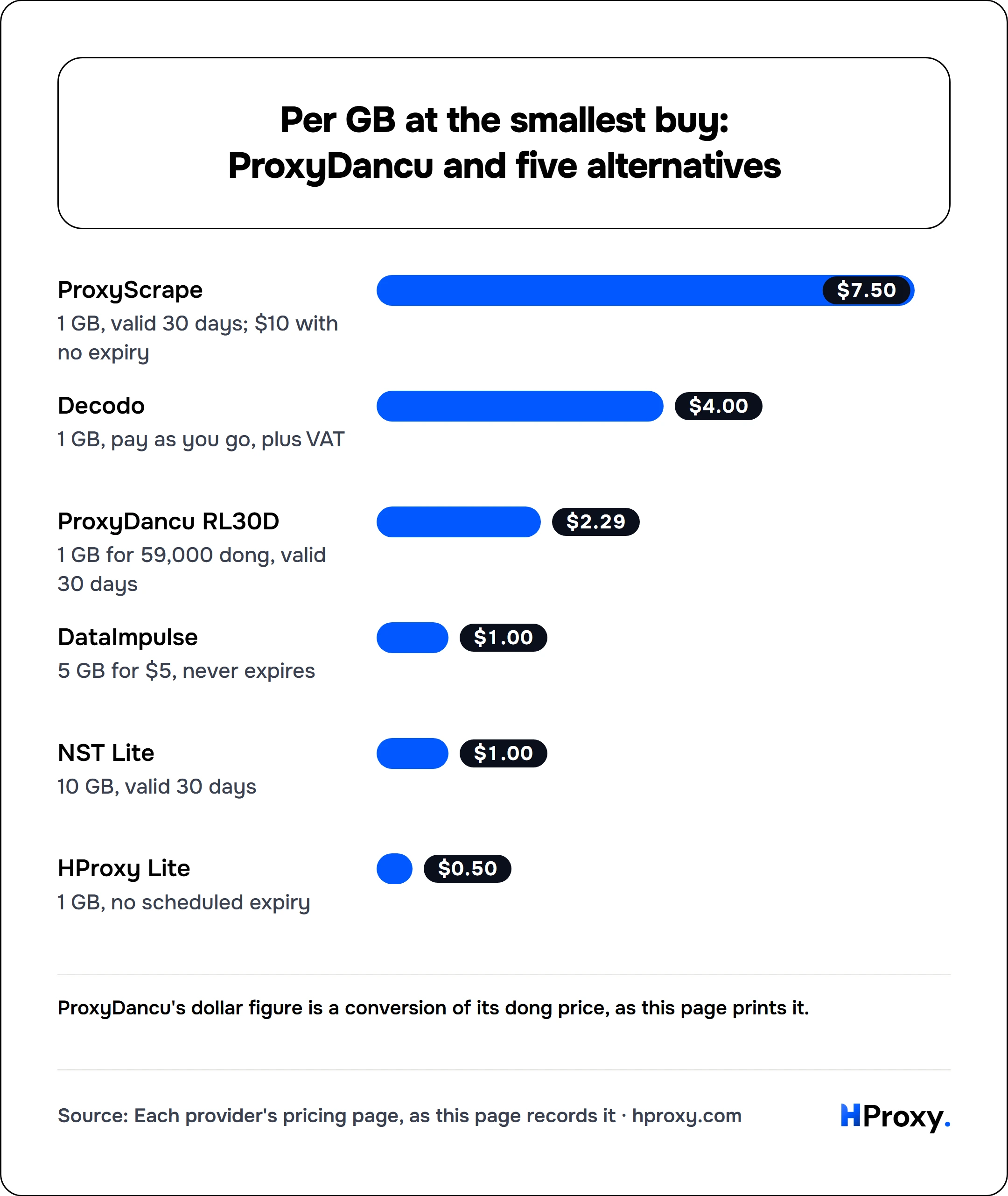
For the daily Vietnam plans with unlimited bandwidth, ProxyDancu has no like-for-like rival in this table. For traffic by the gigabyte, several rows cost less per gigabyte and last longer. Our reviews of DataImpulse, NST, ProxyScrape and Decodo cover their terms in full.
Who ProxyDancu suits
It suits a buyer in Vietnam who runs many accounts and wants a local carrier IP by the day, pays in dong, and likes support in Vietnamese. It also suits someone who needs cheap fixed datacenter addresses or a VPS from the same shop.
It suits you less if you pay in another currency, need traffic that outlasts a month, or plan to scrape, which its terms forbid unless a product allows it.
Before you commit
Start with one day of a Vietnam plan, and check the IP against your target before you buy more. Ask support what period each static residential price covers. Our proxy checker shows whether an address answers, how fast, and from where, whoever sold it.
The limits of this review
We did not buy from ProxyDancu or test its network. Every price and rule here comes from its own pages as they stood on 27 September 2026, and its pool size is its own claim. Dollar figures are our conversion at one bank rate of that day. We found no independent review we could read.
Every figure here carries the day it was read, and this page is due for a check by 27 December 2026.
Sources
- ProxyDancu, proxydancu.com: homepage, product pages for Vietnam, Viettel, US and gigabyte residential plans, the static residential pages for Vietnam and Japan, the US datacenter IPv4 and IPv6 pages, terms and contact page. Read 27 September 2026.
- Internet Archive, copies of the ProxyDancu homepage from October 2021, March 2022, December 2023 and October 2025.
- Verisign, registry record for proxydancu.com. Read 27 September 2026.
- Vietcombank, published exchange rates of 27 September 2026.
- DataImpulse, NST, ProxyScrape and Decodo, residential price pages. Read 26 and 27 September 2026; ProxyScrape's price data again on 28 September 2026.
- HProxy, our Vietnam page, our own product records, price table and terms.