We compete with ProxyChecker, so treat every line below as coming from an interested party. What follows is the record we hold, the questions their marketing page does not answer, and a test you can run yourself that outranks this page and every other review.
Everything we can stand behind
You will find them at proxychecker.co.
There is no price in this comparison because we do not have one we can date and attribute. What follows instead is the set of questions that decide the cost once you do read their page.
Find the rate available with no commitment, then find the cheapest rate and what it costs to reach. The distance between those two tells you what kind of vendor you are dealing with.
Their own description, read this week
On 9 September 2026 the site introduced itself as "ProxyChecker, An easy to use open-source, multithreaded Proxy Checker.". The one-paragraph pitch on their own page: "An easy to use open-source, multithreaded Proxy Checker."
Taken from the same page, on the same day:
We found no separate pricing page linked from the homepage, which usually means the price arrives by quotation.
Every line above is a quotation from their marketing rather than a measurement by us. It is included because it is checkable, not because it is evidence of performance.
The questions behind the numbers
Shared or dedicated changes everything
A shared address arrives with a history you did not create and cannot see. For read-only work it rarely matters. For anything that keeps a session, it is the most common cause of unexplained failure.
Who pays for the requests that fail
Divide the spend by the successful responses, not by the requests sent. That single change reorders most price comparisons in this market, and your accounting will use it eventually anyway.
The limit that stops the job
Bandwidth is rarely the constraint on a real workload. Concurrent connections, requests per second and per-session caps are, and they are frequently buried in the documentation rather than the pricing page.
The comparison, honestly framed
Here are the comparisons that survive contact with a real workload:
| Question to ask | ProxyChecker | HProxy |
|---|---|---|
| Entry price | Not verified by us, read their page | From $0.44/GB, pay as you go |
| Does unused balance expire? | Read their current terms | Never |
| Minimum commitment | On their own terms page | None |
| Identity checks | Not published clearly, ask before paying | Card orders are screened, and verification is sometimes requested |
| Targeting | On their own terms page | Country, city and ISP |
| Free way to evaluate | Not published clearly, ask before paying | Free proxy list and proxy checker |
Treat the right-hand column as a claim by an interested party, because it is one. Every line in it is checkable on our own pages and in our own terms.
The test that beats this page
It is a small amount of money for an answer that is actually about your target.
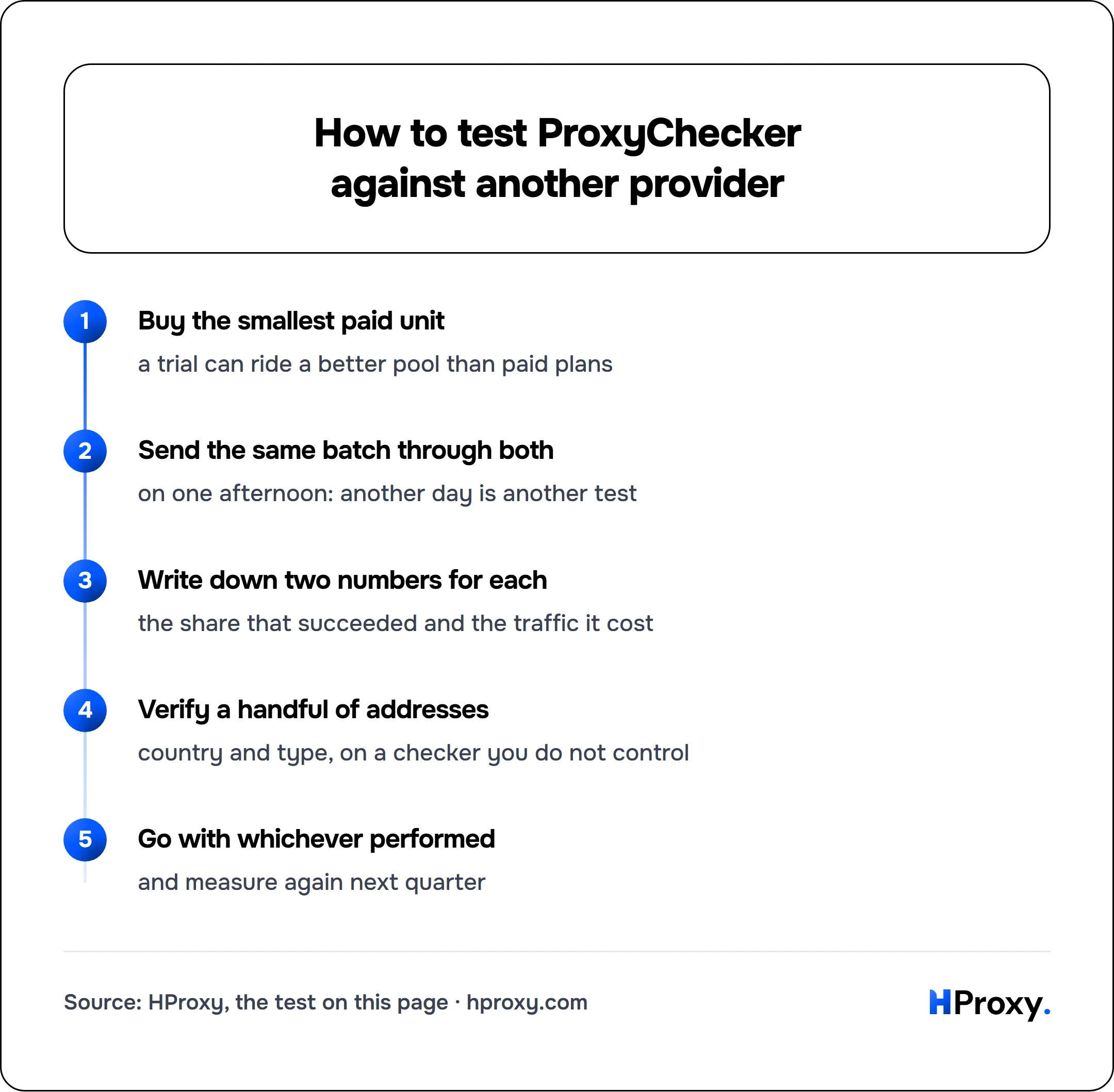
- Take the smallest paid unit each provider will sell you. A free trial works for a first pass, though trials sometimes ride better pools than paid plans do.
- Fire the same batch through both on one afternoon. Different days are different conditions, and that ruins the comparison.
- Write down two numbers per provider: the share of requests that succeeded, and the traffic it cost.
- Take a handful of the addresses you were given and verify their country and type against a checker you do not control.
- Go with whichever performed, then measure again next quarter. Networks change underneath you.
Buy the smallest paid unit
a trial can ride a better pool than paid plans
Send the same batch through both
on one afternoon: another day is another test
Write down two numbers for each
the share that succeeded and the traffic it cost
Verify a handful of addresses
country and type, on a checker you do not control
Go with whichever performed
and measure again next quarter
Comparable providers
We hold the same record for these, and the same honest limits apply to each:
- Toolip alternatives
- Topfreeproxy alternatives
- ToProxy.ru alternatives
- Toproxylab alternatives
- Toptierproxy alternatives
- TorchLabs alternatives
What we sell, stated plainly
If you want our side of it: $0.44 per GB for residential, pay as you go, nothing expires, and the free tools stay free. We would rather you measured than believed us, which is why the test comes before this paragraph rather than after it.