Two things decide whether a proxy provider works for you, and neither appears on a pricing page: how the pool behaves against your specific target, and what happens to money you have paid but not spent.
What we know about Proxydeals, and what we do not
Their site is proxydeals.com.
There is no price in this comparison because we do not have one we can date and attribute. What follows instead is the set of questions that decide the cost once you do read their page.
Find the rate available with no commitment, then find the cheapest rate and what it costs to reach. The distance between those two tells you what kind of vendor you are dealing with.
The site, as it reads today
Their homepage title, read on 9 September 2026: "Cheapest USA Elite Private Proxies - Buy Now with 50% DISCOUNT! - DreamProxies.com Private Elite Proxies". The description they publish for search engines reads: "50% OFF - For All Private Proxies! DreamProxies - Cheapest USA Elite Private Proxies! + FREE PROXIES With Bigger Proxy Plans! Volume Discounts Lifetime Savings Best Proxy Prices"
The rest of what the page puts in writing:
Payment methods mentioned: PayPal. Support is advertised as around the clock. A refund or money-back term is mentioned. Their pricing page is titled "Pricing - Cheapest USA Elite Private Proxies - Buy Now with 50% DISCOUNT!".
Nothing there has been tested. It is a record of what the page said on the day, which is the honest limit of what a page like this can offer without a measurement.
Age, and why it matters here
The domain was registered on 3 May 2015, through Dynadot Inc, which makes it about 11 years old. The lookup behind those dates ran on 9 September 2026. As things stand the domain is held to 3 May 2027.
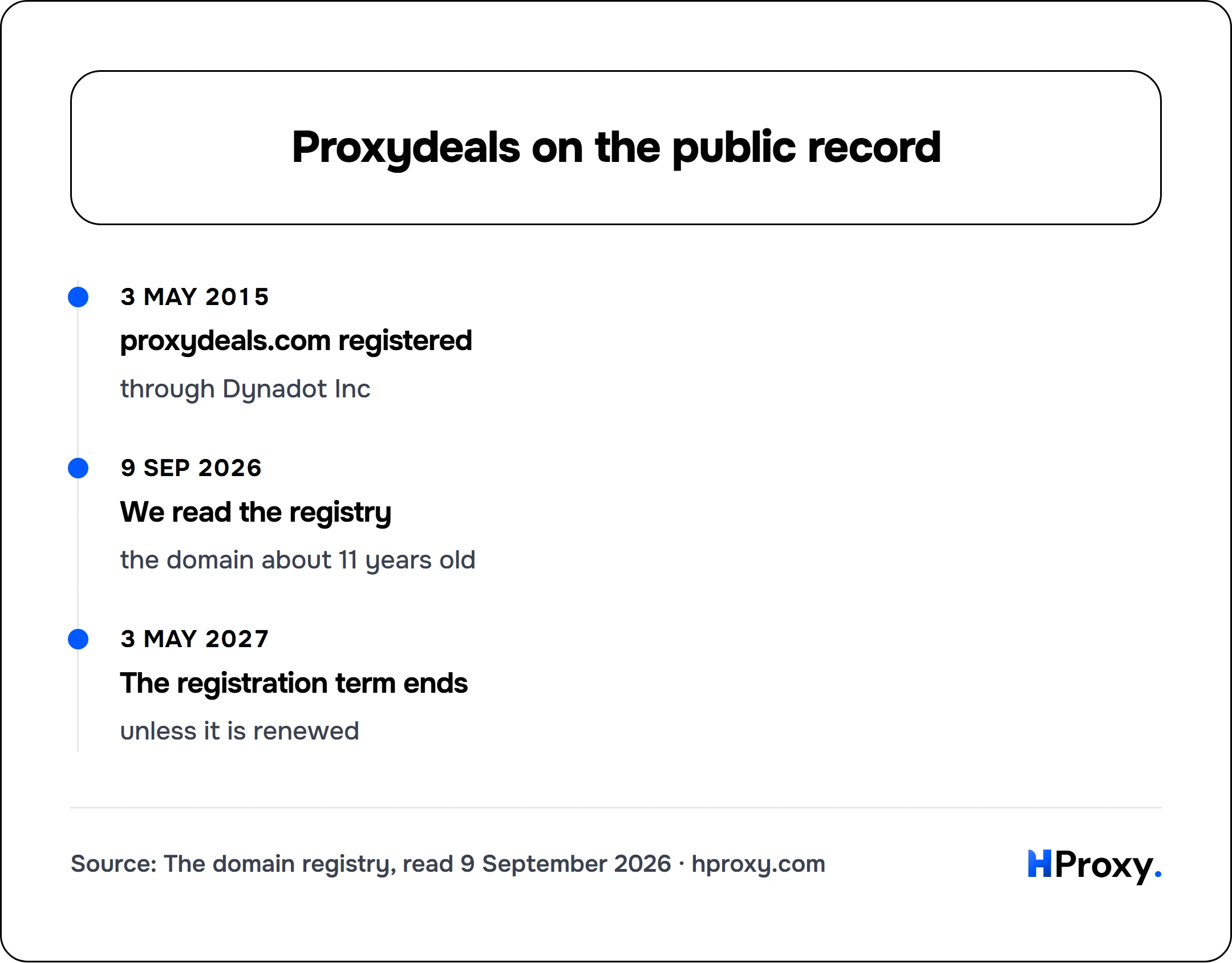
3 May 2015
proxydeals.com registered
through Dynadot Inc
9 Sep 2026
We read the registry
the domain about 11 years old
3 May 2027
The registration term ends
unless it is renewed
None of it predicts success rate. It is here because domain age and archive depth are free to check, and a provider whose public record starts last quarter deserves a smaller first order.
The questions behind the numbers
Match the units before anything else
Half this market prices bandwidth and half prices addresses. A per-address plan is cheap for heavy traffic through few exits and ruinous for light traffic through many, and the reverse holds for per-gigabyte plans.
The day something goes wrong
Test the support channel before you need it. Ask something specific and technical, and judge both the speed and whether the answer came from somebody who understood the question.
Why an old benchmark is wrong
Pools are rebuilt, suppliers change and detection improves. A provider that beat the field last spring may be mid-table now. Nothing in this market stays true long enough to buy once and stop measuring.
The comparison, honestly framed
Compare on these rows and ignore the feature lists on both sites:
| Question to ask | Proxydeals | HProxy |
|---|---|---|
| Entry price | Not verified by us, read their page | From $0.44/GB, pay as you go |
| Does unused balance expire? | Their terms page answers this | Never |
| Minimum commitment | Worth confirming in writing before you commit | None |
| Identity checks | Read their current terms | Card orders are screened, and verification is sometimes requested |
| Targeting | On their own terms page | Country, city and ISP |
| Free way to evaluate | Not published clearly, ask before paying | Free proxy list and proxy checker |
Where a cell points you at their terms, that is because the answer moves and a stale quotation would be worse than none. The missing row, in every table of this kind, is the one only your own measurement can fill.
The test that beats this page
It is a small amount of money for an answer that is actually about your target.
- Take the smallest paid unit each provider will sell you. A free trial works for a first pass, though trials sometimes ride better pools than paid plans do.
- Fire the same batch through both on one afternoon. Different days are different conditions, and that ruins the comparison.
- Write down two numbers per provider: the share of requests that succeeded, and the traffic it cost.
- Take a handful of the addresses you were given and verify their country and type against a checker you do not control.
- Choose on the measurement, not the marketing, and expect the answer to change within a year.
Where else buyers look
If this one does not fit, these are the nearest comparable providers we have written up, each on the same terms as this page.
Where we fit
For completeness: residential from $0.44 per GB with country targeting, city and ISP targeting on Residential Premium from $1.00 per GB, no monthly minimum, and a balance that stays where you left it. We are a good fit for uneven workloads and a poor one for anybody who wants a signed enterprise agreement.