ProxyScrape is trading normally, and it sells two very different things. On 26 September 2026 proxyscrape.com sold residential, datacenter, ISP and mobile proxies, next to the free proxy list it started with in 2018. Residential traffic starts at $14.25 for 5 GB valid 30 days, and traffic that never expires costs about a third more. The free list works for roughly one address in three. If you came to replace it, the paid alternatives are in the alternatives table.
ProxyScrape at a glance
| what we found on 26 September 2026 | |
|---|---|
| status | trading, proxyscrape.com answered normally |
| operator | Thib BV, Mechelen, Belgium |
| founded | 2018 as a free proxy tool, paid proxies from 2020 |
| products | residential, unlimited residential, datacenter, ISP, mobile, a SERP API and a free proxy list |
| cheapest residential | 5 GB for $14.25, valid 30 days |
| lowest residential rate | $1.05 a GB, on 10,000 GB valid 30 days |
| traffic terms | 30, 60 or 90 days, or no expiry for about a third more |
| refunds | within 3 days, under 1 GB used, card or PayPal, up to $100 |
| identity check | a KYC form may be required |
| Trustpilot | 4 of 5 from 484 reviews, archived 25 February 2026 |
The record, with dates
| date | what the record shows |
|---|---|
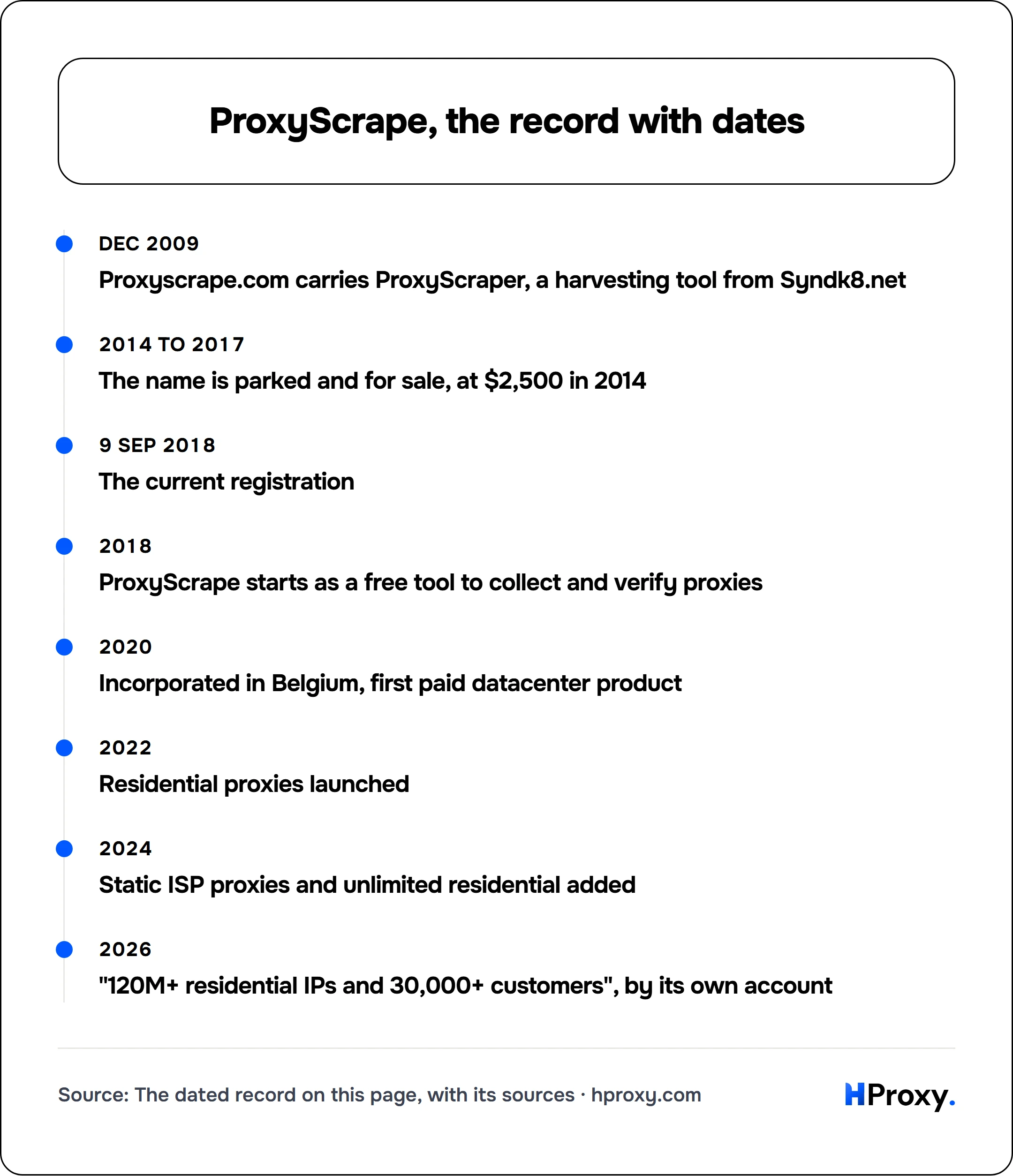
| December 2009 | proxyscrape.com carries ProxyScraper, a harvesting tool from Syndk8.net |
| 2014 to 2017 | the name is parked and for sale, at $2,500 in 2014 |
| 9 September 2018 | the current registration |
| 2018 | ProxyScrape starts as a free tool to collect and verify proxies |
| 2020 | incorporated in Belgium, first paid datacenter product |
| 2022 | residential proxies launched |
| 2024 | static ISP proxies and unlimited residential added |
| 2026 | "120M+ residential IPs and 30,000+ customers", by its own account |
Dec 2009
Proxyscrape.com carries ProxyScraper, a harvesting tool from Syndk8.net
2014 to 2017
The name is parked and for sale, at $2,500 in 2014
9 Sep 2018
The current registration
2018
ProxyScrape starts as a free tool to collect and verify proxies
2020
Incorporated in Belgium, first paid datacenter product
2022
Residential proxies launched
2024
Static ISP proxies and unlimited residential added
2026
"120M+ residential IPs and 30,000+ customers", by its own account
Sources: the Internet Archive captures of proxyscrape.com, the Verisign registry record and the ProxyScrape about page, all read on 26 September 2026. The 2009 tool shares the name only; the company dates its own founding to 2018.
What the paid proxies cost
Its product page draws these prices by script from a table on its own servers. We read that table on 26 September 2026, and every figure below excludes VAT.
| traffic | valid 30 days | 60 days | 90 days | never expires |
|---|---|---|---|---|
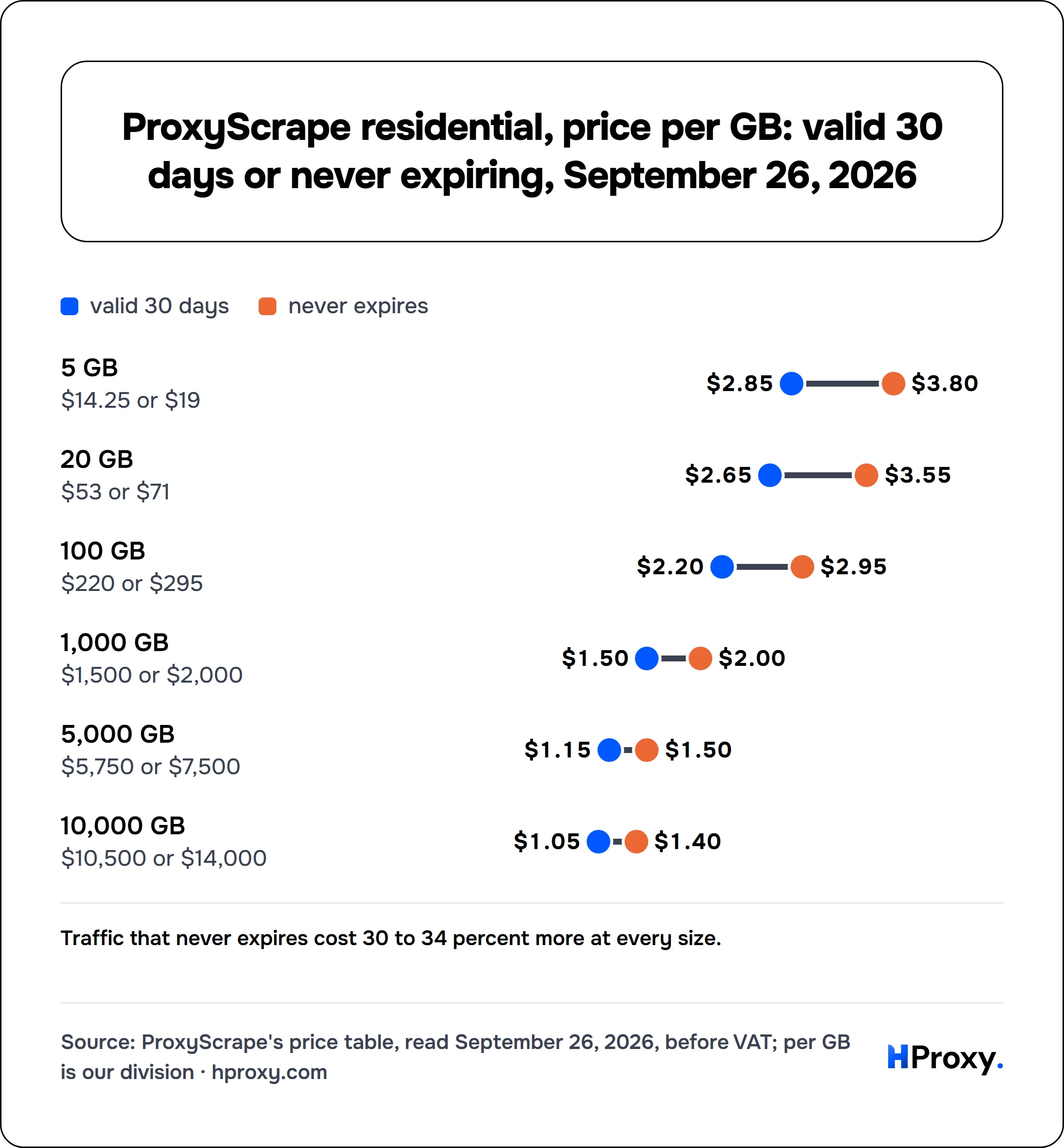
| 5 GB | $14.25 | $15.25 | $16.25 | $19 |
| 20 GB | $53 | $57 | $60 | $71 |
| 100 GB | $220 | $235 | $250 | $295 |
| 1,000 GB | $1,500 | $1,600 | $1,700 | $2,000 |
| 5,000 GB | $5,750 | $6,000 | $6,500 | $7,500 |
| 10,000 GB | $10,500 | $11,000 | $12,000 | $14,000 |
- valid 30 days
- never expires
The shape is simple. The cheapest traffic lasts 30 days, and traffic without an expiry date costs 30 to 34 percent more at every size. A 1 GB trial costs $1.
Two labels do not match this table. The pricing page labels its popular bundle "10 GB = $35.5", while the table lists 10 GB at $28.50 for 30 days and $38 without expiry. The "from $1.15/GB" headline is the 5,000 GB bundle.
The other product lines
| product | price on 26 September 2026 |
|---|---|
| unlimited residential, priced by speed | 100 Mbps: $190 a day, $617.50 a week, $1,425 for 30 days |
| shared datacenter ("Premium") | 1,000 US proxies for 30 days: $25 with 250 GB, $75 unmetered |
| dedicated datacenter | 5 US proxies for $9.50 a month, 1,000 for $1,000 |
| dedicated ISP | from $1.65 per proxy, 17 locations, trial 5 proxies for $5.92 |
| mobile | from $1.15 a GB, drawn from the same table as residential |
The popular unlimited bundle, "200 MBps = $933", buys a week, not a month. Unmetered datacenter plans come with a fair-use rule: 1 TB per $5 paid, with a 10 TB minimum.
The fine print
The refund window is three days. Buyers waive the usual 14-day withdrawal right. A refund then needs all of these: under 1 GB used, payment by card or PayPal, a purchase of $100 or less, and no other refund that month.
A KYC form may come. The terms say access "may require a verification process", in which you explain how you will use the proxies. A refused or false form can end the account without a refund.
One end user per plan. Resale or sharing of a plan needs written consent.
Payment. The terms list Bitcoin, Ethereum and Litecoin, WebMoney, UPI, PayTM, AliPay, UnionPay and several European bank methods. The refund clause names card and PayPal payments.
The contract is with Thib BV in Mechelen, under Belgian law, and these terms took effect on 1 September 2026.
The free list, measured
The free list is where ProxyScrape began, and it is still a strong one. Its page says the list "typically holds 20,000+ live proxies across 180+ countries at any time", rechecked every minute.
| what | result |
|---|---|
| the claim on its page | 20,000+ live proxies at any time |
| its free API, 16 September 2026 | 2,000 lines, 1,895 distinct addresses |
| its free API, 26 September 2026 | 2,000 lines, 1,940 distinct addresses |
| our sample, 9 September 2026 | 26.7 percent relayed, then 33.3 percent thirty minutes later |
| every address, 16 September 2026 | 27.4 percent answered our request |
On 9 September 2026 only free-proxy-list.net and ProxyNova beat it among the eleven lists we sampled. On 16 September, 72 percent of its addresses sat on datacenter space and 93.6 percent carried an abuse flag in the IP data we hold.
For a script, one working proxy in three means about thirty dials for ten working sessions. The dials are cheap; the waiting is not. A dead proxy hangs rather than refuses. With a five-second connect timeout, twenty failures cost under two minutes; at thirty seconds they cost about ten. Check each address with a real page before your job uses it, and never route a login through a free proxy. We cover the safe cases in when free proxies are fine.
Where ProxyScrape is stronger
A free list and free tools. The list, the checkers and the browser extension cost nothing, and they are a fair place to learn.
Cheap shared datacenter at volume. 1,000 shared US proxies for $25 a month works out at 2.5 cents an address.
Unlimited plans priced by speed. A buyer with heavy, steady traffic can pay for bandwidth by the week instead of by the gigabyte.
Targeting and protocols. Residential targets country, state, city, operating system and ASN, over HTTP and SOCKS5 with UDP.
Cheaper short-lived traffic. If you use traffic within 30 days, the 30-day bundles are about a quarter cheaper than the same traffic with no expiry.
Where HProxy differs
We sell proxies too, so read this part as the account of a competitor. Every HProxy fact here comes from our own product code.
No expiry without a surcharge. Our purchased gigabytes have no set expiry date, and there is no second, dearer price for that. You buy from 1 GB, in any amount.
Longer sessions. Premium sticky sessions last from 3 minutes to 24 hours, against the 120 minutes ProxyScrape lists for residential.
ISP targeting on Premium. Our Premium pool targets country, state, city and ISP by AS number for $1.49/GB a gigabyte at 1 GB, and SOCKS5 lines carry UDP. The networks are on the ISP targeting page.
No documents to start. We ask for no documents at sign-up or at an ordinary checkout.
Where we are behind. Our Lite pool targets by country only. One gigabyte of Lite costs $0.50/GB; Premium costs $1.49/GB and falls to $1.00/GB from 1,000 GB+, with the steps on the price table. For datacenter we sell private IPs, IPv4 at $1.58/IP for a month from a single IP, and no shared pool at 2.5 cents an address. Our own free proxy list and proxy checker are free, like theirs. The price-by-price comparison sits in HProxy vs ProxyScrape.
The alternatives for residential traffic
Every figure below is from the residential page of each vendor, read on 26 September 2026. A rate you cannot reach is not a price.
| provider | smallest buy | lowest rate, and what it needs | ASN targeting | unused traffic |
|---|---|---|---|---|
| ProxyScrape | 5 GB for $14.25, 30 days | $1.05 a GB at 10,000 GB | yes | 30 to 90 days, or pay a third more |
| Decodo | $4 for 1 GB, pay as you go | $2 a GB at 1 TB | yes | not stated |
| DataImpulse | $5 for 5 GB | $0.80 a GB at 1 TB | listed as new | never expires |
| SOAX | $5 a GB for US traffic, no plan fee | $0.85 a GB at $3,000 a month | from $1,500 a month | credits last 60 days |
| Bright Data | $8 a GB pay as you go, $4 with a 3-month coupon | 798 GB at $1,999 a month | yes, free | commitment does not roll over |
| Massive | $80 a month for 10 GB | $4.90 a GB at 100 GB; enterprise from $3.20 | not listed | rolls over |
| HProxy Lite | 1 GB at $0.50/GB | $0.44/GB at 2,000 GB+ | no, country only | no expiry date |
| HProxy Premium | 1 GB at $1.49/GB | $1.00/GB at 1,000 GB+ | yes, no extra cost | no expiry date |
DataImpulse is the nearest match on price at volume and keeps its traffic without an expiry charge. Decodo sells a single gigabyte and adds ZIP targeting, and we cover it in our Decodo review. Massive starts higher, at $8 a gigabyte, and our Massive pricing page has the detail. The ProxyScrape alternatives page keeps our side of the comparison current.
Who ProxyScrape suits
It suits a developer who wants a free list to learn on, and a buyer who needs thousands of cheap shared datacenter addresses. It also suits steady residential use that is spent inside 30 days, where its bundles are cheap.
It suits occasional use less well. Traffic kept for later costs a third more, sticky sessions stop at two hours, and a refund needs less than 1 GB of use within three days.
The limits of this review
We tested the free list, not the paid network, so this page makes no claim about paid speed or success rates. The price table can change without a page edit, and the page label already disagrees with it. We cannot say why the free API serves exactly 2,000 lines. Our audit of 9 September 2026 survives as the figures published that day, without its raw output.
Every figure here carries the day it was read, and this page is due for a check by 26 December 2026.
Sources
- ProxyScrape, pricing page, residential, ISP and mobile product pages, free proxy list page and about page. Read 26 September 2026.
- ProxyScrape, the price table its pages load for residential, unlimited residential, shared and dedicated datacenter. Read 26 September 2026.
- ProxyScrape, Terms and Conditions, effective 1 September 2026. Read 26 September 2026.
- ProxyScrape, its public free list API, counted on 26 September 2026.
- Internet Archive, captures of proxyscrape.com from 2009 to 2017.
- Verisign, registry record for proxyscrape.com. Read 26 September 2026.
- Trustpilot, the ProxyScrape page as archived on 25 February 2026.
- HProxy, free proxy market audit of 9 September 2026 and free proxy industry audit of 16 September 2026.
- Decodo, DataImpulse, SOAX, Bright Data and Massive, residential pricing pages. Read 26 September 2026.
- HProxy, our own product records, price table and terms.