The answer to "what should I use instead of ProxyCrawl" depends entirely on why you are leaving. Price, a commitment, a country, a support experience and a blocked target all point at different replacements.
What is on file for ProxyCrawl
Their site is proxycrawl.com. Category, as we track it: proxy provider.
There is no price in this comparison because we do not have one we can date and attribute. What follows instead is the set of questions that decide the cost once you do read their page.
Find the rate available with no commitment, then find the cheapest rate and what it costs to reach. The distance between those two tells you what kind of vendor you are dealing with.
The site, as it reads today
On 9 September 2026 the site introduced itself as "Crawlbase · Web Data Infrastructure for Developers, Enterprises and LLMs". Their meta description, the sentence Google shows under the link, says: "Web data infrastructure that keeps your data flowing. Crawl and scrape any website with a smart AI proxy, crawling API, enterprise crawler, managed scrapers, cloud storage, and a Web MCP Server for AI agents. No browsers, proxies or anti-bot maintenance. Start free with up to 5,000 requests."
Taken from the same page, on the same day:
The product lines named on that page are residential and a scraping or SERP API. They advertise 30 countries or locations. Payment methods mentioned: cards and Wise or Payoneer. The page offers some form of free trial. Their pricing page is titled "Pricing: One Rate Card for Every Product, Crawlbase".
Every line above is a quotation from their marketing rather than a measurement by us. It is included because it is checkable, not because it is evidence of performance.
Age, and why it matters here
The domain was registered on 10 April 2017, through NameCheap, Inc, which makes it about 9 years old. We pulled that from the registry on 23 April 2026. The Internet Archive holds 20 snapshots of the site, the earliest from August 2017. The current registration term ends 10 April 2027.
None of it predicts success rate. It is here because domain age and archive depth are free to check, and a provider whose public record starts last quarter deserves a smaller first order.
What the search data says about ProxyCrawl
Worldwide, the brand carries about 20 searches a month: 10 a month for their pricing and 10 a month for a review of them. Figures read from Google Keyword Planner on 9 September 2026.
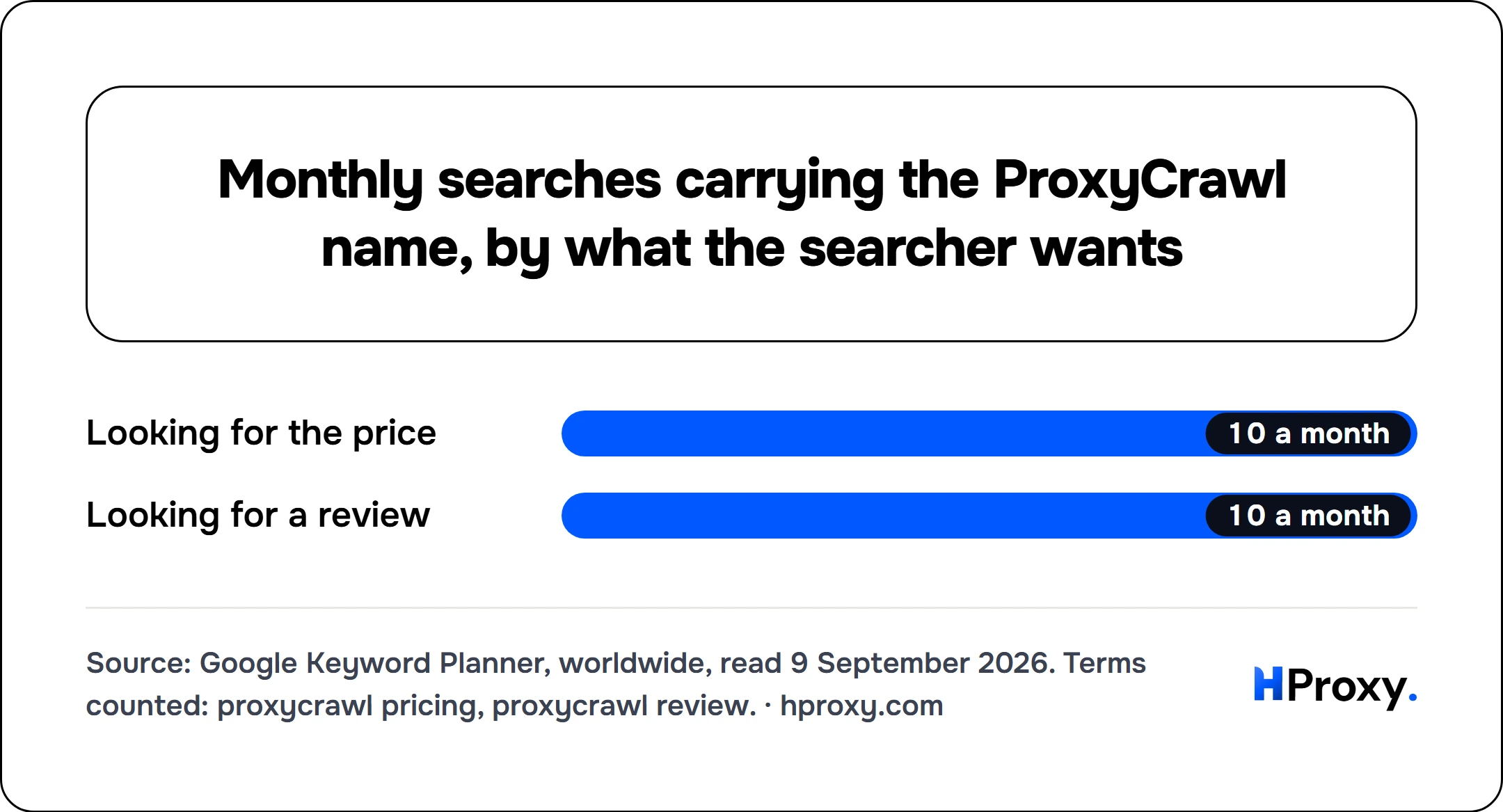
The largest share is people trying to work out what it costs, which is the honest starting point for a page like this one.
The questions behind the numbers
Ask what happens to unused balance
Find out whether unspent traffic rolls over, expires, or expires only on some plans. The answer changes the effective rate by more than most of the price differences buyers spend their time arguing about.
The rate behind the sales call
The lowest published rate in this market usually sits behind a monthly commitment measured in thousands. Quoting it beside a pay as you go rate is not a comparison. Compare the rate you can reach today.
The limit that stops the job
A plan with generous traffic and a low thread limit is a slow plan. Find both numbers before you size anything, because the smaller of the two is your actual ceiling.
The comparison, honestly framed
Here are the comparisons that survive contact with a real workload:
| Question to ask | ProxyCrawl | HProxy |
|---|---|---|
| Entry price | Not verified by us, read their page | From $0.44/GB, pay as you go |
| Does unused balance expire? | Their terms page answers this | Never |
| Minimum commitment | Worth confirming in writing before you commit | None |
| Identity checks | Read their current terms | Card orders are screened, and verification is sometimes requested |
| Targeting | Worth confirming in writing before you commit | Country, city and ISP |
| Free way to evaluate | Read their current terms | Free proxy list and proxy checker |
Where a cell points you at their terms, that is because the answer moves and a stale quotation would be worse than none. The missing row, in every table of this kind, is the one only your own measurement can fill.
The measurement that outranks every review
This costs less than a coffee and produces the only evidence that applies to your workload.
- Fund both accounts with the least money each will accept, and note what that minimum was, because it is part of the comparison.
- Aim both at the page that matters to you rather than a test endpoint, and keep every other variable fixed.
- Record the success rate and the data consumed for the identical batch on each side.
- Check some of the addresses yourself for country, ASN and type before you trust the label on the plan.
- Keep the winner, and repeat the whole thing quarterly, because pools age.
Comparable providers
We hold the same record for these, and the same honest limits apply to each:
What we sell, stated plainly
If you want our side of it: $0.44 per GB for residential, pay as you go, nothing expires, and the free tools stay free. We would rather you measured than believed us, which is why the test comes before this paragraph rather than after it.