
ArnProxy is a Turkish proxy seller, and it is trading normally. On 26 September 2026 arnproxy.com sold private IPv4, static ISP, IPv6, residential and rotating proxies. One IPv4 address costs $0.75 for a week or $1.50 for a month, a static ISP address $2.50 a month, and residential starts at $3 for 1 GB. If you came to compare, the prices are in the alternatives tables.
ArnProxy at a glance
| what we found on 26 September 2026 | |
|---|---|
| status | trading, arnproxy.com answered normally |
| seller | ARNPROXY Server Services, Rize, Turkey |
| online since | 2020, domain registered 28 July 2020 |
| products | IPv4, IPv4 Mixed, static ISP, IPv6, residential, rotating ISP, rotating datacenter |
| cheapest address | IPv4 Mixed, $0.50 for a week |
| locations | 43+ active, 39 for IPv4 and 24 for static ISP |
| residential | 1 GB for $3 a month, down to $0.95 a GB at 3,000 GB |
| discounts | 2 percent at 5 addresses, up to 35 percent at 1,000 |
| replacements | free within 24 hours of purchase |
| payment | PayPal, cards and mobile payment, from a prepaid balance |
The name started with gamers. Its first archived page, from November 2020, sold private SOCKS and IPv4 or IPv6 proxies "with unlimited traffic" for Knight Online, Silkroad Online, Metin2, Instagram and Pinterest. A second domain, arnproxy.net, carried an English copy of the site in 2025; it gave no answer on 26 September 2026, and the English pages now live on arnproxy.com.
What ArnProxy costs
Every price below comes from its English price page, read on 26 September 2026. The per-address prices are for the United States, which most of its locations match.
| product | 1 week | 1 month | longer |
|---|---|---|---|
| IPv4 | $0.75 | $1.50 | $15.84 for 12 months |
| static ISP | $1.25 | $2.50 | $4.85 for 2 months |
| IPv4 Mixed, random country | $0.50 | $1 | |
| IPv6, from 10 addresses | $0.15 each |
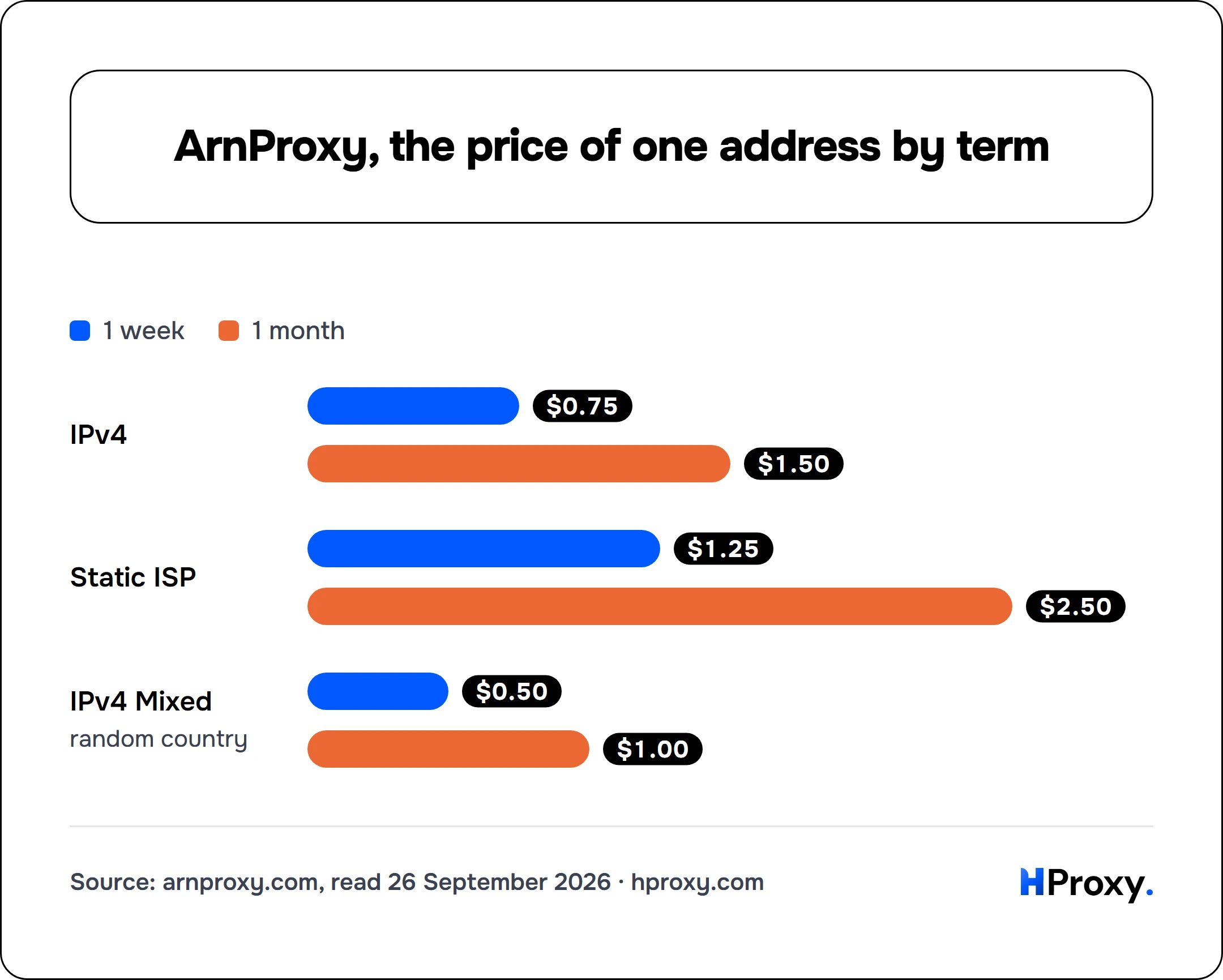
- 1 week
- 1 month
Two discounts stack on top. Buying more addresses saves 2 percent at 5, 12 percent at 100 and 35 percent at 1,000. Renting for longer saves 3 percent for two months and 13.2 percent for a year. Kazakhstan and South Korea cost more, from $1.40.
The per-gigabyte products are sold as monthly packages:
| product | smallest package | lowest printed rate |
|---|---|---|
| residential | 1 GB for $3 | 3,000 GB for $2,849, $0.95 a GB |
| rotating ISP, US | 10 GB for $10 | 500 GB for $250, $0.50 a GB |
| rotating datacenter, US | 10 GB for $6 | 500 GB for $155, $0.31 a GB |
The pages we read do not say what happens to unused traffic when the month ends.
The fine print
Replacement is quick, refunds are narrow. A proxy that fails, or that your target blocks, within 24 hours of purchase is replaced for free. A refund needs more: the proxy cannot work and cannot be replaced, support confirms a connection failure, or the location you paid for is missing. Even then the refund is partial, less the rental time already used.
You carry the platform risk. The return policy puts it on the buyer to know whether a target accepts proxies. A proxy bought for one site and used on another loses its performance guarantee, and no refund follows.
Location changes need support. You cannot switch a bought proxy to another country. For a city or region on per-address products, its FAQ says to ask an operator after purchase.
Expiry is final. Its FAQ says a proxy can usually not be extended after it expires, and it sends an email and SMS three days before that date.
Payment. PayPal, Visa, Mastercard, mobile payment and other cards, all through a balance you load first. Mobile payments cannot be refunded, and no cryptocurrency is named.
The user agreement names the seller as ARNPROXY Server Services in Rize, Turkey, with tax number 0780475301; the site footer reads ARN PROXY Limited Company.
Where ArnProxy is stronger
Cheap single addresses. One static ISP address costs $2.50 for a month, from a single address. Among the offers we read the same day, only shared or multi-address plans came lower.
Short rentals. A week of IPv4 for $0.75 suits a test or a short campaign without paying for a month.
Discounts that scale. Up to 35 percent off at 1,000 addresses, plus up to 13.2 percent for a year.
Residential with ISP targeting. Its residential proxies target country, region, city and ISP, with sticky and rotating sessions.
A local shop. Turkish pages and support, mobile payment, and a free swap in the first 24 hours.
Where HProxy differs
We sell proxies too, so read this part as the account of a competitor. Every HProxy fact here comes from our own product code.
Static ISP by the address. Ours is one dedicated address held as long as you keep it, with unlimited bandwidth, at $2.70/IP for a month. ArnProxy charges $2.50 for the same month; test both on your own target.
Residential without a monthly clock. Our purchased gigabytes have no scheduled expiry date. Lite targets by country at $0.50/GB for one gigabyte. Premium, our pool with city, state and ISP targeting, costs $1.49/GB for one gigabyte and $1.00/GB from 1,000 GB+. ArnProxy charges $3 for its first gigabyte and $1 a gigabyte at 1,000.
Sessions and UDP. Premium sticky sessions last from 3 minutes to 24 hours, and SOCKS5 lines carry UDP.
Crypto and no paperwork. We take cards and thirty-two crypto assets and networks, and we ask for no documents at sign-up or at an ordinary checkout.
Where we are behind. We have no quantity discount ladder like its 35 percent at 1,000 addresses. For datacenter, our IPv4 costs $1.58/IP for a month against its $1.50.
The alternatives, side by side
Every figure below comes from the page of each vendor, read on 26 September 2026. One static ISP address for a month:
| provider | smallest buy | per address, one month | note |
|---|---|---|---|
| ArnProxy | 1 address | $2.50 | US price, 24 locations |
| Oxylabs | 10 addresses for $16 | $1.60 | shared by up to 3 users |
| Decodo | 3 addresses for $9.99 | $3.33 | dedicated, plus VAT |
| Massive | 10 addresses for $30 | $3.00 | United States only |
| ProxyScrape | 5-proxy trial for $5.92 | from $1.65 | 17 locations |
| HProxy | 1 address | $2.70/IP | dedicated, kept as long as you renew |
Residential traffic by the gigabyte:
| provider | smallest buy | lowest rate, and what it needs | ISP targeting | unused traffic |
|---|---|---|---|---|
| ArnProxy | 1 GB for $3 | $0.95 a GB at 3,000 GB | yes | monthly packages |
| Decodo | $4 for 1 GB | $2 a GB at 1 TB | yes | not stated |
| DataImpulse | $5 for 5 GB | $0.80 a GB at 1 TB | listed as new | never expires |
| HProxy Lite | 1 GB at $0.50/GB | $0.44/GB at 2,000 GB+ | no, country only | no expiry date |
| HProxy Premium | 1 GB at $1.49/GB | $1.00/GB at 1,000 GB+ | yes | no expiry date |
Oxylabs is the cheapest address in the first table, but three users share it. Decodo and Massive sell dedicated addresses at a higher entry. For residential, DataImpulse is the cheapest at volume, and our Decodo review covers the dearer, finer option.
Who ArnProxy suits
It suits someone who needs a few private addresses for a week or a month and pays by card, PayPal or phone. Its early customers were gamers and social media accounts, and its prices still favour that buyer.
It suits you less if you pay in crypto, need residential traffic at small volumes, or want a refund policy that covers a change of mind. We found no independent review we could read: Trustpilot refused our reader and holds no archived copy.
Before you commit
Buy the smallest amount any candidate sells and test it on your own target inside the free swap window. Our proxy checker shows whether an address answers, how fast, and from where, whoever sold it. The same checks run on the public proxies of our free proxy list.
Other small sellers on our blog: AWMProxy, AYCD, Baker Proxies, and Backtalk, whose name is now parked.
The limits of this review
We did not test the ArnProxy network, so this page makes no claim about speed or success rates. It prints no residential pool size, and its pages do not say what happens to unused monthly traffic. We found no independent review we could read.
Every figure here carries the day it was read, and this page is due for a check by 26 December 2026.
Sources
- ArnProxy, English price page, homepage, residential and IPv6 product pages, and FAQ. Read 26 September 2026.
- ArnProxy, Return Policy and Public offer (user agreement). Read 26 September 2026.
- Internet Archive, captures of arnproxy.com from November 2020 and of arnproxy.net from June 2025.
- Verisign, registry records for arnproxy.com and arnproxy.net. Read 26 September 2026.
- Oxylabs, Decodo, Massive and ProxyScrape, ISP and datacenter price pages. Read 26 September 2026.
- Decodo and DataImpulse, residential pricing pages. Read 26 September 2026.
- HProxy, our own product records, price table and terms.