LuxProxy is gone. Until mid-2023 it sold private, shared and SOCKS5 proxies by the month at luxproxy.com. From October 2024 the domain sent visitors to a sale page, and on 27 September 2026 it shows only a Namecheap parking page. Below is the record from the Internet Archive and the registry. Then come five places to buy the same kind of proxy, priced the same week.
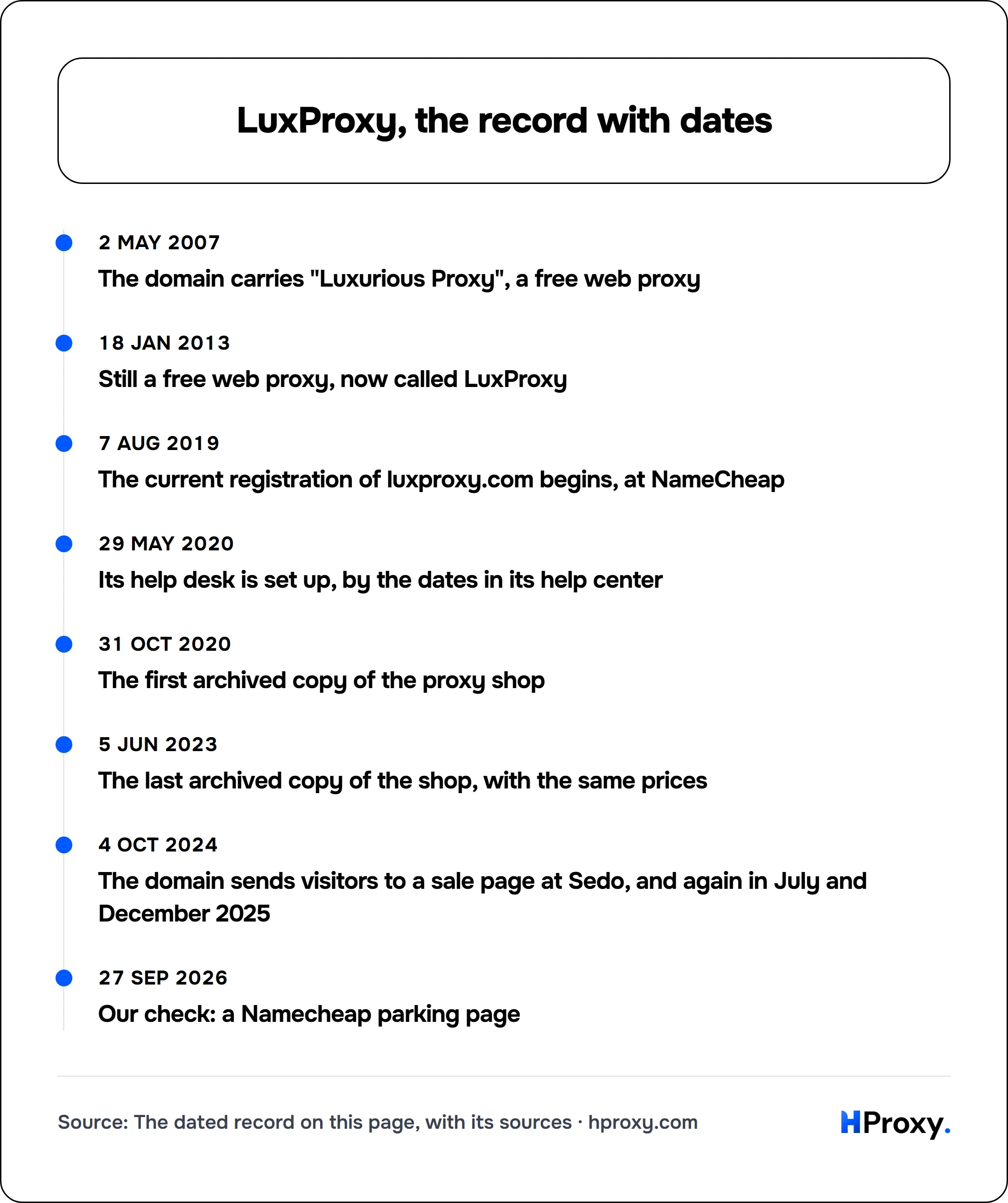
The record, with dates
| date | what happened |
|---|---|
| 2 May 2007 | The domain carries "Luxurious Proxy", a free web proxy. |
| 18 January 2013 | Still a free web proxy, now called LuxProxy. |
| 7 August 2019 | The current registration of luxproxy.com begins, at NameCheap. |
| 29 May 2020 | Its help desk is set up, by the dates in its help center. |
| 31 October 2020 | The first archived copy of the proxy shop. |
| 5 June 2023 | The last archived copy of the shop, with the same prices. |
| 4 October 2024 | The domain sends visitors to a sale page at Sedo, and again in July and December 2025. |
| 27 September 2026 | Our check: a Namecheap parking page. |
2 May 2007
The domain carries "Luxurious Proxy", a free web proxy
18 Jan 2013
Still a free web proxy, now called LuxProxy
7 Aug 2019
The current registration of luxproxy.com begins, at NameCheap
29 May 2020
Its help desk is set up, by the dates in its help center
31 Oct 2020
The first archived copy of the proxy shop
5 Jun 2023
The last archived copy of the shop, with the same prices
4 Oct 2024
The domain sends visitors to a sale page at Sedo, and again in July and December 2025
27 Sep 2026
Our check: a Namecheap parking page
Sources: the Verisign registry, the Internet Archive and our own check on 27 September 2026.
What it sold, in its last archived pages
| product | a month | what its page said |
|---|---|---|
| shared proxy | $1 to $1.50 | several users on one IP |
| private proxy | $6.99 | one user per IP, unlimited bandwidth |
| private SOCKS5 | $8.99 | one user per IP, unlimited bandwidth |
| residential IP | $13.98 | an ISP address with a physical location |
Longer terms of 3, 6 and 12 months were on offer. It claimed more than 100 locations, with no limit on threads or bandwidth. It pitched the private and residential IPs at people who run Amazon and eBay seller accounts.
It took cards, PayPal, Bitcoin, ETH and BCH through Avangate, a payment service. Its FAQ said it had no money-back guarantee, though it might replace proxies or refund an order that went wrong.
Who ran it
No company name appears on its pages. The contact was an email address, lux@mm.st. The About and Contact blocks carried template text such as "hello@yourname.com". Support ran on its own help desk, later moved to its member area. Today the member area fails a certificate check, and the help desk name no longer resolves.
What we could not check
- The day the shop closed. The archive holds no copy between June 2023 and October 2024.
- What happened to paid orders and balances when it went offline.
- Whether it trades under another name. We found no successor.
- Its network. We never used it.
What it offered that we do not
- Shared datacenter proxies at $1 a month, with several users on one IP.
Where HProxy is different
| LuxProxy, as last archived | HProxy | |
|---|---|---|
| site | gone since mid-2023 | answers today |
| private datacenter IP | $6.99 a month | dedicated IPv4 at $1.58/IP for a month |
| static residential IP | $13.98 a month | static ISP at $2.70/IP for a month |
| shortest term | a month | a week, for IPv4 and ISP |
| payment | cards, PayPal and crypto | cards, Alipay and thirty-two crypto options |
| who runs it | no company named | the company is named in our imprint |
Five alternatives, priced the same week
Every rate below comes from the price page of each vendor, read from our server on 26 or 27 September 2026.
| provider | one private datacenter IP for a month | worth knowing |
|---|---|---|
| Proxy-Cheap | $1.42 | static residential IPv4 from $2.44 a month |
| FastProxy | $1.50 | dedicated IPv4 on a 30-day term, paid in crypto only |
| Byteful | $2.50 | static residential ISP at $3.50 an IP a month |
| OwlProxy | $3.52 | dedicated IPv4 for 30 days, with no traffic limit |
| 911Proxy | $4.90 | static datacenter for 30 days, from a $10 list price |
| HProxy | $1.58/IP | dedicated IPv4 with unlimited bandwidth, static ISP at $2.70/IP |
Our reviews of Proxy-Cheap, FastProxy, Byteful, OwlProxy and 911Proxy cover their terms in full.
Which one to pick
- You used its private proxies: all five sell one dedicated IPv4 for a month. Proxy-Cheap and FastProxy cost the least that week.
- You used its residential IPs: rent a static residential or ISP address by the month. Evomi sells a private one at $2.50, Proxy-Cheap from $2.44 and Byteful at $3.50, and our static ISP costs $2.70/IP.
- You used its shared proxies: Evomi also sells a shared static residential IP at $1 a month.
Whichever seller you pick, test what you get with our free proxy checker. It checks HTTP and SOCKS proxies with no sign-up.
The limits of this record
Every LuxProxy price here comes from the Internet Archive, from October 2020 to June 2023. We never used its network, and we checked the name on 27 September 2026 from our server. If it comes back, this page is due for a rewrite; otherwise, for a check by 27 December 2026.
Sources
Read on 27 September 2026, from our server:
- The live luxproxy.com, which shows a Namecheap parking page, and our DNS checks of luxproxy.com and its member and help desk hosts.
- Verisign, registry record for luxproxy.com.
- Internet Archive: copies of luxproxy.com from 2007, 2013 and October 2020 to June 2023, its help center of October 2020, and the sale redirects of 2024 and 2025.
- Proxy-Cheap, FastProxy, Byteful, OwlProxy, 911Proxy and Evomi price pages, read on 26 and 27 September 2026.
- HProxy, our product catalogue, imprint and payment page.