911Proxy (911proxy.com) sells residential proxies, rotating and static ISP proxies, datacenter proxies and unlimited residential plans. On 27 September 2026 its residential traffic cost $2.70 a GB in the smallest plan, and its privacy policy said the company is located in mainland China. Its name is close to 911 S5, the proxy service US authorities dismantled in 2024. This page keeps the two apart, and every fact about 911 S5 comes from an official source. For the comparison, jump to the alternatives table.
911Proxy at a glance
| what we found on 27 September 2026 | |
|---|---|
| status | live, plans on sale |
| operator | no company named; "located in mainland China" |
| current site | first archived in September 2023 |
| residential | 90M+ IPs claimed, 195 countries |
| residential price | $27 for 10 GB, down to $0.88 a GB at 1,000 GB |
| ISP | by the gigabyte, or by the IP from 10 days |
| datacenter | from $2.45 for one IP for 10 days |
| trial | 512 MB, on request |
| refunds | none once a product is dispatched |
| sign-up | real-name authentication, by its privacy policy |
What 911Proxy sells
Residential proxies. A pool it puts at more than 90 million IPs in 195 countries, with targeting by country, state, city and ISP. It says there is no limit on traffic during the validity period of a plan.
Rotating ISP proxies. ISP IPs sold by the gigabyte, each valid for up to 24 hours.
Static ISP and datacenter IPs. Fixed IPs with unlimited traffic, rented for 10, 30, 60 or 90 days.
Unlimited residential and APIs. Plans billed by the day with no cap on traffic, plus a web scraper, a SERP API and a video downloader API, each with its own price page.
What 911Proxy charges
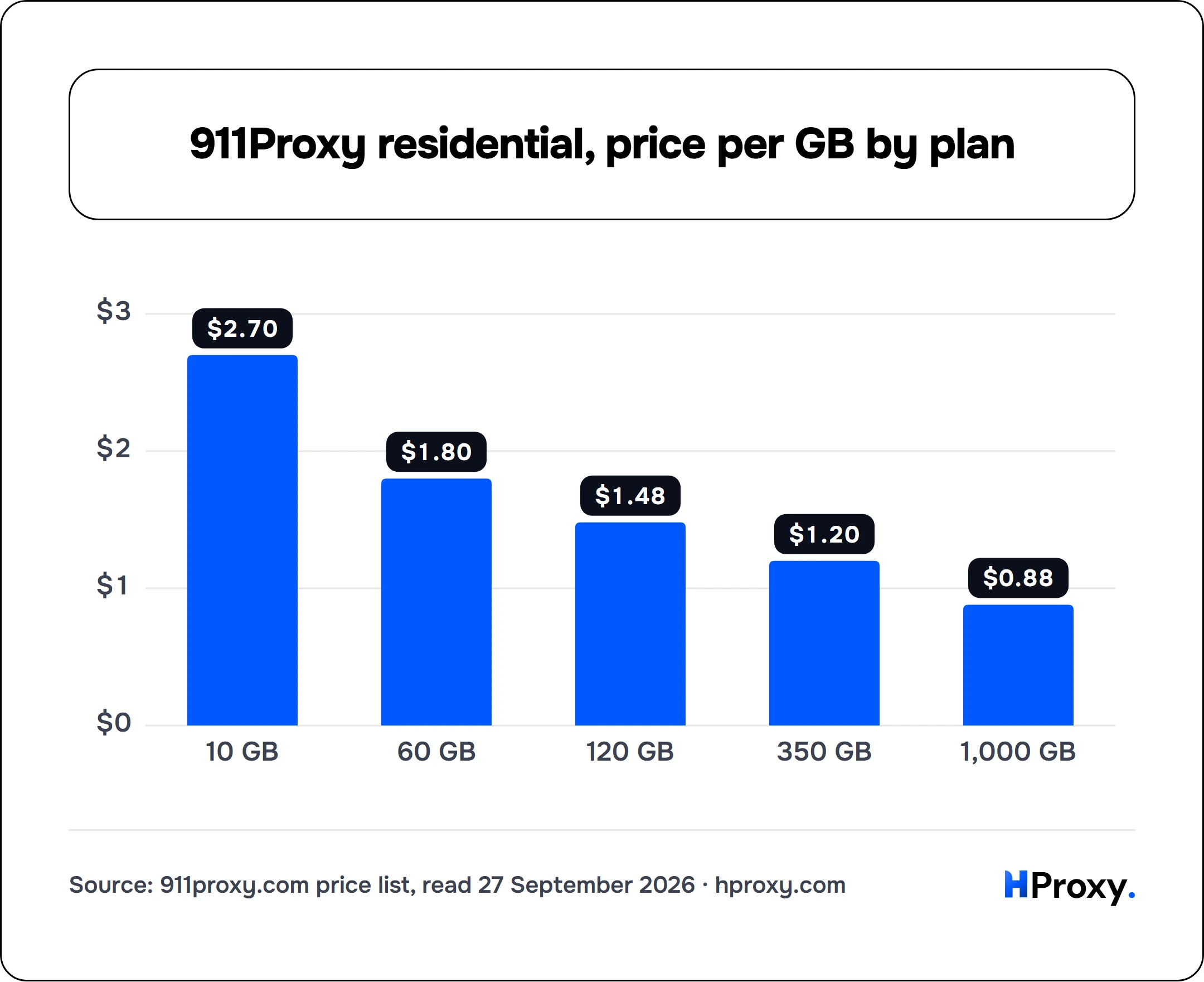
Every price below comes from its price pages, read on 27 September 2026, and most plans show a discount against a higher list price.
| residential plan | total | per GB |
|---|---|---|
| 10 GB | $27.00 | $2.70 |
| 60 GB | $108.00 | $1.80 |
| 120 GB | $178.00 | $1.48 |
| 350 GB | $420.00 | $1.20 |
| 1,000 GB | $880.00 | $0.88 |
Rotating ISP traffic costs $15 for 10 GB and $200 for 300 GB, or $0.67 a GB. A static ISP IP costs $3.50 for 10 days, $6.90 for 30 days and $15 for 90 days. A datacenter IP costs $2.45 for 10 days and $4.90 for 30 days. Unlimited residential starts at $85.43 a day on a 30-day plan, a total of $2,562.99.
The fine print
No refunds, a small trial. Its refund policy says: "Once an order is placed, and the product is dispatched, refunds will not be issued." It adds that "All payments are considered final", so the 512 MB free trial it offers through its contacts is the way to test first.
Real-name sign-up. Its privacy policy asks for "real-name authentication" with details that include a name, a QQ number, bank account information and business registration.
Who you deal with. No company name appears on the pages we read. The privacy policy says: "911Proxy is located in mainland China."
The name, and what happened to 911 S5
The domain 911proxy.com is older than the current shop: in 2016 it carried a proxy list site, and in January 2022 it was offered for sale. The current 911Proxy site first appears in the Internet Archive in September 2023.
911 S5 was a different name. On 29 May 2024 the US Justice Department announced that an international operation had dismantled the 911 S5 botnet. It said YunHe Wang was arrested on 24 May on charges of creating and running the service. According to the release, Wang and others allegedly built the network from malware on millions of Windows computers, linked to more than 19 million IP addresses, from 2014 through July 2022. The Treasury sanctioned Wang and two others the day before, and the FBI published guidance for victims.
None of those three official releases names 911proxy.com, and we found no source that connects 911Proxy to 911 S5. Our page on 911 S5 covers that takedown in more detail.
Where 911Proxy is stronger
Cheap ISP traffic at volume. Rotating ISP proxies at $0.67 a GB in the 300 GB plan.
Short rentals. Static ISP and datacenter IPs for 10 days, not only by the month.
Unlimited plans. Residential traffic with no cap, billed by the day.
Where HProxy differs
We sell proxies too, so read this part as the account of a competitor. Every HProxy fact here comes from our own product code and pages.
One gigabyte, city targeting. Premium, our pool with state, city and ISP targeting, costs $1.49/GB for one gigabyte, against $27 for the smallest 911Proxy plan. It falls to $1.00/GB from 1,000 GB+.
By country for less. Our Lite pool targets by country at $0.50/GB for one gigabyte, and purchased residential gigabytes have no scheduled expiry date.
Static addresses by the month. A dedicated ISP address costs $2.70/IP for a month, against $6.90 for 30 days at 911Proxy. Datacenter IPv4 costs $1.58/IP for a month.
A named company, no documents. Our imprint names the company behind HProxy, and we ask for no documents at sign-up or at an ordinary checkout.
Where we are behind. From 1,000 GB its residential rate of $0.88 a GB is below our Premium floor, and we sell no unlimited plans by the day and no rentals shorter than a week.
The alternatives, side by side
Residential proxies with city targeting, at the smallest buy. Every figure comes from the page of each vendor, read on 26 or 27 September 2026.
| provider | smallest buy | per GB at that size |
|---|---|---|
| 911Proxy | 10 GB for $27 | $2.70 |
| GloryCloud | 1 GB for $7 | $7.00 |
| Shifter | 5 GB for $10 | $2.00 |
| DataImpulse | 5 GB for $5 | $2.00 with city filters |
| NST Prime | 50 GB | $1.60 |
| HProxy Premium | 1 GB | $1.49/GB |
Our reviews of GloryCloud, Shifter, DataImpulse and NST cover their terms in full.
Who 911Proxy suits
It suits a buyer who wants rotating ISP traffic in bulk, static IPs for ten days, or unlimited residential traffic by the day, and who accepts no refunds and real-name sign-up.
It suits you less if you want a refund when a plan disappoints, a company you can name, or a single gigabyte to test.
Before you commit
Ask for the 512 MB trial first and test it on your own target. Read the refund policy before paying, since all payments are final. Our proxy checker shows whether an address answers, how fast, and from where, whoever sold it.
The limits of this review
We did not test the 911Proxy network. Every price and rule here comes from its own pages as they stood on 27 September 2026, and its pool size is its own claim. The facts on 911 S5 come only from the Justice Department, Treasury and FBI releases of May 2024, read in archived copies, and this page adds nothing beyond them.
Every figure here carries the day it was read, and this page is due for a check by 27 December 2026.
Sources
- 911Proxy, 911proxy.com: homepage, price pages for residential, rotating ISP, static ISP, datacenter and unlimited proxies, refund policy and privacy policy. Read 27 September 2026.
- Internet Archive, copies of 911proxy.com from January 2016, November 2020, January 2022, September 2023 and January 2024.
- US Department of Justice, "911 S5 Botnet Dismantled and Its Administrator Arrested in Coordinated International Operation", 29 May 2024.
- US Department of the Treasury, "Treasury Sanctions a Cybercrime Network Associated with the 911 S5 Botnet", 28 May 2024.
- FBI Internet Crime Complaint Center, "Guidance on the 911 S5 Residential Proxy Service", 29 May 2024.
- Verisign, registry record for 911proxy.com. Read 27 September 2026.
- GloryCloud, Shifter, DataImpulse and NST, residential price pages. Read 26 and 27 September 2026.
- HProxy, our imprint, our own product records, price table and terms.