
Cyber Gateway (cyber-gateway.net) rents lists of shared datacenter IPv4 addresses by the month: 300 addresses cost $35 to $39, and the largest list, 50,000 addresses, starts at $3,899. Its prices have risen a long way. The list of about 15,000 addresses cost $255 for 30 days in May 2017 and has cost $1,099 a month since October 2024. Its pages name "Cyber Gateway Net, Pte." with an address on a Singapore university campus, and the one Singapore company of that name in the register copy we read was struck off. Webshare sells the same kind of shared list for less than a third of the price per address. The comparison below sets the three sellers side by side.
What Cyber Gateway sells
The core product is a static list of shared addresses, billed by the month with no traffic limit. Mixed lists come in nine sizes, from 300 addresses in one region to 50,000 across "40+ countries". Country lists, in sizes of 300, 600 and 1,000, cover fourteen countries, among them Germany, the Netherlands, Japan, Russia, Turkey and the United Kingdom. Since 1 November 2024 an "experimental" plan has sold 100 addresses in Pakistan for $25. A free test account runs for 30 minutes "with 50 IPs in the pool".
Its terms list the rest of the range: "Personal (dedicated) proxy servers", lists with UDP support, "Rotating (back-connect) proxy servers" and virtual servers. A list works in two ways. Bound to your own IP address, it answers on port 8085 for HTTP and 1085 for SOCKS; with a login, on ports 8080 and 1080.
The site's own numbers do not agree with each other. The homepage promises servers "in datacenters of 50+ countries" and, further down, servers that "span across 27 countries"; the price page, in its copy archived on 9 October 2026, says "40+ countries". The pool is "64K+ Shared Datacenter IP addresses" on the homepage and "75,000 IPs" on the price page. Its hardware page says the company uses "hardware servers only" and never "bot-net".
Until at least January 2023 the homepage title read "Cyber Gateway - Anonymous proxy service"; by January 2026 it read "Buy Fast Datacenter Proxies | From $0.07/IP". Interest in the name has fallen this year: Google counted 1,900 searches for "cyber-gateway.net" in December 2025 and 30 in August 2026.
What it costs, and how the prices rose
Its price page has changed many times, and the Internet Archive kept copies of most versions. The list of about 15,000 addresses appears in every one we read.
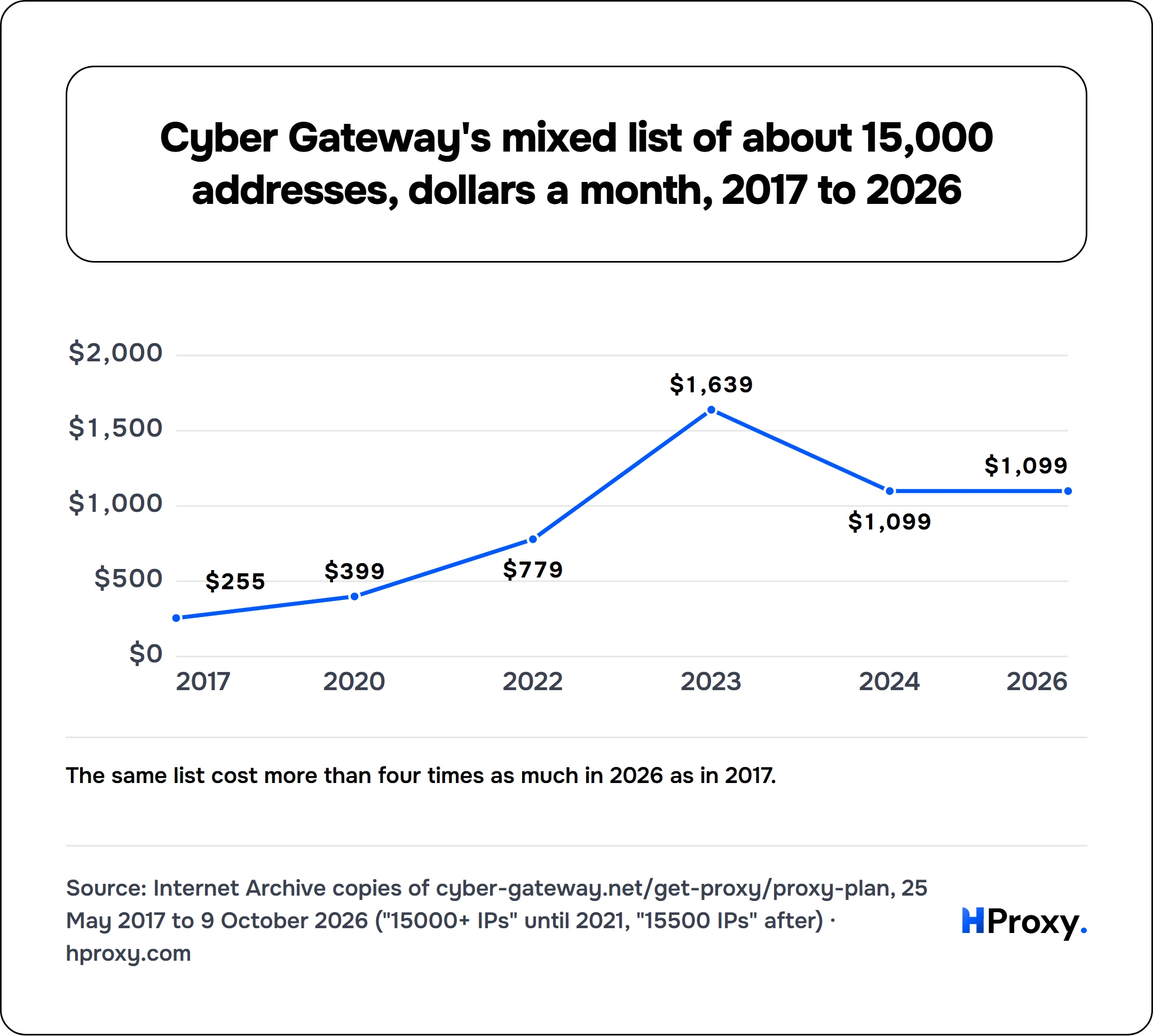
The small lists rose further. In May 2017 a list of 5,000 or more addresses cost $45 for 30 days; by October 2020 it was $121, or $99 on offer, and in 2026 a list of 5,500 starts at $449. A mixed list of 900 has cost $99 a month since October 2023. The range has moved up as well: in 2017 the smallest list held 10 addresses for $8 for 30 days and 200 cost $20, while the smallest list of 2026 holds 300 and costs $35.
| list | price a month | per address |
|---|---|---|
| 300 addresses in Asia | $35 | $0.117 |
| 300 in Europe | $39 | $0.13 |
| 500, mixed | $69 | $0.138 |
| 900, mixed | $99 | $0.11 |
| 2,500, mixed | $249 | $0.0996 |
| 5,500, mixed | $449 | $0.082 |
| 15,500, mixed | $1,099 | $0.071 |
| 25,000, mixed | $2,499 | $0.10 |
| 50,000, mixed | $3,899 | $0.078 |
These are the starting prices of the copy archived on 9 October 2026. The cheapest address in the table comes in the list of 15,500, which matches the "From $0.07/IP" in the homepage title. A list of 25,000 costs more per address than the smaller list of 15,500, and the 50,000 list sits between the two.
What its terms say
Refunds within 24 hours. The refund policy promises "a 24-hour money-back guarantee from the time of purchase", then warns that "more than three within a single month" may be refused. After 24 hours an order can be cancelled for "a credit for unused funds on your internal balance", once every three days.
A fee for every complaint. Its acceptable use page charges a fee "for processing each complaint" about a customer's traffic: $39 from 1 January 2024 and $50 from 20 April 2026, payable within three days, with the service restored only after payment. It adds that "Claims of compromised servers" are no grounds for exemption.
A face check for card payments. Since 15 March 2025 card payments through Stripe, Paystack and Payselection need "face verification through the 'Sumsub' platform", recorded "in video mode". Customers who ordered before that date are exempt. The rule names only those three processors; the list of payment methods also holds crypto and e-wallets.
Limits on connections. Traffic is unlimited, but a list of up to 799 addresses allows 600 threads, larger lists one to three threads per address, and a customer who goes over is slowed "by a factor of 10 for a period of one hour".
One account per person. The terms forbid "Multi-accounting" and say the company may detect it by "device fingerprinting, IP analysis, and other verification techniques".
Who runs it
The site names a company in three slightly different ways. The footer reads "Cyber Gateway Net, Pte." beside the years 2015-2026, the terms speak of "The Cyber Gateway Pte. company", and the legal page puts the site's copyright "under the laws of Singapore". The contact page gives the head office as the Data Storage Institute, "DSI Building, 5 Engineering Drive 1", on Kent Ridge Crescent, the campus of the National University of Singapore. That address has stood on the page since at least January 2018.
The legal page shows where some of its text came from. In 2021 it read: "The University's crests and logos should never be removed from pages on which they originally appear." In October 2026 it still asks that "The University's webpages should always appear exactly as posted".
OpenCorporates holds one Singapore company with the name: CYBER GATEWAY PTE. LTD., number 200516987C, "Struck Off", registered at 16 Tai Seng Street with industry codes for hardware consultancy and systems integration. Its address differs from the website's, and we found no record that links the two. The team page dates the business to 2007, when "two friends realized that there was still much to be desired on the Internet market"; the domain was registered on 11 January 2015, and the archive's first copy of the site is from the same month.
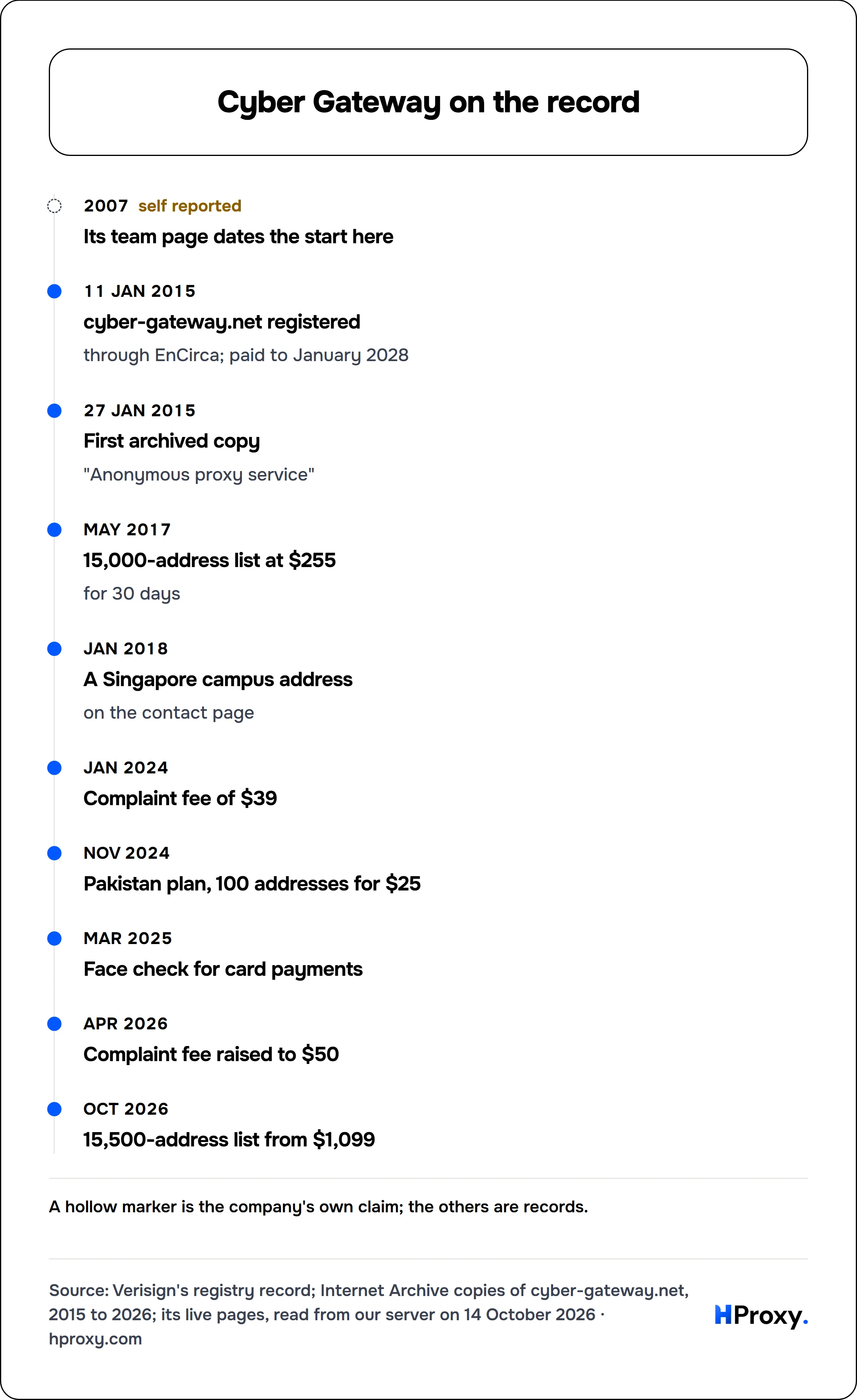
2007self reported
Its team page dates the start here
11 Jan 2015
cyber-gateway.net registered
through EnCirca; paid to January 2028
27 Jan 2015
First archived copy
"Anonymous proxy service"
May 2017
15,000-address list at $255
for 30 days
Jan 2018
A Singapore campus address
on the contact page
Jan 2024
Complaint fee of $39
Nov 2024
Pakistan plan, 100 addresses for $25
Mar 2025
Face check for card payments
Apr 2026
Complaint fee raised to $50
Oct 2026
15,500-address list from $1,099
Its sitemap still carries pages of the website template it was built on, such as "module-positions" and "menu-options", and the archive holds hundreds of generated pages with addresses like "proxy-server-illegal-in-texas" and "monaco-proxy-low-price".
How it compares
A shared list is the cheapest kind of datacenter proxy, and the price per address falls as the list grows. At about 5,000 addresses, the three sellers we read compare like this:
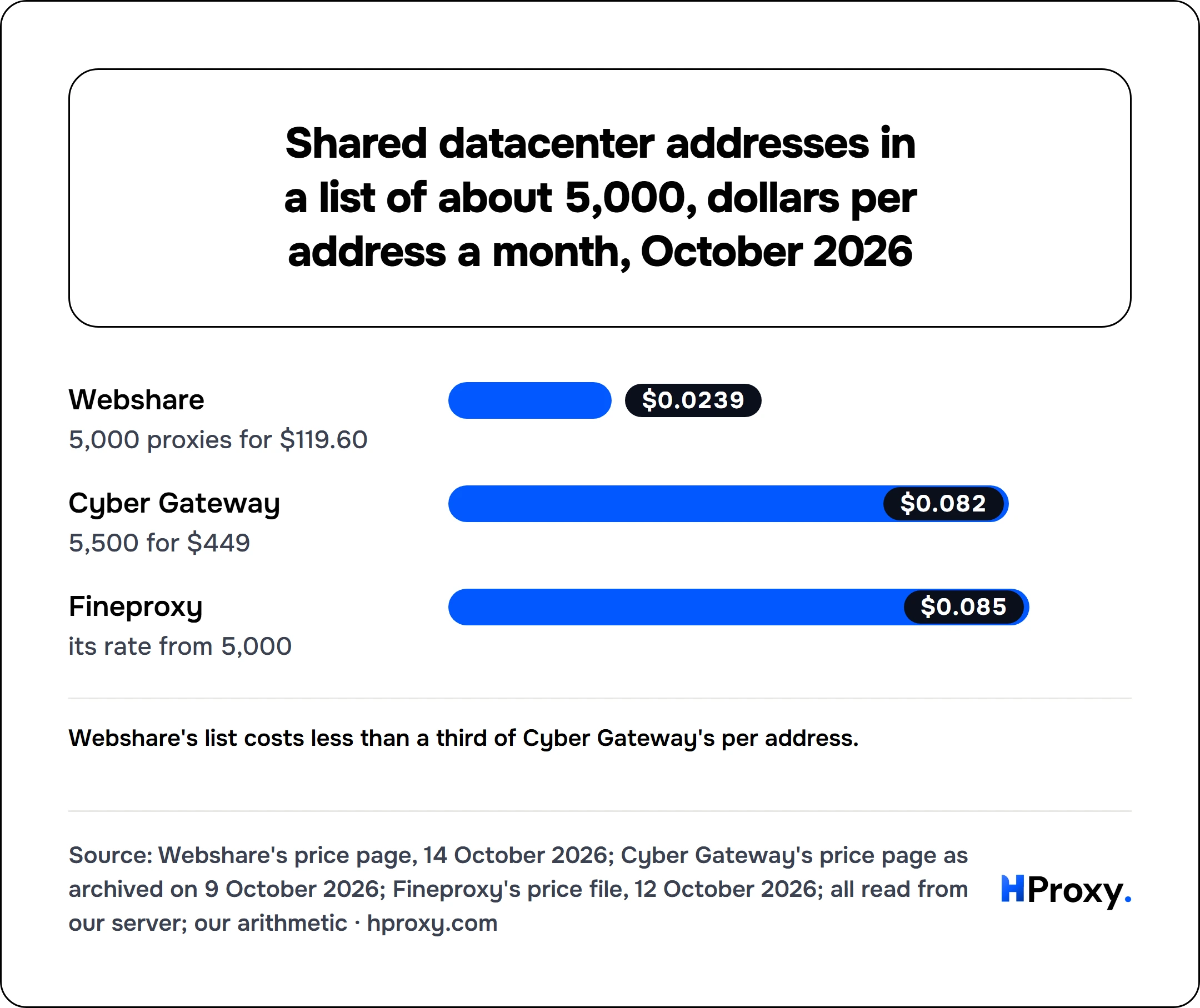
Webshare sells its "Proxy Server" plans at $2.99 a month for 100 proxies, $26.91 for 1,000 and $119.60 for 5,000, with 10 proxies free. Fineproxy, which sells the same kind of shared block by the month, charges $0.111 an address from 1,000 and $0.07 from 15,000, close to Cyber Gateway's prices. For addresses that belong to one buyer, Rayobyte lists datacenter IPs "from $0.85 /IP a month".
Where HProxy fits
We sell datacenter IPv4 addresses one at a time, at $1.58 per IP for a month, each kept for one buyer. That costs more per address than any shared list above, and it suits work where an address must not be shared with strangers. For thousands of shared addresses, the list sellers above are cheaper.
Which one to pick
- Webshare for the lowest price per shared address, and 10 free proxies to test first.
- Fineproxy for shared blocks by the month at prices close to Cyber Gateway's, with a published price file.
- Cyber Gateway for lists from a single country among its fourteen, or for its free 30-minute test.
- A per-address seller, Rayobyte or us, when one address must belong to one account.
What we could not find out
We do not know who runs Cyber Gateway: no register entry we could read matches its name and address, and its team page offers names only. We bought nothing and tested no address, so speed and block rates remain its claims. Its terms forbid "parsing" its content, so after one reading of thirteen of its pages on 14 October 2026 we took the rest from the Internet Archive. The country plans' prices are set by a selector on the page, which we did not run. We will check these records again by 14 January 2027.
Sources
- cyber-gateway.net: home, price-by-country, support, terms, privacy, acceptable use, payment methods, contacts, team, hardware and mission pages, its robots file and sitemap, read from our server on 14 October 2026.
- The Internet Archive's copies of cyber-gateway.net: homepages from 2015 to 2026, contact pages from 2015 to 2023, the price-plan page from 2015 to 9 October 2026, and the legal page of June 2021.
- Verisign's registry record of cyber-gateway.net, 14 October 2026.
- OpenCorporates: CYBER GATEWAY PTE. LTD. (Singapore, 200516987C), read 14 October 2026.
- Webshare's price page, read from our server on 14 October 2026; Fineproxy's price file and Rayobyte's product list, read on 12 and 14 October 2026.
- HProxy's IPv4 price: our live price table, 14 October 2026.
- Google Keyword Planner, worldwide: monthly searches for cyber-gateway.net, read 14 October 2026.