Byteful (byteful.com) is the new name of Ping Proxies, a proxy seller run by Ping Technology Labs LTD in Manchester, England. On 27 September 2026 its residential traffic cost $3.25 a GB up to 24 GB, falling to $1.75 from 5,000 GB, and that traffic never expires. It also sells static ISP, datacenter and mobile proxies. Refunds are possible within 24 hours, once. The alternatives table prices five sellers, read the same day.
The record, with dates
| date | what happened |
|---|---|
| April 2019 | First archived page of pingproxies.com: "Ping Proxies". |
| November 2022 | Its page offers access to a "115+ Million proxy network". |
| 1 March 2026 | Last archived page under the Ping Proxies name. |
| 8 April 2026 | The rename to Byteful, as dated by a third party. |
| 27 September 2026 | Our check: pingproxies.com forwards to byteful.com, with the prices below. |
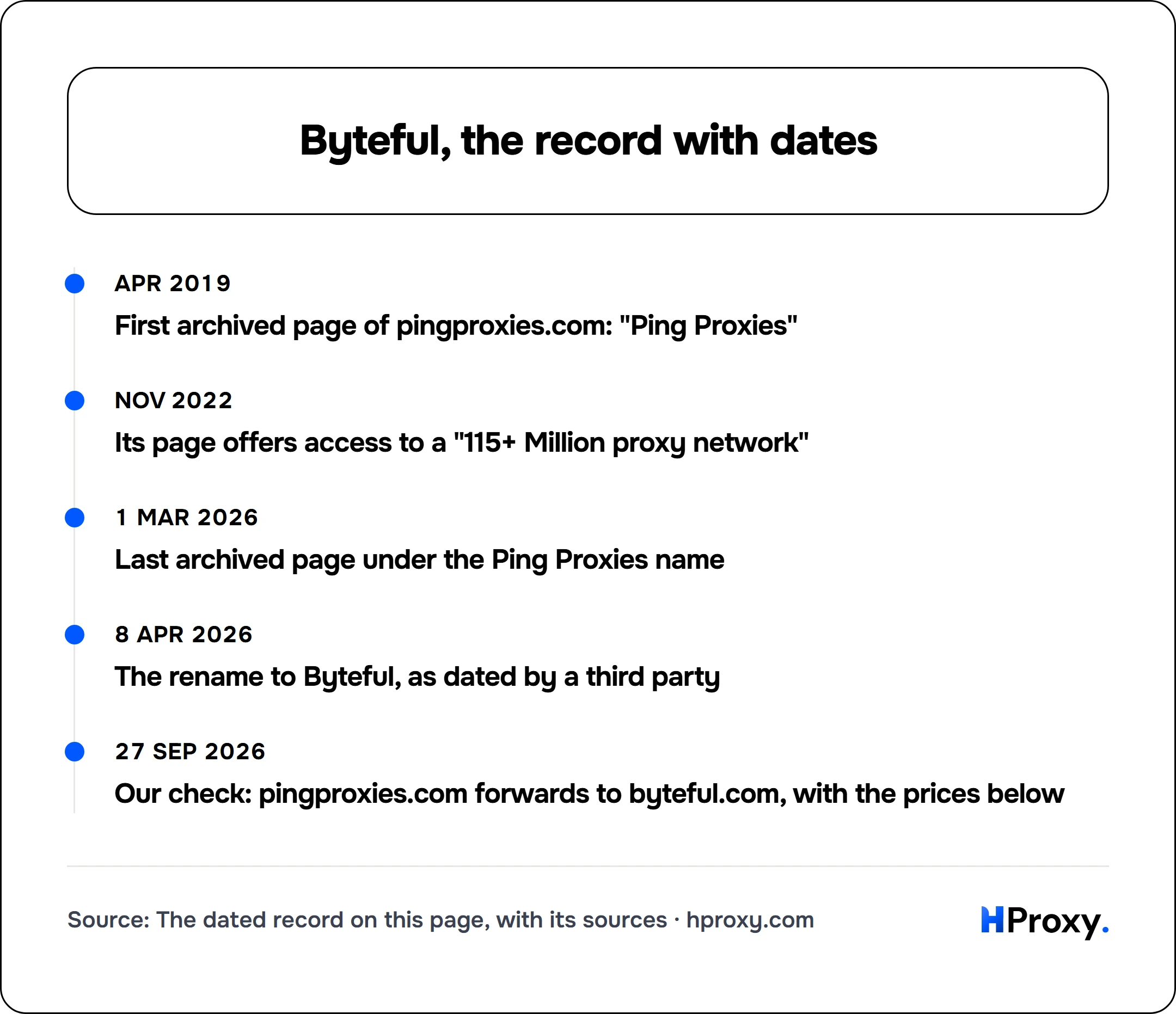
Apr 2019
First archived page of pingproxies.com: "Ping Proxies"
Nov 2022
Its page offers access to a "115+ Million proxy network"
1 Mar 2026
Last archived page under the Ping Proxies name
8 Apr 2026
The rename to Byteful, as dated by a third party
27 Sep 2026
Our check: pingproxies.com forwards to byteful.com, with the prices below
Sources: the Internet Archive, the Byteful terms, a dated third-party page and our own check.
What it sells, and what it costs
| product | smallest order | middle | largest tier |
|---|---|---|---|
| residential, per GB | $3.25 a GB, up to 24 GB | $2.75 from 100 GB | $1.75 from 5,000 GB |
| mobile, per GB | $4.25 a GB, up to 24 GB | $3.45 from 100 GB | $2.25 from 5,000 GB |
| static ISP, per IP a month | $3.50 for one IP | $2.75 from 100 IPs | $2.25 from 1,000 IPs |
| datacenter, per IP a month | $2.50 for one IP | $1.60 from 100 IPs | $1.40 from 1,000 IPs |
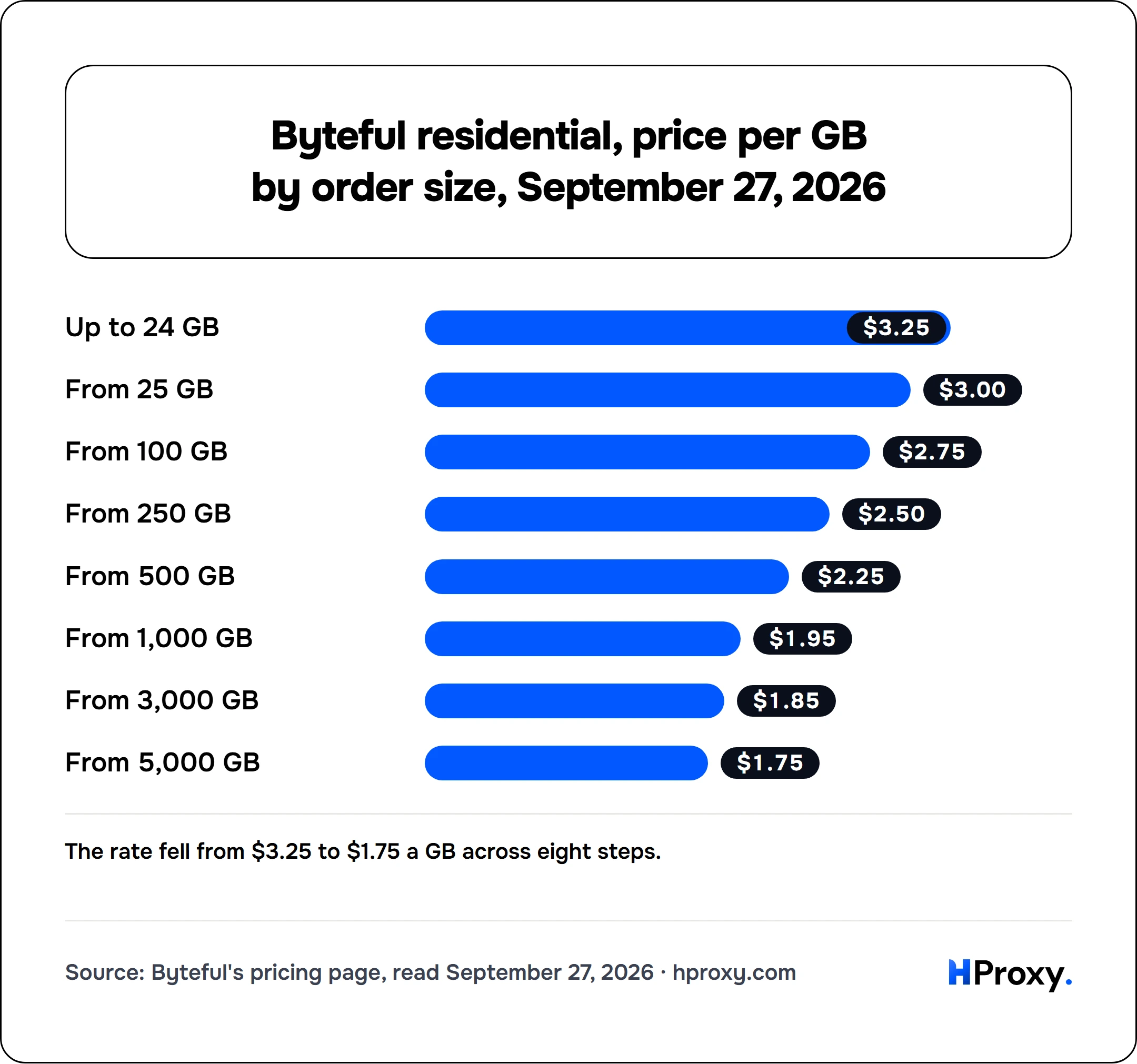
Between those steps, residential costs $3.00 from 25 GB, $2.50 from 250 GB, $2.25 from 500 GB, $1.95 from 1,000 GB and $1.85 from 3,000 GB. IP products are 10% off when you pay by the quarter and 20% off by the year.
Its residential line includes city targeting and sticky sessions of up to 24 hours. Static ISP IPs sit on networks such as Comcast, Spectrum, AT&T and DTAG. It claims 35 million+ residential IPs in 195+ countries.
The fine print
- Traffic. Residential bandwidth "never expires", even if you cancel or pause a subscription.
- Refunds. Within 24 hours, only if you used no more than 2 GB or 25% of the plan, and "one refund during their lifetime". The terms add that sales are otherwise "final and non-refundable".
- The trial. The homepage shows a free trial button; the pricing FAQ says there is none. A review of August 2026 describes a 1 GB trial after an identity check.
- Payment. Cards through Stripe, Apple Pay, Google Pay and crypto. Bank transfers are for top-ups over $1,000.
- The company. Ping Technology Labs LTD, England and Wales, company 12699144. English law applies.
Where Byteful is the stronger choice
- A named UK company with a public company number, under English law.
- Static ISP IPs on named US networks, down to $2.25 an IP from 1,000 IPs.
- Datacenter IPs by the month, from $2.50 and down to $1.40.
- City targeting included in the residential rate, on traffic that never expires.
Where HProxy is different
| Byteful, 27 September 2026 | HProxy | |
|---|---|---|
| smallest residential purchase | $3.25 a GB, any size up to 24 GB | 1 GB of Lite at $0.50/GB |
| city targeting, a few GB | $3.25 a GB | Premium at $1.49 for one GB |
| city targeting at volume | $1.95 a GB from 1,000 GB | Premium at $1.00 per GB at 1,000 GB+ |
| country targeting at volume | $1.75 a GB from 5,000 GB | $0.44/GB at 2,000 GB+ |
| does traffic expire | never | never: the balance does not expire |
| refunds | 24 hours, 2 GB or 25%, once | a public refund policy |
| one static IP | $3.50 a month | static ISP at $2.70/IP per month |
| mobile | $4.25 a GB, up to 24 GB | $1.50 per GB, 1 GB minimum |
| payment | cards, Apple Pay, Google Pay, crypto | card, Alipay, crypto and local wallets |
Both sellers keep residential traffic without expiry. The gap sits in the price of each GB, which the table shows at each size.
Five alternatives, priced the same day
Every rate below comes from each vendor pricing page, read from our server on 27 September 2026. A rate you cannot reach is not a price.
| provider | entry rate | lowest published rate | worth knowing |
|---|---|---|---|
| DataImpulse | $1 per GB: 5 GB for $5, for new users | $0.80 per GB at 1 TB for $800 | Traffic never expires. State, city, ZIP and ASN filters count at double the rate. |
| Evomi | $0.99 per GB pay as you go, from 15 GB | $0.49 per GB on the 100 GB plan at $49 a month | Pay-as-you-go data has no expiry. |
| Webshare | $3.50 for 1 GB a month, half a $7 list price | $1.40 per GB: 3,000 GB for $4,200 a month | Monthly traffic does not roll over. |
| SOAX | $5 per GB on the free Sandbox plan, tier 1 | from $0.85 per GB on the $3,000 a month plan | Credits on Sandbox and monthly plans expire after 60 days. |
| HProxy | $0.50/GB for 1 GB of Lite, country targeting | $0.44/GB at 2,000 GB+ | City and ISP targeting on Premium: $1.49 for one GB. |
Which one to pick
- You want static ISP or datacenter IPs by the month from a named UK company: Byteful is a sound fit.
- You buy residential traffic a few GB at a time: a seller that sells 1 GB, such as our Lite at $0.50/GB.
- You need city or ISP targeting from one GB: our Premium pool at $1.49 for one GB.
- You used Ping Proxies before: your provider is still there, under the Byteful name.
Whichever seller you pick, test what you get with our free proxy checker. It checks HTTP and SOCKS proxies with no sign-up.
The limits of this record
We did not buy from Byteful, so nothing here measures its network. Its pool size is its own claim. The trial question stays open: the homepage and the FAQ disagree. The rename date comes from a third party, and the archive brackets it between March and August 2026. This page is due for a check by 27 December 2026.
Sources
Read on 27 September 2026, from our server:
- Byteful: the homepage, the pricing page and its price data, the terms and the refund policy.
- Internet Archive: captures of pingproxies.com from 2019 to 2026 and of byteful.com from August 2026.
- IPFighter, its Byteful review, and mobileproxies.org, its page on Ping Proxies.
- DataImpulse, Evomi, Webshare and SOAX pricing pages, the DataImpulse targeting docs and the Webshare help center.
- HProxy, our product catalogue and our legal and payment pages.