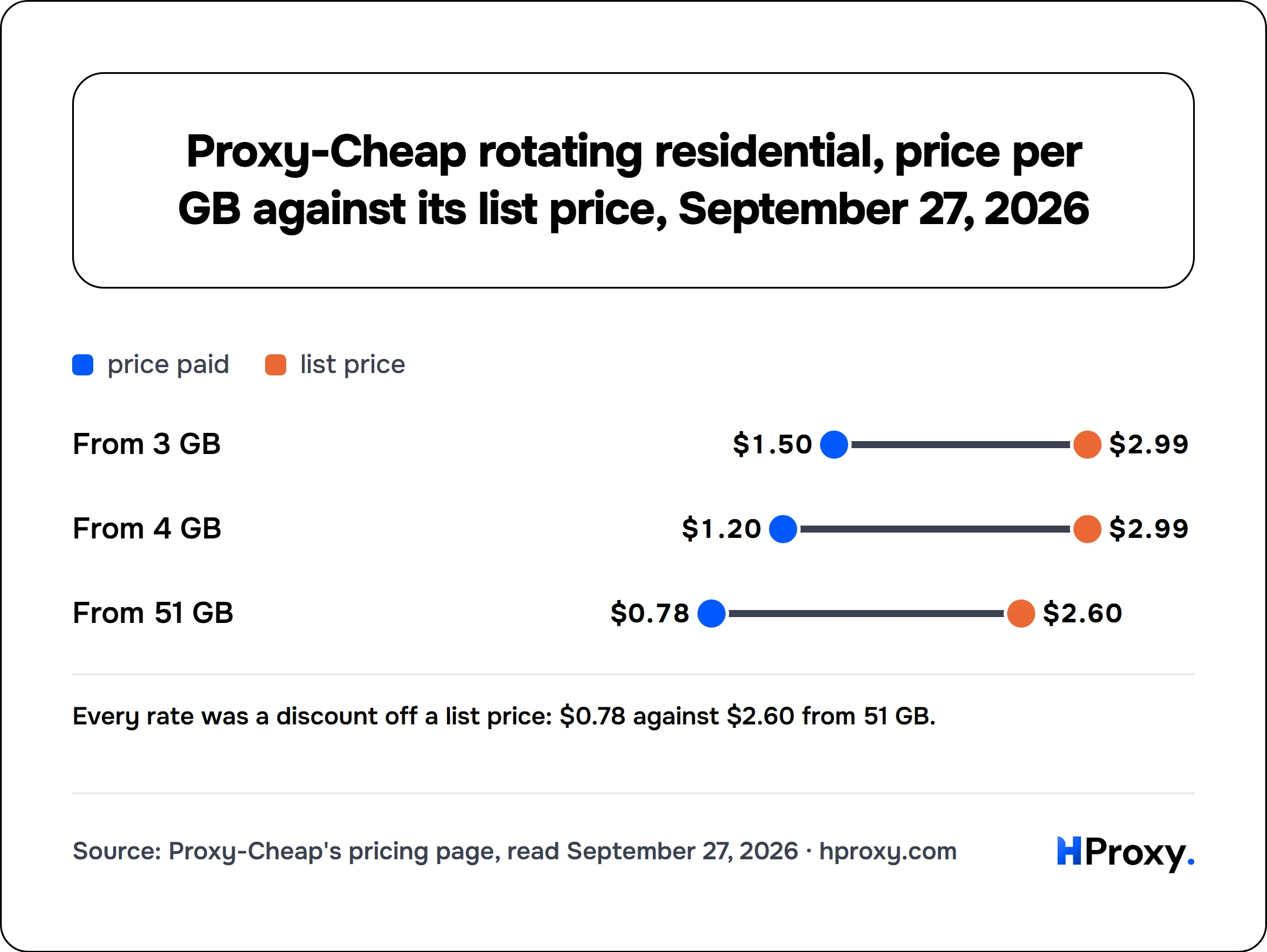
Proxy-Cheap (proxy-cheap.com) has sold proxies since at least 2019. On 27 September 2026 its rotating residential proxies cost $1.50 a GB from 3 GB, $1.20 from 4 GB and $0.78 from 51 GB. Each rate is a discount off a list price of $2.99 or $2.60. It also sells mobile, static residential and datacenter proxies, most of them per IP by the month. The alternatives table prices five sellers, read the same day.
Who runs Proxy-Cheap, who it is connected to and how it began: our Proxy-Cheap company page.
The record, with dates
| date | what happened |
|---|---|
| 13 November 2018 | The domain proxy-cheap.com is registered. |
| May 2019 | First archived page: "Cheap Proxies - Buy Cheap Proxy from $0.30". |
| 16 February 2024 | Current terms: Delaware law, courts in Wilmington. |
| 22 May 2024 | Current refund policy. |
| 14 August 2025 | Archived Trustpilot page: 3.8 from 716 reviews. |
| 27 September 2026 | Our check: the site is live, and the prices below apply. |
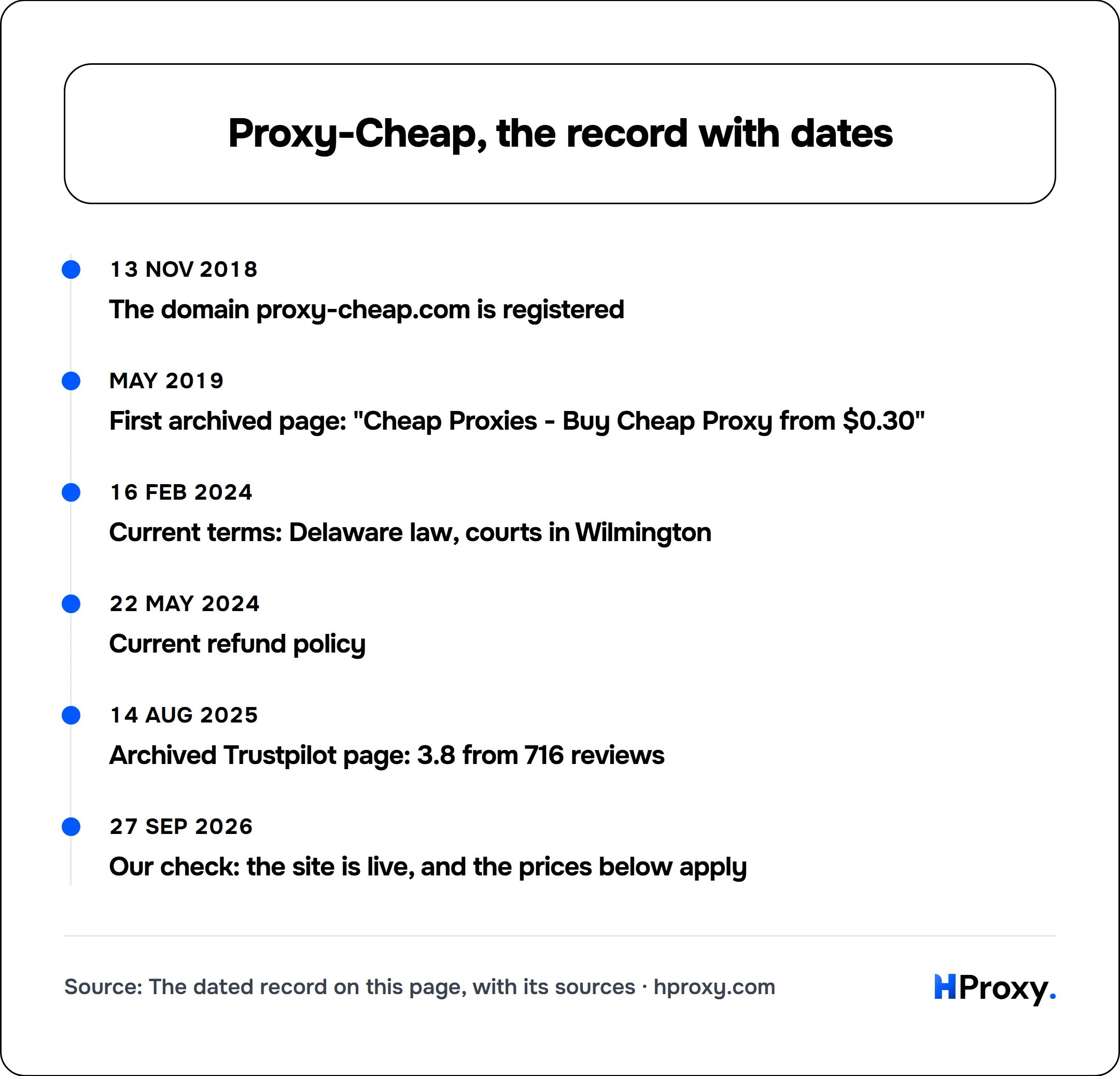
13 Nov 2018
The domain proxy-cheap.com is registered
May 2019
First archived page: "Cheap Proxies - Buy Cheap Proxy from $0.30"
16 Feb 2024
Current terms: Delaware law, courts in Wilmington
22 May 2024
Current refund policy
14 Aug 2025
Archived Trustpilot page: 3.8 from 716 reviews
27 Sep 2026
Our check: the site is live, and the prices below apply
Sources: the Verisign registry, the Internet Archive, the Proxy-Cheap terms and our own check.
What it sells, and what it costs
| product | how it is sold | price on 27 September 2026 |
|---|---|---|
| rotating residential | per GB | $1.50 from 3 GB, $1.20 from 4 GB, $0.78 from 51 GB |
| rotating mobile | per GB | $5.99 at every size |
| static residential, IPv4 | per IP, per month | Basic $2.71, Standard $2.44, 7-day trial $1.99 |
| static residential, IPv6 | per IP, per month | $0.63, down to $0.52 at 500 |
| datacenter, IPv4 | per IP, per month | Basic $1.42, Standard $1.49, 7-day trial $1.13 |
| datacenter, IPv6 | per IP, per month | $0.18, down to $0.15 at 500 |
| dedicated mobile | per IP | $39.51 for a month, $23.84 a month over a year |
- price paid
- list price
The residential list price is $2.99 below 51 GB and $2.60 from 51 GB. The Standard plans show 15% off, at $2.87 and $1.75 before the discount.
Its residential page lists country and city targeting and sticky sessions, over HTTP, HTTPS and SOCKS5. It claims "80M+" residential IPs and "155M+" IPs in all. The country count moves from page to page: 130+ on the menu, 180+ on the homepage, 195+ in one page title. Static residential IPs come with unlimited traffic, and you can pick the country and the ISP.
The fine print that decides the bill
- The 50 GB cap. Top-ups run from 1 GB to 50 GB a month, while the $0.78 rate starts at 51 GB. The pages do not say how the two rules meet. For plan limits, its FAQ says to contact "your dedicated account manager".
- The discount. Every residential rate is 50% to 70% off the list price. A discount is part of the price, and it can end.
- Refunds. A full refund if the service is not delivered. Bandwidth plans qualify only if "no more than 20%" of the traffic was used. Plans that run for a set time qualify within 3 days, renewals within 24 hours.
- The balance. It "can be refunded only if the account is permanently closed", and not at all if a required KYC check fails.
- Payments. Visa, Mastercard, Maestro, American Express, PayPal, Alipay and crypto through CoinGate. An older answer on the same page adds wire transfers in dollars and euros.
- Static prices. The plans show $2.71 (Basic) and $2.44 (Standard), and one line says "as low as $1.27". Check the cart before you pay.
- The company. The terms apply Delaware law and name courts in Wilmington. They mention "its parent company" but name no company.
Where Proxy-Cheap is the stronger choice
- City targeting at mid volume. Its $0.78 a GB from 51 GB is below our Premium rate of $1.00 per GB at 1,000 GB+.
- Static IPs by ISP, with a paid 7-day trial at $1.99 before a full month.
- Payment by PayPal, which we do not take.
- A long record: the same name since at least 2019, on a domain from 2018.
Where HProxy is different
| Proxy-Cheap, 27 September 2026 | HProxy | |
|---|---|---|
| smallest residential order | the ladder starts at 3 GB, $1.50 a GB | 1 GB of Lite at $0.50/GB |
| does traffic expire | not stated on the pages we read | never: the balance does not expire |
| city targeting, a few GB | $1.50 a GB from 3 GB | Premium at $1.49 for one GB |
| city targeting at volume | $0.78 a GB from 51 GB | Premium at $1.00 per GB at 1,000 GB+ |
| country targeting at volume | $0.78 a GB from 51 GB | $0.44/GB at 2,000 GB+ |
| one static IP | $2.44 to $2.71 a month | static ISP at $2.70/IP per month |
| mobile | $5.99 a GB | $1.50 per GB, 1 GB minimum |
| payment | cards, PayPal, Alipay, crypto | card, Alipay, crypto and local wallets such as Pix |
Proxy-Cheap lists city targeting on its residential page, and the pages we read show no extra charge for it. The clearest difference is the entry. Proxy-Cheap publishes its ladder from 3 GB, while we sell a single GB, and our balance never runs out.
Five alternatives, priced the same day
Every rate below comes from each vendor pricing page, read from our server on 27 September 2026. A rate you cannot reach is not a price.
| provider | entry rate | lowest published rate | worth knowing |
|---|---|---|---|
| DataImpulse | $1 per GB: 5 GB for $5, for new users | $0.80 per GB at 1 TB for $800 | Traffic never expires. State, city, ZIP and ASN filters count at double the rate. |
| Evomi | $0.99 per GB pay as you go, from 15 GB | $0.49 per GB on the 100 GB plan at $49 a month | Pay-as-you-go data has no expiry. |
| Webshare | $3.50 for 1 GB a month, half a $7 list price | $1.40 per GB: 3,000 GB for $4,200 a month | Monthly traffic does not roll over. |
| SOAX | $5 per GB on the free Sandbox plan, tier 1 | from $0.85 per GB on the $3,000 a month plan | Credits on Sandbox and monthly plans expire after 60 days. |
| HProxy | $0.50/GB for 1 GB of Lite, country targeting | $0.44/GB at 2,000 GB+ | City and ISP targeting on Premium: $1.49 for one GB. |
At 100 GB a month, the Evomi plan is the lowest rate in the table, at $0.49 a GB. Our Evomi page goes into it in detail.
Which one to pick
- You buy 51 GB or more at a time with city targeting: Proxy-Cheap at $0.78 a GB is hard to beat. Ask how the 50 GB top-up cap applies first.
- You buy a few GB at a time: a seller that sells 1 GB, such as our Lite at $0.50/GB or DataImpulse at $1 a GB.
- You need city or ISP targeting from one GB: our Premium pool at $1.49 for one GB.
- You want a static IP for a week before you commit: the Proxy-Cheap trial at $1.99.
- You pay with PayPal: Proxy-Cheap takes it, and we do not.
Whichever seller you pick, test what you get with our free proxy checker. It checks HTTP and SOCKS proxies with no sign-up.
The limits of this record
We did not buy from Proxy-Cheap, so nothing here measures its network. The pool size and the country counts are its own claims. Its live Trustpilot page refused our server, so the score above is from August 2025. The pages we read do not say whether residential traffic expires. Prices move often: the discounts ran from 10% to 70% on the day we read them. This page is due for a check by 27 December 2026.
Sources
Read on 27 September 2026, from our server:
- Proxy-Cheap: the homepage, the pricing page and its FAQ, the residential service pages, the refund policy and the terms.
- Verisign, registry record for proxy-cheap.com.
- Internet Archive: captures of proxy-cheap.com from 2019 to 2026, and of its Trustpilot page from August 2025.
- DataImpulse, Evomi, Webshare and SOAX pricing pages, the DataImpulse targeting docs and the Webshare help center.
- HProxy, our product catalogue, documentation and legal pages.