FastProxy (fastproxy.to) sells residential, datacenter, ISP and mobile proxies for crypto only, with no identity check. The domain was registered on 24 February 2026, and the site names its operator only as "FastProxy Inc.", with no address. Residential traffic costs $1 a GB on its Budget pool and $2.50 a GB on Premium, and the balance never expires. Several of its own figures change from one page to the next, and we list them below. The alternatives table prices five sellers, read the same day.
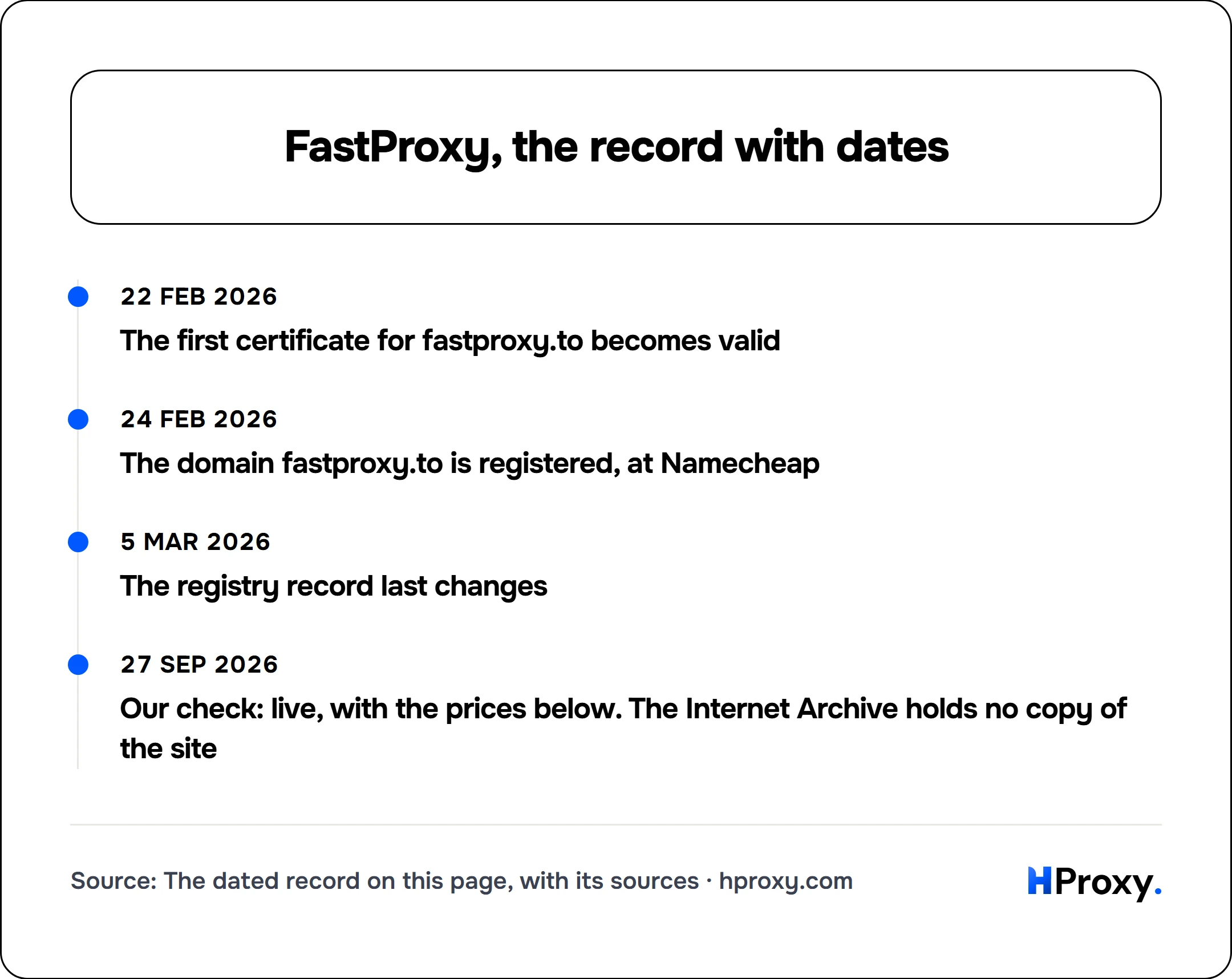
The record, with dates
| date | what happened |
|---|---|
| 22 February 2026 | The first certificate for fastproxy.to becomes valid. |
| 24 February 2026 | The domain fastproxy.to is registered, at Namecheap. |
| 5 March 2026 | The registry record last changes. |
| 27 September 2026 | Our check: live, with the prices below. The Internet Archive holds no copy of the site. |
22 Feb 2026
The first certificate for fastproxy.to becomes valid
24 Feb 2026
The domain fastproxy.to is registered, at Namecheap
5 Mar 2026
The registry record last changes
27 Sep 2026
Our check: live, with the prices below. The Internet Archive holds no copy of the site
Sources: the .to registry, the public certificate logs, the Internet Archive and our own check.
The footer names "FastProxy Inc." and nothing more: no address, no company number and no country. Its terms, refund and use pages each showed 27 September 2026 as their last update, the day we read them.
A different site, fastproxy.win, has run a free web proxy under the same name since 2018. Nothing on either site links the two.
What it sells, and what it costs
| product | how it is sold | price |
|---|---|---|
| residential, Budget pool | per GB, no minimum | $1.00 a GB. |
| residential, Premium pool with city targeting | per GB | $2.50 a GB. |
| residential with unlimited traffic | by time and speed | From $737 a week; trials of 30 minutes at $20, $30 or $50. |
| shared datacenter | per day | $3.50 a day. |
| dedicated datacenter IPv4 | per IP, per month | $1.50 an IP. |
| IPv6 pool | per day | From $0.50 a day. |
| ISP, static IPs | per IP, per 30 days | $2.75; $2.61 each in a pool of 25 or more. |
| mobile | per GB, or a dedicated line | $2.50 a GB; $90 a month for a dedicated line. |
It claims 100M+ residential IPs, all from people who agreed to share their connection. We did not test that claim, or any other.
The fine print
- Payment. Crypto only, through the processor OxaPay: Bitcoin, Ethereum, USDT on six networks, USDC, Litecoin and more.
- Identity. No KYC: it asks for an email address and says it never asks for ID, proof of address or company documents.
- Refunds. It offers no crypto refunds and calls deposits "generally non-refundable". It may credit your balance for duplicate charges or failures on its side.
- Expiry. Bandwidth never expires, and there is no minimum spend.
- Use. Its policy bans spam, credential stuffing, fraud and malware, and says accounts can be closed without a refund.
Where its own figures disagree
| topic | one page says | another page says |
|---|---|---|
| countries | "50+ countries" (homepage, pricing) | "195+ countries" (residential page) |
| city targeting on Budget | on Premium only (pricing card) | on Budget too (residential page, homepage banner) |
| ISP price | $2.75 an IP (pricing card) | "ISP from $4/IP" (description of the same page) |
| unlimited plans | "starting at $29/month" (blog, February and March) | from $737 a week (pricing today) |
| card payments | "Also accepted" (blog, February) | "Crypto only" (pricing FAQ) |
| datacenter price | "from $0.10/GB" (blog, March) | $3.50 a day (pricing today) |
Two of its blog posts carry dates in January and February 2026, before the domain was registered. The homepage shows five named customer quotes and a count of 2,400+ customer reviews; we found no way to check either.
Where FastProxy is the stronger choice
- Unlimited residential traffic by the week, with trials of half an hour. We sell no unmetered residential, and our page on unlimited residential proxies explains why.
- Dedicated datacenter IPv4 at $1.50 a month, and ISP IPs at $2.61 each in blocks of 25.
- An IPv6 pool by the day, and UDP on its Budget pool, by its own account.
- Crypto on many networks, for buyers who want neither a card nor documents.
Where HProxy is different
| FastProxy, 27 September 2026 | HProxy | |
|---|---|---|
| residential, smallest purchase | $1.00 a GB on Budget | $0.50/GB for 1 GB of Lite. |
| residential with city targeting | $2.50 a GB on Premium | $1.49 for one GB of Premium, with city and ISP targeting. |
| static ISP address | $2.75 for 30 days | $2.70/IP for a month. |
| datacenter IPv4 | $1.50 a month | $1.58/IP for a month. |
| mobile traffic | $2.50 a GB | $1.50 per GB. |
| identity | An email address only | No documents at sign-up or at an ordinary checkout. |
| payment | Crypto only | Card, Alipay, crypto and local wallets. |
| who runs it | "FastProxy Inc.", with no address | Our imprint names the company and its address. |
| does traffic expire | Never | Never: the balance does not expire. |
We screen card payments, and we ask for identification when a payment looks wrong or the law requires it. The difference is the default: an ordinary order with us needs no documents.
Five alternatives, priced the same day
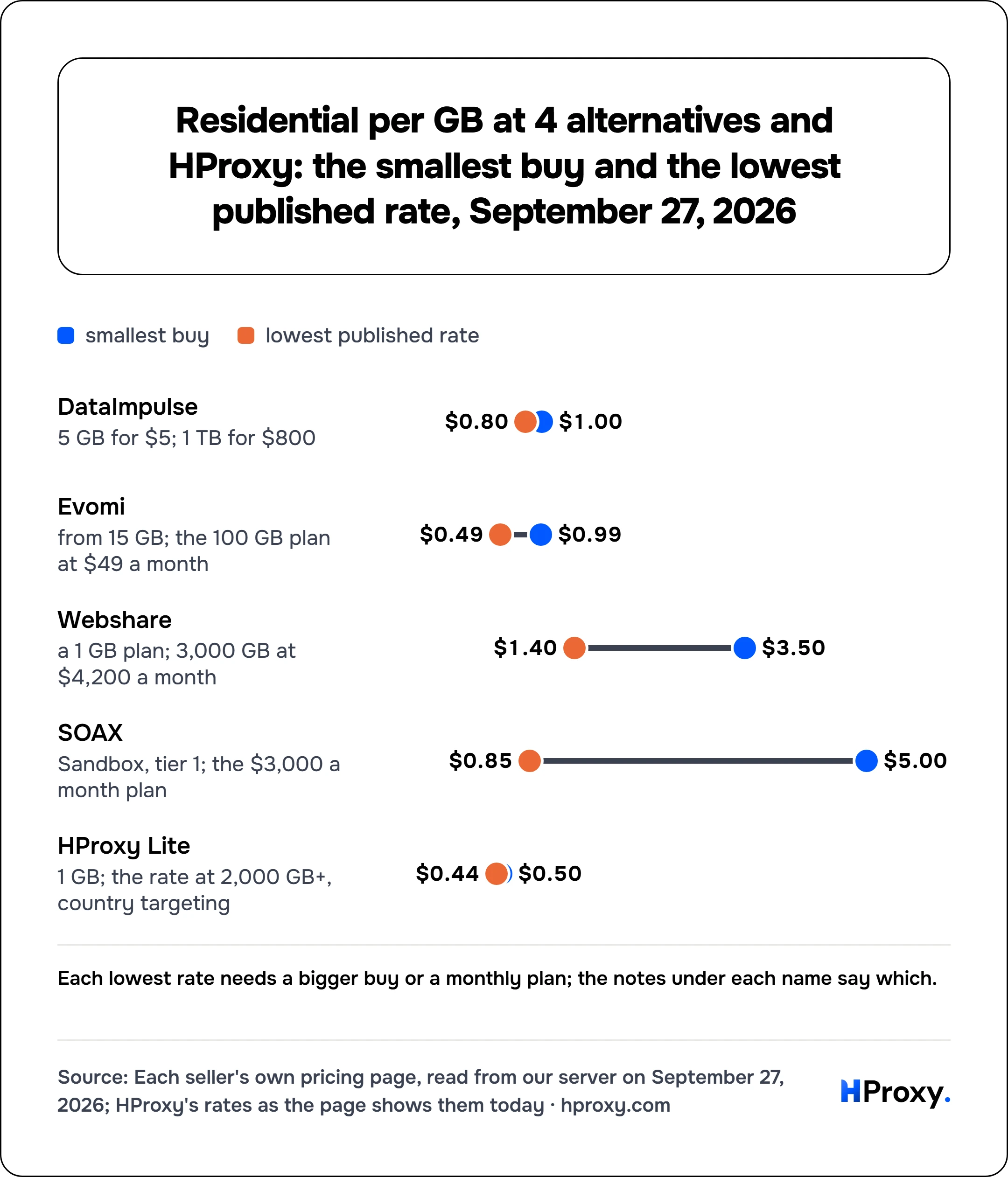
Every rate below comes from each vendor pricing page, read from our server on 27 September 2026. A rate you cannot reach is not a price.
| provider | entry rate | lowest published rate | worth knowing |
|---|---|---|---|
| DataImpulse | $1 per GB: 5 GB for $5, for new users | $0.80 per GB at 1 TB for $800 | Traffic never expires. State, city, ZIP and ASN filters count at double the rate. |
| Evomi | $0.99 per GB pay as you go, from 15 GB | $0.49 per GB on the 100 GB plan at $49 a month | It also sells static residential IPs from $1.00 an IP. |
| Webshare | $3.50 for 1 GB a month, half a $7 list price | $1.40 per GB: 3,000 GB for $4,200 a month | Monthly traffic does not roll over. |
| SOAX | $5 per GB on the free Sandbox plan, tier 1 | from $0.85 per GB on the $3,000 a month plan | Credits on Sandbox and monthly plans expire after 60 days. |
| HProxy | $0.50/GB for 1 GB of Lite, country targeting | $0.44/GB at 2,000 GB+ | City and ISP targeting on Premium: $1.49 for one GB. |
- smallest buy
- lowest published rate
Which one to pick
- You need unmetered residential traffic by the week: FastProxy sells it, and we do not.
- You want residential traffic by the GB and would rather pay by card or Alipay: a seller such as ours, from $0.50/GB for 1 GB.
- You need city or ISP targeting from one GB: our Premium pool at $1.49 for one GB.
- You want to know who takes your money: pick a seller whose imprint names a company and an address.
Whichever seller you pick, test what you get with our free proxy checker. It checks HTTP and SOCKS proxies with no sign-up.
The limits of this record
We did not buy from FastProxy, so nothing here measures its network. Everything comes from its own pages, which disagree with each other, and the Internet Archive holds no copy of the site. Trustpilot answered our server with a bot check, so we did not read reviews there. This page is due for a check by 27 December 2026.
Sources
Read on 27 September 2026, from our server:
- FastProxy: the homepage, the pricing page, the residential page, the terms, refund and use policies, and four blog posts.
- The .to registry, the public certificate logs and the Internet Archive, for fastproxy.to and fastproxy.win.
- DataImpulse, Evomi, Webshare and SOAX pricing pages, the DataImpulse targeting docs and the Webshare help center.
- HProxy, our catalogue, payment, KYC and imprint pages, and our product sheets.