Every free proxy list page, ours included, is built from advertised prices and claimed pool sizes. Those two materials cannot tell you what you actually need to know, so this page spends most of its length on what they leave out.
What is on file for clarketm proxy-list (GitHub)
You will find them at github.com/clarketm/proxy-list. In our own records they sit in the free proxy list category.
There is no price in this comparison because we do not have one we can date and attribute. What follows instead is the set of questions that decide the cost once you do read their page.
When you do read it, note four things: the rate you actually qualify for today, the minimum purchase, whether unused balance expires, and whether failed requests are billed. Those four decide the real cost more than the headline does.
clarketm proxy-list (GitHub) in its own words
The title tag on 9 September 2026 was "GitHub - clarketm/proxy-list: A list of free, public, forward proxy servers. UPDATED DAILY! · GitHub". Written for search engines, their description says: "A list of free, public, forward proxy servers. UPDATED DAILY! - clarketm/proxy-list"
What else that page states, without interpretation:
The product lines named on that page are SOCKS5. Support is advertised as around the clock. Their pricing page is titled "Pricing · Plans for every developer · GitHub".
Nothing there has been tested. It is a record of what the page said on the day, which is the honest limit of what a page like this can offer without a measurement.
How far back the record goes
The domain was registered on 9 October 2007, through MarkMonitor Inc, which makes it about 18 years old. Checked against the registry on 9 September 2026. The registration currently runs to 9 October 2028.
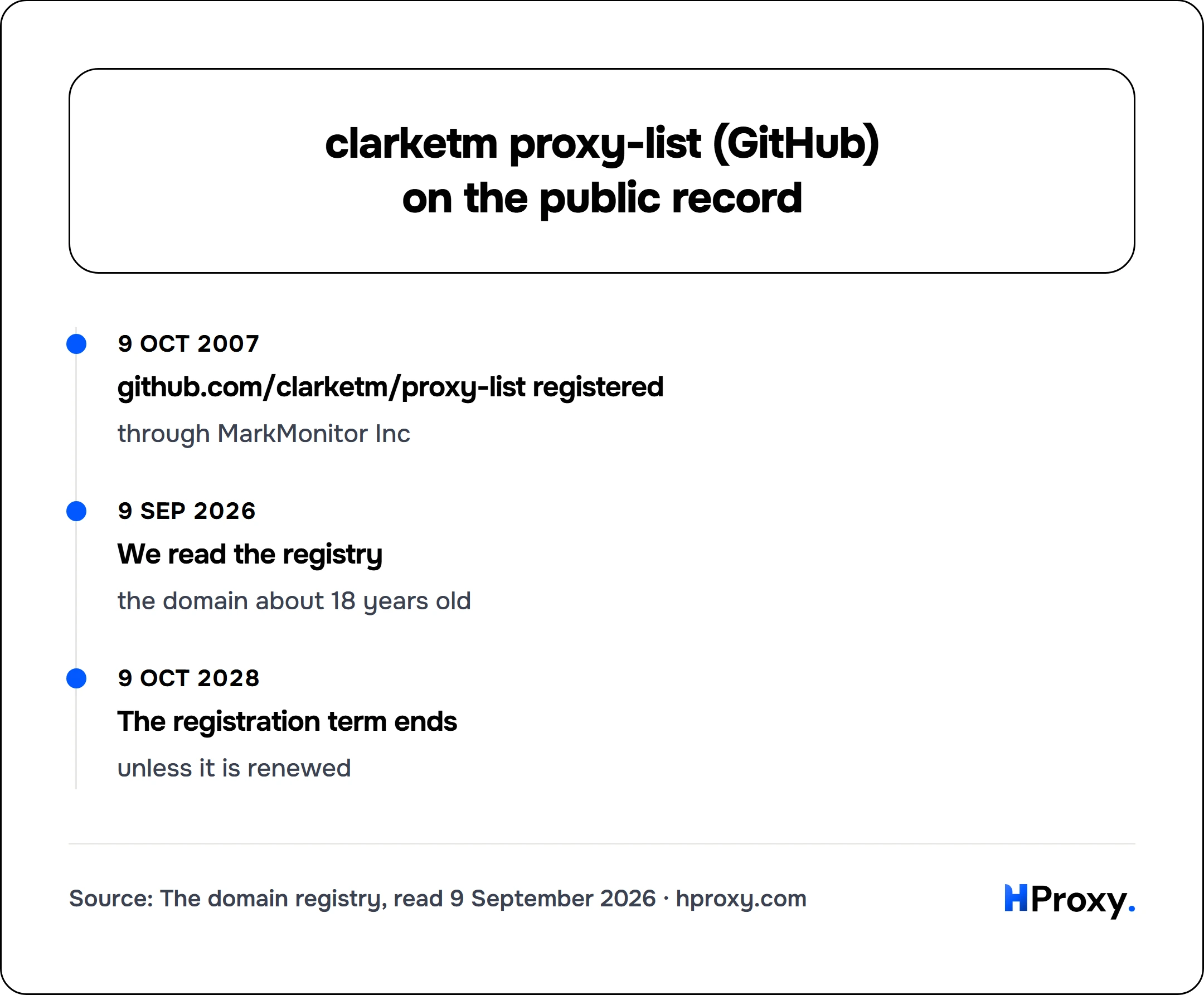
9 Oct 2007
github.com/clarketm/proxy-list registered
through MarkMonitor Inc
9 Sep 2026
We read the registry
the domain about 18 years old
9 Oct 2028
The registration term ends
unless it is renewed
None of it predicts success rate. It is here because domain age and archive depth are free to check, and a provider whose public record starts last quarter deserves a smaller first order.
Who is behind the list
We checked this one by hand on 6 September 2026. It is a repository, and we record the operator as github. Evidence recorded: 2,385 stars, last push 2026-03-01. Stale since March 2026.
It is a public repository rather than a business. Repository lists are usually the freshest thing in this category and the least supported: nobody is on call when the scraper behind it stops.
Every list in this category has the same underlying problem, which is decay. We measure it on our own network and publish it: 4,023 alive on 2026-08-11, out of 589,918 ever discovered. Those that worked, then stopped, lasted a median 10 days, counting only addresses with fewer than 20 of them, without Amazon's networks or one June evening when our checker failed (measured 2026-09-28). A list is only as good as its last check.
The questions behind the numbers
Shared or dedicated changes everything
A shared address arrives with a history you did not create and cannot see. For read-only work it rarely matters. For anything that keeps a session, it is the most common cause of unexplained failure.
The country total, and the country you use
Ask for the pool size in your country rather than in total, and expect the answer to be vague. Where it is not published, the ten minute test at the end of this page settles it for a few dollars.
The response time nobody advertises
Every provider works when nothing is wrong. The difference shows up on the day a subnet gets flagged or a gateway stops answering. Before committing volume, send one real question through the support channel and time the reply.
The comparison, honestly framed
Compare on these rows and ignore the feature lists on both sites:
| Question to ask | clarketm proxy-list (GitHub) | HProxy |
|---|---|---|
| Entry price | Not verified by us, read their page | From $0.44/GB, pay as you go |
| Does unused balance expire? | Their terms page answers this | Never |
| Minimum commitment | Worth confirming in writing before you commit | None |
| Identity checks | Read their current terms | Card orders are screened, and verification is sometimes requested |
| Targeting | On their own terms page | Country, city and ISP |
| Free way to evaluate | Not published clearly, ask before paying | Free proxy list and proxy checker |
A table like this can rank the things that are written down. It cannot rank the thing that matters most, which is how the network behaves against the site you care about.
The test that beats this page
It is a small amount of money for an answer that is actually about your target.
- Take the smallest paid unit each provider will sell you. A free trial works for a first pass, though trials sometimes ride better pools than paid plans do.
- Fire the same batch through both on one afternoon. Different days are different conditions, and that ruins the comparison.
- Write down two numbers per provider: the share of requests that succeeded, and the traffic it cost.
- Take a handful of the addresses you were given and verify their country and type against a checker you do not control.
- Choose on the measurement, not the marketing, and expect the answer to change within a year.
Comparable providers
We hold the same record for these, and the same honest limits apply to each:
- Proxy Daily alternatives
- Proxy IP List alternatives
- Proxy List alternatives
- Proxy-Listen.de alternatives
- Proxy Searcher alternatives
- Proxy11 alternatives
What we sell, stated plainly
For completeness: residential from $0.44 per GB with country targeting, city and ISP targeting on Residential Premium from $1.00 per GB, no monthly minimum, and a balance that stays where you left it. We are a good fit for uneven workloads and a poor one for anybody who wants a signed enterprise agreement.