Comparison

Proxy-Listen.de alternatives, checked for how many entries are alive

A Proxy-Listen.de alternative, judged by a competitor who says so up front: the record we hold, the gaps in it, and the test that outranks this page.

HProxy Team··4 min read
HProxy.Comparison

Free proxies won't hold up here.

Shared datacenter IPs get flagged and dropped fast. When it has to hold, gaming, streaming, accounts, you need mobile and residential IPs that read as a real device, from $0.44/GB, pay as you go.

See plans & pricing

You can settle this yourself for less than the price of lunch. That is the argument of this page, and the sections before the test exist to tell you what to measure once you start.

The record we hold

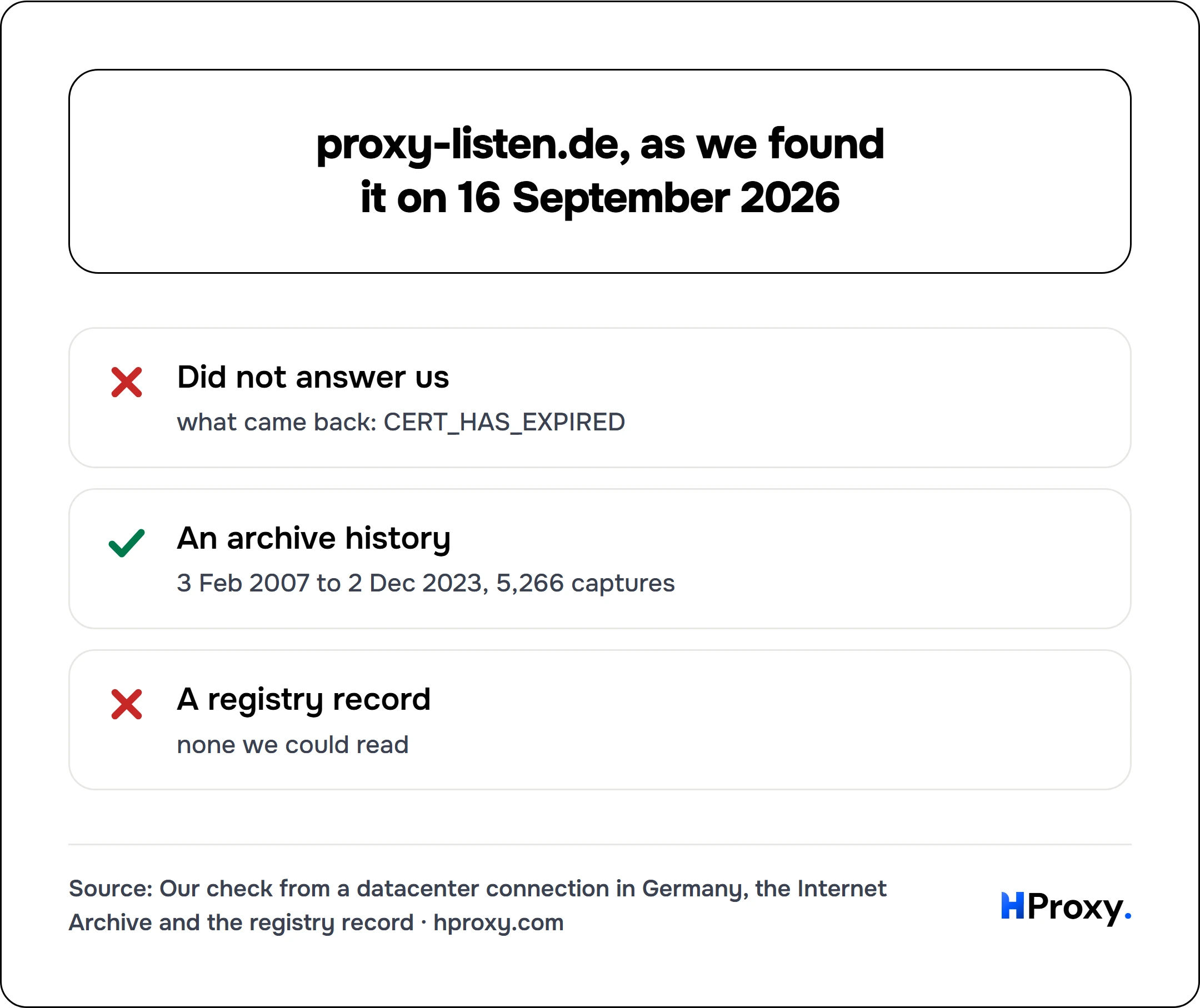
Proxy-Listen.de operates from proxy-listen.de. Our classification for them is free proxy list.

What we do not hold is a current, sourced price for Proxy-Listen.de. Rather than print a figure we cannot stand behind, this page leaves it out and tells you what to look for when you read their page yourself.

Note the price, the unit it is quoted in, the minimum, and the expiry. Unit and expiry are where most comparisons in this market quietly go wrong.

Ownership of the list

We checked this one by hand on 6 September 2026. It is a list, and we record the operator as independent. We could not settle its status with confidence, which is itself worth knowing before relying on it. Evidence recorded: http 301 to https; https no answer. German list.

No proxy seller behind it that we could find. Independent lists tend to live on ad revenue, so expect the page to be busier than the data warrants.

The Internet Archive has it from 6 February 2007 to 2 February 2023, about 17 years of coverage.

What none of that tells you is how many of the addresses answer today. We publish our own measurement of that on the free side: of 589918 addresses discovered, 4023 were alive at the last check, with a median lifespan of 145 hours. Any list without a check date is describing a past that has already gone.

The parts no marketing page answers

What passes through, and what is kept

Anything routing your traffic can read it unless it is encrypted end to end, and can alter anything that is not. Assume the operator sees the metadata and decide whether that is acceptable for the work.

Networks age, so re-test quarterly

Pools are rebuilt, suppliers change and detection improves. A provider that beat the field last spring may be mid-table now. Nothing in this market stays true long enough to buy once and stop measuring.

A pool total is not a promise

Claims of ten million, one hundred million or more say nothing about whether your requests get through this week. Your job meets the handful of exits it draws, in your countries, against one target. Rotation policy and freshness move that outcome far more than the headline total.

Side by side, with the blanks left blank

The table answers what we can answer and marks what we cannot:

Question to askProxy-Listen.deHProxy
Entry priceNot verified by us, read their pageFrom $0.44/GB, pay as you go
Does unused balance expire?Worth confirming in writing before you commitNever
Minimum commitmentNot published clearly, ask before payingNone
Identity checksOn their own terms pageCard orders are screened, and verification is sometimes requested
TargetingNot published clearly, ask before payingCountry, city and ISP
Free way to evaluateOn their own terms pageFree proxy list and proxy checker

Two notes on that table. The rows we left for you to check are not evasions: those terms change, and printing a stale figure is exactly the failure this page is trying to avoid. And no table can hold the number that should decide your purchase, which is the success rate on your own target.

A test worth more than this comparison

Do this once and you will never need a comparison page for this decision again.

  1. Open an account on each and add the smallest amount they take. Skip the trial if a paid unit is cheap enough to buy outright.
  2. Point both at your real target, through your real tool, on the same day, with the same mix of requests.
  3. Count how many requests returned what you wanted, and how much bandwidth each side spent doing it.
  4. Spot-check the exits. Confirm they are in the country you paid for and the connection type you were sold.
  5. Buy the one that won on your target, and diarise a re-test in three months.

Who else is in this bracket

The same treatment, applied to the providers most often weighed against this one:

Our side of it

HProxy is pay as you go from $0.44 per GB on residential, with ISP, mobile and datacenter under one balance and no commitment attached to any of them. Run the test. If we lose on your target, we lose, and you have your answer.

Frequently asked questions

How is HProxy different?
The models differ more than the products do. HProxy is pay as you go from a balance you top up when you want, the balance does not expire, there is no subscription unless the optional discount suits you, and residential starts at $0.44 per GB with city and ISP targeting included. Whether that beats a tiered plan depends on your usage pattern, which a short test settles.
Do I have to talk to sales or sign a contract to switch?
Not with us. You can sign up, add funds and send traffic without a call, a minimum or a subscription. Whether another provider requires any of those is on their own pricing page and is worth reading, because a required commitment is part of the price even when it is not part of the rate.
How often should I re-test a provider?
Quarterly is a reasonable rhythm for most workloads, and immediately after a noticeable drop in success rate. Pools are rebuilt, suppliers change and detection improves, so a benchmark from last year describes a network that no longer exists.
Does a bigger pool mean better results?
No. Your job meets only the exits it draws, in the countries it needs, against one target's defences. Freshness and rotation policy move the outcome far more than the headline total, and pool totals across this market are counted generously and rarely audited.
Why do free proxy lists stop working so quickly?
Because the addresses on them are mostly misconfigured devices that get fixed, or short-lived hosts that get shut down. We measure this on our own free network: of 589918 addresses discovered, 4023 were answering at the last check. A list without a check date is telling you nothing about today.

Proxies that don't die mid-job

Residential, ISP, datacenter and mobile, verified by the same engine that runs tens of millions of checks. They read as a real device and hold up under load. Pay as you go, and your balance never expires. $0.44/GB is the 2,000 GB+ rate; a single gigabyte is $0.50/GB, with no minimum order.

129M+ proxy checks run · 100+ countries · HTTP / HTTPS / SOCKS · re-checked every few minutes · no signup