Before anything about Proxy Searcher: pool totals, uptime badges and country counts predict almost nothing about your result. What predicts it is a measured success rate on your own target, and that measurement costs a few dollars.
The record we hold
The domain is proxysearcher.sourceforge.net. They are filed here as a free proxy list.
What we do not hold is a current, sourced price for Proxy Searcher. Rather than print a figure we cannot stand behind, this page leaves it out and tells you what to look for when you read their page yourself.
Their pricing page will answer three of the four questions that matter. Send an email for the fourth, which is usually whether blocked requests are billed, and keep the reply.
How Proxy Searcher presents itself
As of 9 September 2026 the tab reads "Burd's Proxy Searcher Homepage".
What else that page states, without interpretation:
We found no separate pricing page linked from the homepage, which usually means the price arrives by quotation.
Those are claims, and claims are free. They earn their place here only because the date makes them checkable later.
Who actually runs Proxy Searcher
We checked this one by hand on 6 September 2026. It is a tool, and we record the operator as independent. Desktop tool, SourceForge page.
It appears to be independently operated. That is the better case for neutrality, and it says nothing about whether the addresses work.
The Internet Archive has it from 3 April 2013 to 7 August 2025, about 13 years of coverage.
Every list in this category has the same underlying problem, which is decay. We measure it on our own network and publish it: 4,023 alive on 2026-08-11, out of 589,918 ever discovered. Those that worked, then stopped, lasted a median 10 days, counting only addresses with fewer than 20 of them, without Amazon's networks or one June evening when our checker failed (measured 2026-09-28). A list is only as good as its last check.
Where published figures stop being useful
A pool total is not a promise
Claims of ten million, one hundred million or more say nothing about whether your requests get through this week. Your job meets the handful of exits it draws, in your countries, against one target. Rotation policy and freshness move that outcome far more than the headline total.
Why 195 countries tells you nothing
Ask for the pool size in your country rather than in total, and expect the answer to be vague. Where it is not published, the ten minute test at the end of this page settles it for a few dollars.
The day something goes wrong
Support quality is invisible until it is the only thing that matters. A cheap provider that takes three days to answer a routing problem has cost you more than the saving, and no pricing page reveals that.
A comparison that admits what it cannot say
This is the shortest table that still decides the purchase:
| Question to ask | Proxy Searcher | HProxy |
|---|---|---|
| Entry price | Not verified by us, read their page | From $0.44/GB, pay as you go |
| Does unused balance expire? | On their own terms page | Never |
| Minimum commitment | Read their current terms | None |
| Identity checks | Worth confirming in writing before you commit | Card orders are screened, and verification is sometimes requested |
| Targeting | Their terms page answers this | Country, city and ISP |
| Free way to evaluate | Check the current terms, this one moves | Free proxy list and proxy checker |
Blanks in that table are deliberate. We print what we read and date it, and leave the rest empty rather than repeating something we cannot stand behind.
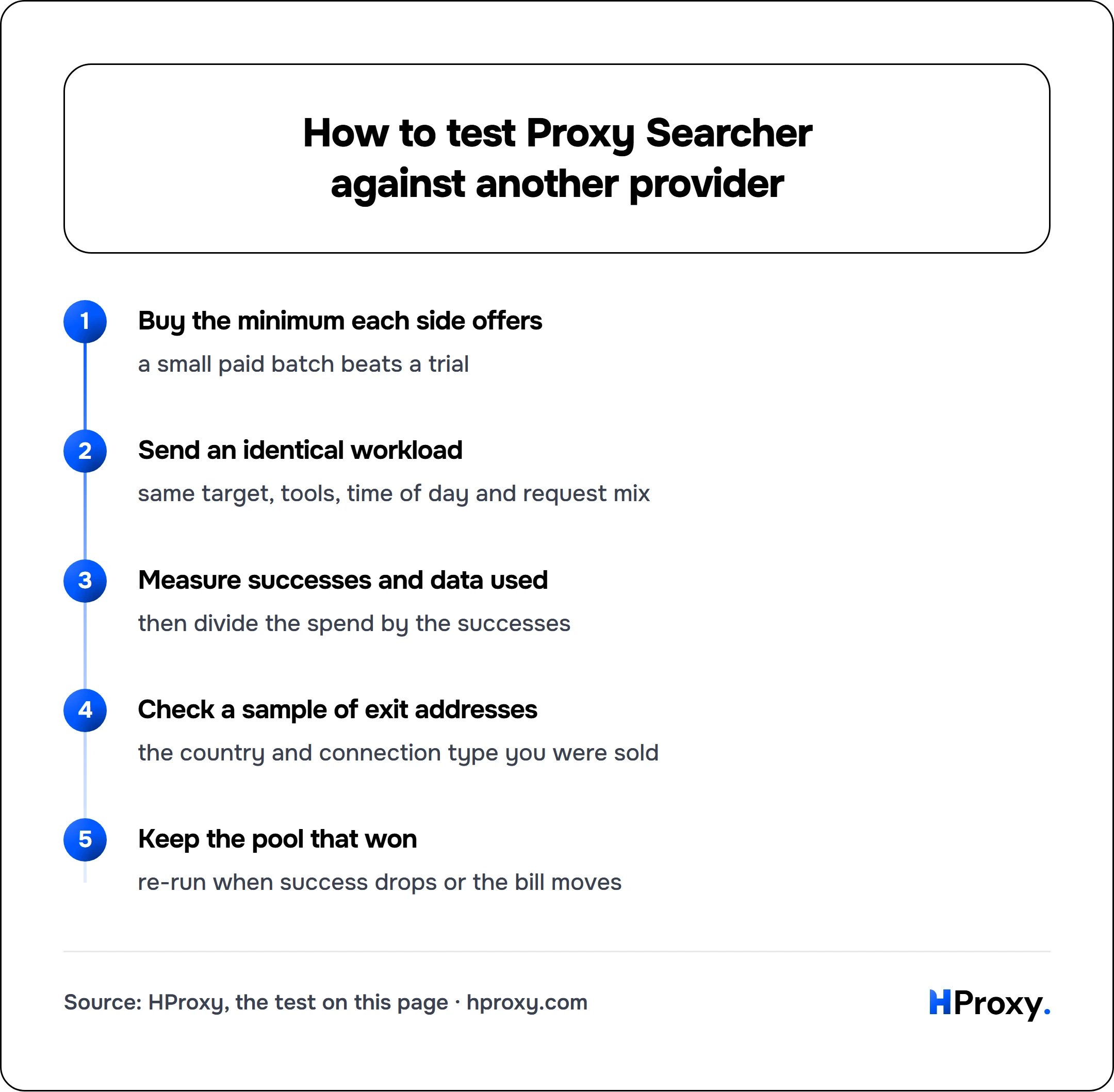
How to settle it yourself in ten minutes
Run this before you commit any volume. It replaces every opinion on this page, including ours.
- Buy the minimum each side offers. Prefer a small paid batch over a trial, because trial traffic does not always ride the same pool.
- Send an identical workload through each: same target, same tooling, same time of day, same request mix.
- Measure what came back correctly and what it consumed, then divide the spend by the successes.
- Push a sample of exit addresses through an independent checker and confirm the country and connection type are what was advertised.
- Keep whichever pool won on your job. Re-run this whenever success rate drops or the bill moves.
Buy the minimum each side offers
a small paid batch beats a trial
Send an identical workload
same target, tools, time of day and request mix
Measure successes and data used
then divide the spend by the successes
Check a sample of exit addresses
the country and connection type you were sold
Keep the pool that won
re-run when success drops or the bill moves
The other names that come up
Other providers in the same bracket, priced and dated the same way:
- Proxy11 alternatives
- Proxy4Free alternatives
- Proxycompass alternatives
- Proxydb alternatives
- Proxyelite alternatives
- Proxyfish alternatives
Our side of it
What we offer is one account holding residential, ISP, mobile and datacenter, priced from $0.44 per GB on residential, with no tier to climb and no allocation to lose at month end. Whether that suits you depends on how steady your volume is.