Proxy Daily sits in a market where the advertised number and the number you pay are frequently different, because tiers, minimums and expiry all sit between them. Untangling that is most of the work here.
What we can and cannot tell you about Proxy Daily
The company behind the name sits at proxy-daily.com. We carry them as a free proxy list.
A price is missing here on purpose. We have not captured a sourced rate for Proxy Daily recently enough to publish one, and a stale number in this market is a wrong number.
Note the price, the unit it is quoted in, the minimum, and the expiry. Unit and expiry are where most comparisons in this market quietly go wrong.
What Proxy Daily says about itself today
As of 9 September 2026 the tab reads "Free Public Proxy List, Paid Public Proxy List Updated Every 5 Minutes". Their meta description, the sentence Google shows under the link, says: "Provider of free public proxies for personal / professional use. More than 1k proxies at any time."
Reading the same page for the things buyers actually ask about:
The product lines named on that page are SOCKS5. Support is advertised as around the clock. A refund or money-back term is mentioned. We found no separate pricing page linked from the homepage, which usually means the price arrives by quotation.
Every line above is a quotation from their marketing rather than a measurement by us. It is included because it is checkable, not because it is evidence of performance.
What the registration record shows
The domain was registered on 16 April 2016, through NameCheap, Inc, which makes it about 10 years old. That record was read from the registry on 9 September 2026. The registry shows it renewed to 16 April 2027.
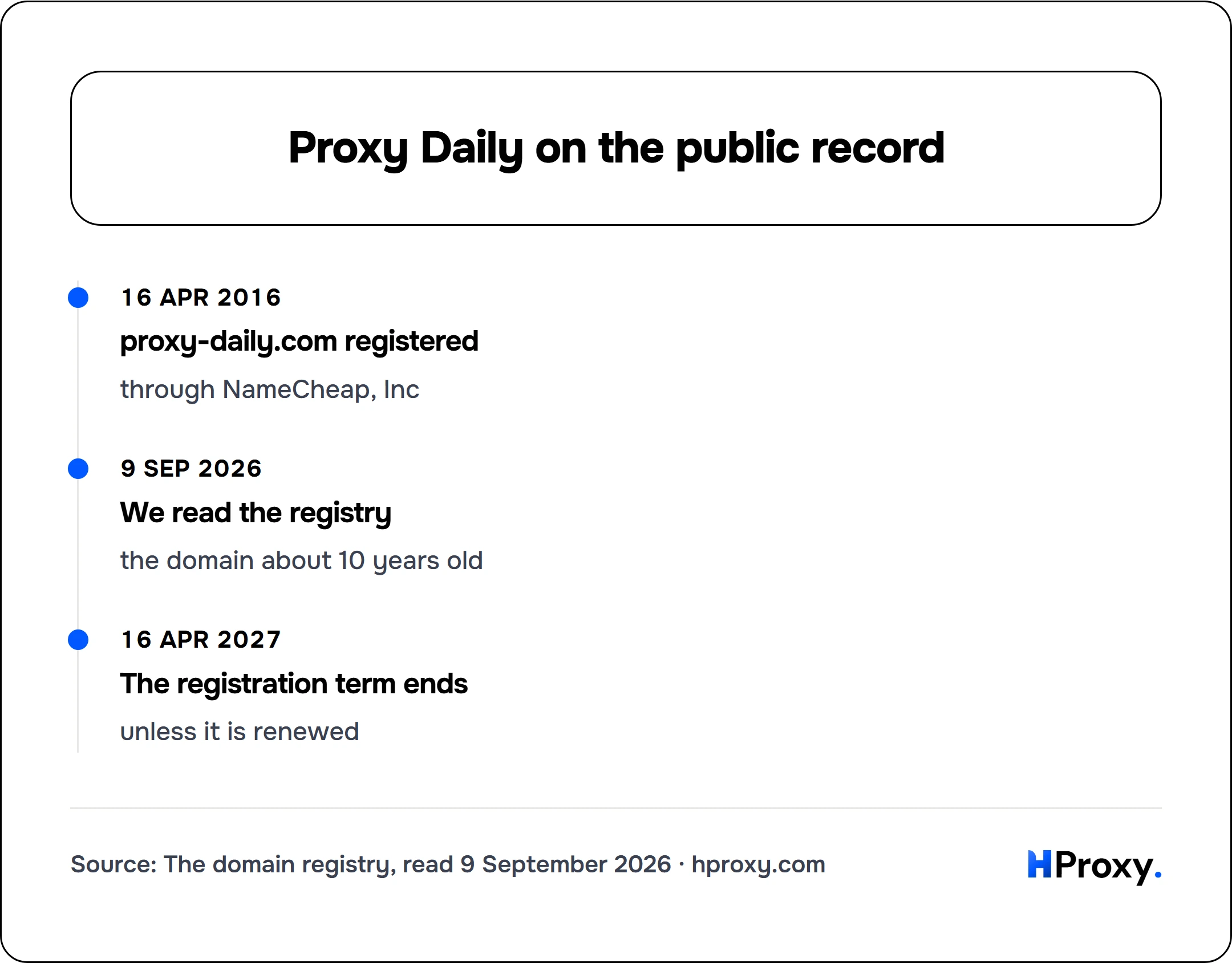
16 Apr 2016
proxy-daily.com registered
through NameCheap, Inc
9 Sep 2026
We read the registry
the domain about 10 years old
16 Apr 2027
The registration term ends
unless it is renewed
Age is not quality. A long registration does not make a network good, and a new one does not make it bad. What it does rule out is the shortest-lived pattern in this market, which is a site that appears, sells, and is gone inside a year.
Ownership of the list
We checked this one by hand on 6 September 2026. It is a list, and we record the operator as independent.
As far as we can establish it is run independently rather than by a proxy vendor. That usually means it survives on advertising, which shapes the site rather than the data.
The Internet Archive has it from 8 May 2016 to 11 June 2026, about 10 years of coverage. The domain was registered 16 April 2016 through NameCheap, Inc.
Every list in this category has the same underlying problem, which is decay. We measure it on our own network and publish it: 4,023 alive on 2026-08-11, out of 589,918 ever discovered. Those that worked, then stopped, lasted a median 10 days, counting only addresses with fewer than 20 of them, without Amazon's networks or one June evening when our checker failed (measured 2026-09-28). A list is only as good as its last check.
Where published figures stop being useful
What passes through, and what is kept
A service with no stated retention period has one anyway, and it is whatever their hosting provider does by default. Absence of a policy is a policy, and usually not the one you would choose.
A country count is not coverage
Almost every provider claims almost every country. What differs is depth, and depth decides whether a single city or a single carrier is usable. No published figure tells you that.
What happens when it breaks at two in the morning
Support quality is invisible until it is the only thing that matters. A cheap provider that takes three days to answer a routing problem has cost you more than the saving, and no pricing page reveals that.
A comparison that admits what it cannot say
The rows that matter, with our own answers stated plainly:
| Question to ask | Proxy Daily | HProxy |
|---|---|---|
| Entry price | Not verified by us, read their page | From $0.44/GB, pay as you go |
| Does unused balance expire? | Worth confirming in writing before you commit | Never |
| Minimum commitment | Not published clearly, ask before paying | None |
| Identity checks | On their own terms page | Card orders are screened, and verification is sometimes requested |
| Targeting | Their terms page answers this | Country, city and ISP |
| Free way to evaluate | Check the current terms, this one moves | Free proxy list and proxy checker |
Every unfilled cell above is a question to put to them directly, in writing, before money changes hands. Vendors answer those questions readily; comparison sites guess at them.
The ten minute version of this decision
For a few dollars you can get a verdict specific to your job, which no comparison page can honestly promise you.
- Buy the minimum each side offers. Prefer a small paid batch over a trial, because trial traffic does not always ride the same pool.
- Send an identical workload through each: same target, same tooling, same time of day, same request mix.
- Log successes, failures and gigabytes used. Cost per successful request is the figure you are after.
- Verify a slice of the exits independently. Country labels in this market are self-reported and are not always right.
- Keep whichever pool won on your job. Re-run this whenever success rate drops or the bill moves.
Others in this market
Nearest alternatives by product shape rather than by who pays us, since nobody does:
- ProxyScan.io alternatives
- ProxyServers.pro alternatives
- ProxySpace alternatives
- PubProxy alternatives
- Socks 24 alternatives
- Socks-Proxy.net alternatives
The competing offer, for completeness
HProxy suits buyers who want to add funds, send traffic and stop thinking about it. Residential from $0.44 per GB, no commitment, nothing expiring. Buyers who need procurement paperwork and a named account manager are better served elsewhere, and we would rather say so here than waste your afternoon.