Free proxy sites die in two shapes, and most people only notice one of them. The obvious death is the list that goes dark: the bookmark that now loads a parked domain or a page nobody has touched in years. The quieter death is the checker, the tool or site you used to test a proxy before trusting it, which tends to disappear without anyone writing an obituary.
We have since counted the graves rather than guessed at them. On 10 September 2026 we resolved and opened every one of the 8,948 sites on the largest surviving proxy directory: 8,831 of those names no longer exist, and not one of the survivors still runs a proxy.
You can already tour the named headstones in the free proxy list graveyard, where we walked through GatherProxy, Samair, and the big list sites that died. This is the wider field guide. It covers the checkers as well as the lists, and, more useful than any obituary, it shows you how to tell a live source from a dead one before you waste an afternoon copying IP addresses that stopped answering in 2019.
Two kinds of dead: lists and checkers
A free proxy list publishes IP addresses. A free proxy checker tests them. In the good old days you used them together: pull a batch off a list, run it through a checker, keep the survivors. Both halves of that workflow have been rotting.
Lists die loudly because people keep the bookmarks and notice the parked page. Checkers die quietly because you only reach for one occasionally, and by the time you do, the desktop tool will not run on your current operating system or the site is a blank shell. The result is a scene full of half-working parts: a list that still displays numbers but serves the dead, and a checker that no longer checks. Knowing which is which saves you the most annoying kind of wasted time, the kind where nothing errors, it just silently fails.
The dead and dying, at a glance
Here is the state of the best-known free proxy sites and checkers. "Dead" means gone or effectively abandoned. "Degraded" means technically alive but barely worth the friction. "Alive" means it still does the one job, with caveats.
| Site | Type | Status | What is left today |
|---|---|---|---|
| GatherProxy | List and scraper tool | Dead | Tool unmaintained for years; lookalike clones ride the name |
| Samair (samair.ru) | List | Moved to paid | Folded into PremProxy; the free list is retired |
| HideMyAss | Web proxy and free list | Dropped free | Went all-in on a paid VPN; the free list and extension are gone |
| FreeProxyLists (freeproxylists.net) | List | Abandoned in practice | Still name-dropped in old roundups, relied on by no one |
| NNTime (nntime.com) | List | Domain for sale | An old free-list domain now parked on a sale marketplace |
| ProxyFire (proxyfire.net) | Checker and community | Dead | The checker and forum faded years ago |
| ProxyWatchdog (proxywatchdog.com) | Checker | Dead | Registration lapsed; the domain is up for grabs |
| Spys.one | List | Degraded | Huge, cluttered, ports hidden behind JavaScript, around 70% uptime |
| ProxyNova | List aggregator | Alive | Still publishes a free list |
| ProxyDB (proxydb.net) | List | Alive | Still serving a proxy list |
The pattern is the same one that shows up every time you look closely: a handful of survivors that kept doing the boring work of re-verification, surrounded by a lot of names that stopped.
The checkers that stopped checking
Checkers deserve their own paragraph because their death is sneakier. A dead list at least looks dead. A dead checker often looks fine, right up until you realize it is passing everything or failing everything, which means it is testing nothing.
ProxyFire is the clearest example. For years it was both a proxy checker and a community where people traded lists and techniques. The checker faded, the community went quiet, and what is left is a name in old forum posts. ProxyWatchdog went further and simply lost its domain, which now sits unregistered and available, the clearest possible sign that nobody is maintaining anything behind it. The lesson is not that these specific tools mattered, it is that a standalone checker is a maintenance commitment, and most of them were abandoned the moment the person running them lost interest.
The reason this matters: a checker is only useful if it makes a real connection through the proxy and reports what actually happened. A tool that has not been updated in years cannot keep up with how sites detect and block proxies now, so even when it runs, its verdict is stale. If you are going to trust a checker, trust one that is actively maintained, which is exactly why we keep ours current and covered how to do the test yourself in how to check if a proxy is working.
How to spot a dead source
You do not need to know a site's history to catch it dying. The tells are all in front of you. Run through this before you copy a single proxy from anywhere.
None of this requires trust in anyone's reputation. It is all observable in about a minute, and it beats discovering the hard way that the "20,000 proxy" list you just imported is 19,900 corpses.
Why free proxy sites keep dying
Strip away the individual stories and the causes are always the same short list. Free proxies are shared and short-lived, so a list is only true if it is re-checked constantly, and constant re-checking is a real engineering job with a real server bill and no glamour. Ad-supported sites decay when the traffic stops paying, the checker breaks, and nobody fixes it. Abuse gets ranges blocklisted until the site is a liability. And any owner with commercial ambition eventually treats the free list as a funnel and quietly swaps it for a paid VPN or proxy plan.
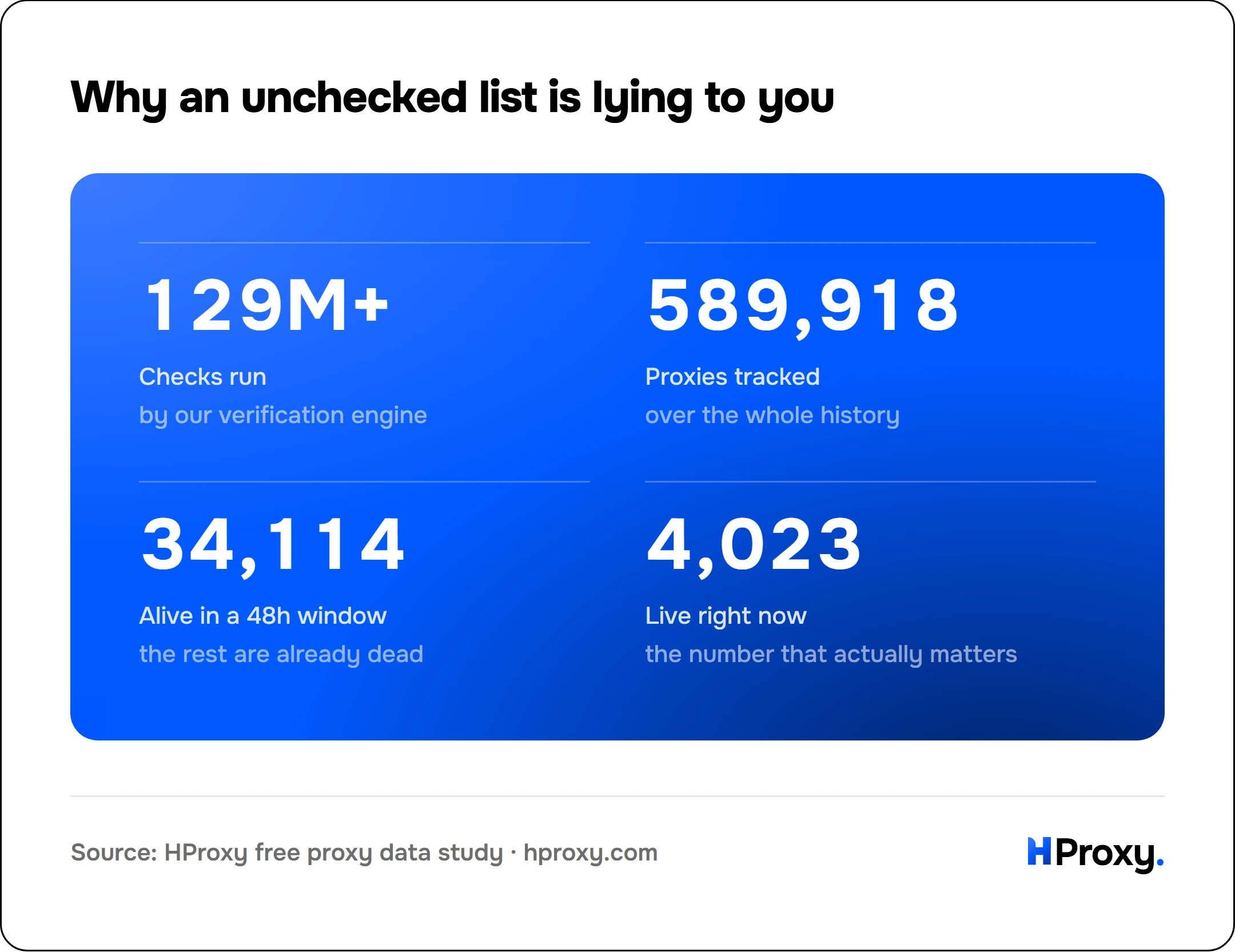
The uncomfortable math is why an unchecked list lies to you even while it looks busy.
Why an unchecked list is lying to you
- 129M+
- Checks run
- 589,918
- Proxies tracked
- 34,114
- Alive in a 48h window
- 4,023
- Live right now
by our verification engine
over the whole history
the rest are already dead
the number that actually matters
Source: HProxy free proxy data study
We pulled these numbers apart in the free proxy data study, and the short version is brutal: the gap between "proxies a list claims" and "proxies alive right now" is enormous. A site that stops re-checking is not serving a smaller list. It is serving a list that is almost entirely dead while still displaying the old count. That is the difference between a source and a fossil.
A list and a checker that still work
The point of a graveyard tour is not nostalgia. It is that the thing all these sites were good at, a fresh list you can actually use, plus a way to test what you have, is not hard to find once you accept that constant verification is the only feature that matters.
We run a free proxy list that is re-checked every few minutes, so dead entries drop off and what you copy was alive moments ago. If you already have proxies from somewhere else, including scraps from one of the dead sites above, drop them into our proxy checker and see which ones still answer before you rely on them. And if you want a wider survey of what is actually worth using today, we keep that current in the biggest free proxy lists and in are free proxies safe.
The old landmarks are not coming back, and the clones wearing their names are not replacements. Bookmark a source that still gets checked, learn the five-second test for a dead one, and you can stop refreshing headstones.
Sources
- HProxy free proxy list graveyard: the named-site obituaries for GatherProxy, Samair, HideMyAss, Spys.one and the other classic list sites.
- HProxy free proxy data study: the check volume and decay figures behind why an unmaintained list is mostly dead within minutes.
- SamAir / PremProxy: the surviving brand that moved off samair.ru toward a paid service.