The answer to "what should I use instead of Proxy List" depends entirely on why you are leaving. Price, a commitment, a country, a support experience and a blocked target all point at different replacements.
Everything we can stand behind
You will find them at proxy-list.org. In our own records they sit in the free proxy list category.
There is no price in this comparison because we do not have one we can date and attribute. What follows instead is the set of questions that decide the cost once you do read their page.
Check the reachable rate, the minimum, the expiry terms and the failure billing, and date your note. A price without those four attached is not a price.
The site, as it reads today
On 9 September 2026 the site introduced itself as "1 minute ago checked proxy servers - Free proxy list service since 2004 year! Almost 10 years of proxy service". Their meta description, the sentence Google shows under the link, says: "Proxy-list.org is the OLDEST free proxy list provider in the world, we are serving free proxies since 2004 year! Our company has almost 11 years of pure reputation!"
Also on the page, stated plainly:
We found no separate pricing page linked from the homepage, which usually means the price arrives by quotation.
Those are claims, and claims are free. They earn their place here only because the date makes them checkable later.
Age, and why it matters here
The domain was registered on 27 November 2005, through PDR Ltd. d/b/a PublicDomainRegistry.com, which makes it about 20 years old. We pulled that from the registry on 9 September 2026. The current registration term ends 27 November 2027.
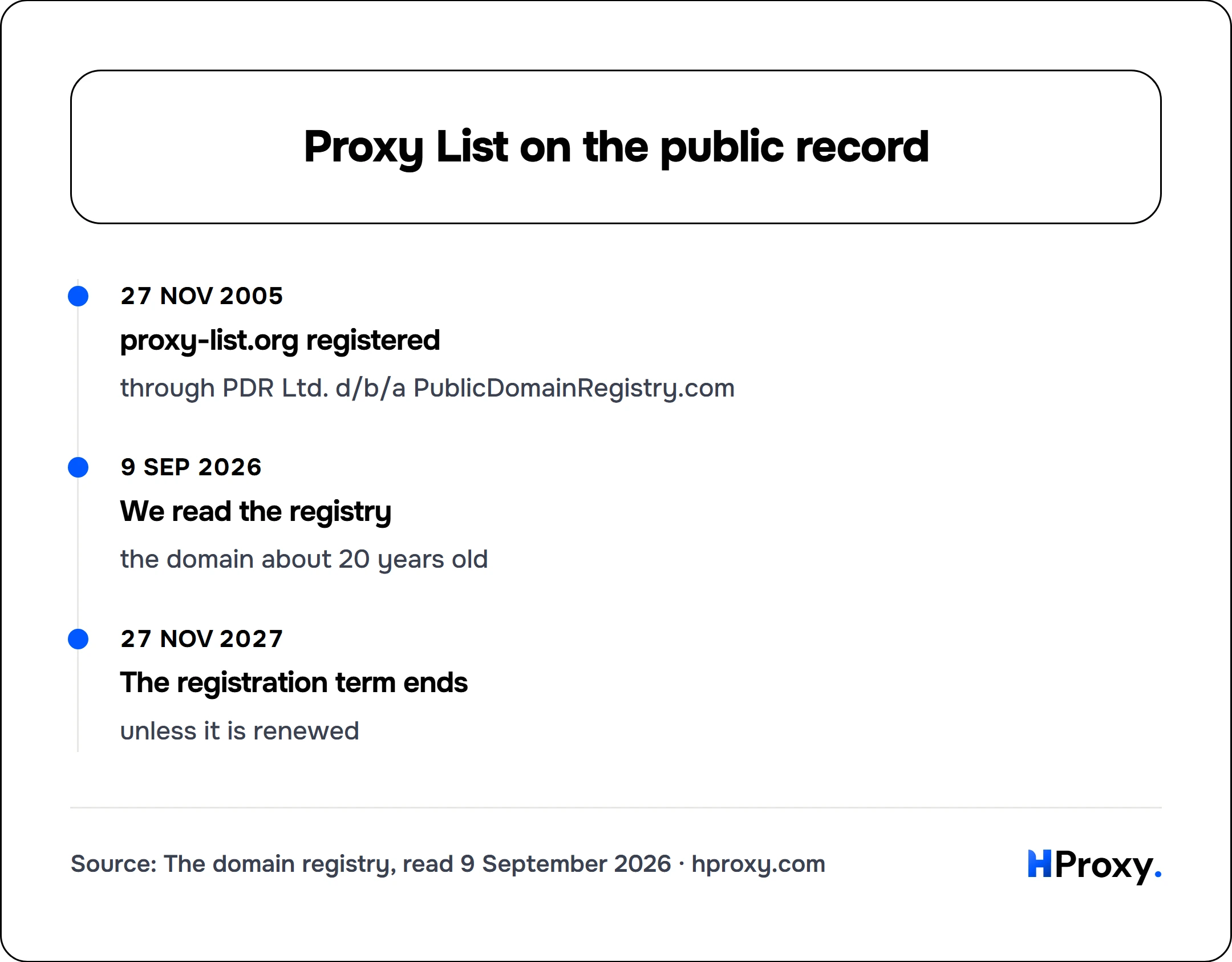
27 Nov 2005
proxy-list.org registered
through PDR Ltd. d/b/a PublicDomainRegistry.com
9 Sep 2026
We read the registry
the domain about 20 years old
27 Nov 2027
The registration term ends
unless it is renewed
None of it predicts success rate. It is here because domain age and archive depth are free to check, and a provider whose public record starts last quarter deserves a smaller first order.
The operator, and why it matters
We checked this one by hand on 6 September 2026. It is a list, and we record the operator as independent. Evidence recorded: 200, title says "free proxy list service since 2004".
It appears to be independently operated. That is the better case for neutrality, and it says nothing about whether the addresses work.
The Internet Archive has it from 29 November 2005 to 7 January 2009, about 4 years of coverage. The domain was registered 27 November 2005 through PDR Ltd. d/b/a PublicDomainRegistry.com.
What none of that tells you is how many of the addresses answer today. We publish our own measurement of that on the free side: of 589,918 proxies discovered, 4,023 were alive on 2026-08-11. Those that worked, then stopped, lasted a median 10 days, counting only addresses with fewer than 20 of them, without Amazon's networks or one June evening when our checker failed (measured 2026-09-28). Any list without a check date is describing a past that has already gone.
The questions behind the numbers
Networks age, so re-test quarterly
Every review of this market, this one included, is a photograph of a moving thing. Read the date on any comparison you find, and discount it heavily once it is more than a few months old.
Ten million addresses, and none of them yours
The number that matters is how many usable exits you can reach in the one country your job needs, this week. A pool total averages that away, which is why two providers with similar totals produce opposite results on the same site.
Why a cheap address is often a used one
An address you share carries the reputation of everyone else on it. That is acceptable for some work and fatal for anything involving a login. The price difference between shared and dedicated usually reflects exactly this.
The comparison, honestly framed
Here are the comparisons that survive contact with a real workload:
| Question to ask | Proxy List | HProxy |
|---|---|---|
| Entry price | Not verified by us, read their page | From $0.44/GB, pay as you go |
| Does unused balance expire? | Not published clearly, ask before paying | Never |
| Minimum commitment | Check the current terms, this one moves | None |
| Identity checks | Their terms page answers this | Card orders are screened, and verification is sometimes requested |
| Targeting | Check the current terms, this one moves | Country, city and ISP |
| Free way to evaluate | Their terms page answers this | Free proxy list and proxy checker |
Where a cell points you at their terms, that is because the answer moves and a stale quotation would be worse than none. The missing row, in every table of this kind, is the one only your own measurement can fill.
What to do instead of reading more comparisons
The steps below take about ten minutes and settle the question properly.
- Put a few dollars on each account. Trials are fine for a first look, but paid traffic is what you will actually be buying.
- Run them against the site you actually care about, using the code you actually run, within the same hour.
- Track the success rate and the bandwidth. A cheap gigabyte that fails half the time is not cheap.
- Run a sample of the addresses through an independent lookup, because advertised geography and actual geography differ more often than the market admits.
- Choose on the measurement, not the marketing, and expect the answer to change within a year.
Where else buyers look
If this one does not fit, these are the nearest comparable providers we have written up, each on the same terms as this page.
- AliveProxy alternatives
- CheckerProxy alternatives
- clarketm proxy-list (GitHub) alternatives
- DidSoft alternatives
What we sell, stated plainly
If you want our side of it: $0.44 per GB for residential, pay as you go, nothing expires, and the free tools stay free. We would rather you measured than believed us, which is why the test comes before this paragraph rather than after it.