Proxy11 (proxy11.com) is a list of public proxies that you fetch through an API with an account key. On 27 September 2026 it was live: free accounts get 50 proxies per request, and paid plans raise the limit to 5,000 from $12 for three months. It has published free proxy lists since at least January 2016. For the comparison, jump to the alternatives table.
Proxy11 at a glance
| what we found on 27 September 2026 | |
|---|---|
| what it is | a public proxy list served through an API |
| online since | a proxy list since at least January 2016 |
| proxies | graded anonymous or transparent, on HTTP ports |
| access | account and API key, in TXT, JSON, CSV or XML |
| free limit | 50 proxies per request |
| paid | $12 for 3 months, $20 for 6, $35 for a year |
| paid limit | 5,000 proxies per request |
| payment | crypto only, through NOWPayments |
| refunds | not guaranteed |
| operator | no company named |
How Proxy11 works
One endpoint, four formats. After you sign up, one address returns the list as TXT, JSON, CSV or XML. You can filter by port, by anonymity (anonymous or transparent), by country and by speed, and ask for fewer rows than your plan allows. Each JSON record carries the IP, port, country, response time and anonymity type.
Rotation on the server. A second endpoint returns one proxy per call. By default each call gets a random proxy, and a sticky session keeps the same one for 10 minutes, adjustable from 1 to 60 minutes.
Client packages. Python and Node.js packages were first published on 1 May 2026 and last updated on 10 July 2026. Their code sits on GitHub under the MIT licence, with 7 stars each.
How often it checks. Its homepage says records are "refreshed by the checker pipeline", with no interval given. Its homepage of 2023 promised proxies "tested every 2-10 minutes".
What we saw on its pages
We did not open an account, so we could only read the two tables it shows to visitors. We read both on 27 September 2026 and connected to none of the proxies.
| measure | homepage demo | free list preview |
|---|---|---|
| proxies shown | 15 | 15 |
| graded | all anonymous | all anonymous |
| countries | all in the US | US 6, Russia 4, Malaysia 3, France 1, Germany 1 |
| on port 80 | 8 of 15 | 8 of 15 |
| response time shown | 0.38 to 4.92 seconds | 0.38 to 1.39 seconds |
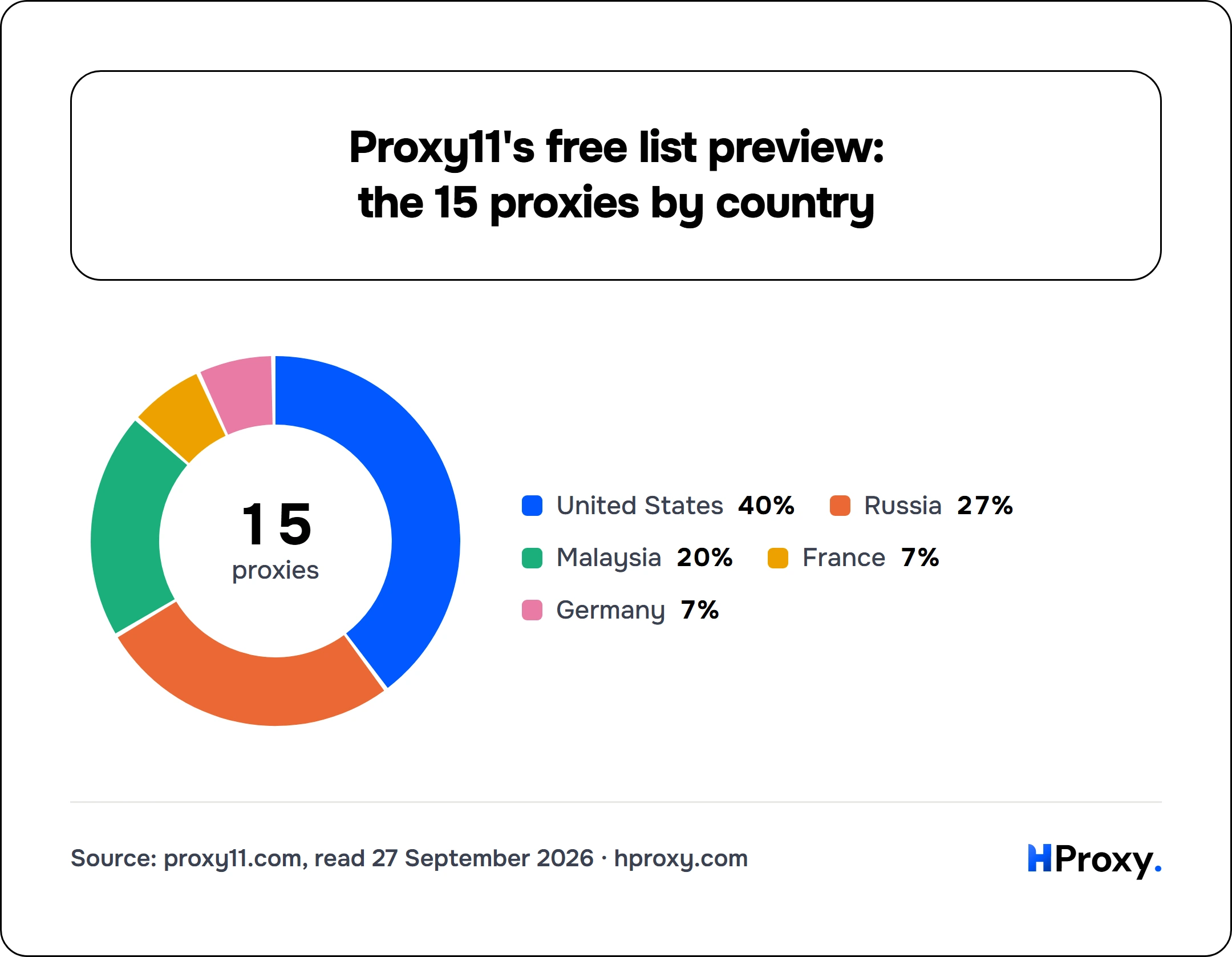
- United States40%
- Russia27%
- Malaysia20%
- France7%
- Germany7%
Neither table has a protocol column, and the API offers no protocol filter. In the preview, five of the fifteen addresses share their first three numbers (5.129.254), so they sit in one small block of addresses.
How it changed
The name is older than the list: its current registration dates from 14 May 2015, and before that it showed a page of proxy links. By January 2016 it offered "the latest 1000 free proxies" and promised a refresh "every 20 minutes". By October 2016 it called itself a free proxy API.
In February 2023 its homepage spoke of "Thousands of http and socks proxies tested daily". In May 2024 and again in November 2025 its prices were free for 50 working proxies, $4 a month for more than 3,000, or $36 a year.
After November 2025 the plans changed to three, six and twelve months with 5,000 proxies per request, and a rotation endpoint was added. The client packages followed in May 2026, and its terms were last updated on 8 July 2026.
The fine print
Public proxies, no promise. Its terms say public proxies "are operated by third parties and are inherently unreliable", and that Proxy11 does not guarantee "the availability, speed, anonymity, or safety of any individual proxy".
Crypto only. Paid plans are billed up front through NOWPayments, a crypto payment service, for a fixed three, six or twelve months.
No refund promise. The terms say Proxy11 "does not guarantee refunds", since access starts at once and the product is third-party proxy data.
Limits of use. Requests are rate-limited per IP address. The terms ban spam, attacks and malware, and reselling access without permission.
Who runs it. The terms name no company and no country, and support runs by email and by tickets from the dashboard.
Where Proxy11 is stronger
A tidy API. Four output formats, simple filters, and client packages for Python and Node.js.
Rotation built in. One proxy per call, random or sticky, so a script needs no pool of its own.
Cheap paid access. $35 a year for 5,000 proxies per request is less than $3 a month.
A long record. It has published free proxy lists for about ten years.
Where HProxy differs
We run a free proxy list too, so read this part as the account of a competitor. Every HProxy fact here comes from our own code and pages.
No key, larger responses. Our free proxy list API needs no account or key and returns every working proxy in one response: 19,417 on 28 September 2026, or up to 10,000 when you set a limit. Its fair-use limit is about 120 requests a minute.
More protocols and grades. It covers HTTP, HTTPS, SOCKS4 and SOCKS5, with three anonymity grades: elite, anonymous and transparent. You can filter by network, port, uptime and latency as well.
History that stays. Each proxy that ever appeared keeps its own page with its uptime record, so you can check whether an address was a public proxy and when.
Paid proxies when free ones fail. Our residential Lite pool targets by country at $0.50/GB for one gigabyte. Premium adds state, city and ISP targeting at $1.49/GB for one gigabyte, and $1.00/GB from 1,000 GB+. A dedicated ISP address costs $2.70/IP for a month.
Where we are behind. Our free API returns lists only, in TXT, JSON or CSV. It has no XML output and no endpoint that hands out one rotating proxy per call.
The alternatives, side by side
Ways to get public proxies into a script, and the paid step up. Every figure comes from the page of each, read on 27 September 2026.
| option | what you get | cost | per request | key needed |
|---|---|---|---|---|
| Proxy11 free | anonymous and transparent HTTP proxies | free | 50 | yes |
| Proxy11 Ultimate | the same list, plus rotation | $12 for 3 months to $35 a year | 5,000 | yes |
| HProxy free list | HTTP, HTTPS, SOCKS4 and SOCKS5 | free | all (up to 10,000 with a limit) | no |
| HProxy residential Lite | rotating residential IPs by country | $0.50/GB for 1 GB | not applicable | account |
| HProxy residential Premium | state, city and ISP targeting | $1.49/GB for 1 GB | not applicable | account |
Free lists suit tests, learning and throwaway tasks. When a job has to keep running, both the Proxy11 terms and we say the same thing: public proxies make no promise.
Who Proxy11 suits
It suits a developer who wants public HTTP proxies in a fixed format, with rotation handled on the server, and is happy to pay a few dollars a year in crypto for larger lists.
It suits you less if you need SOCKS or HTTPS proxies listed as such, want to pay by card, want a refund promise, or need proxies you can depend on for work.
Before you commit
Try the free plan first and compare its 50 proxies with what your target accepts. Test a few against your own target, and never send logins or personal data through a public proxy. Our proxy checker shows whether an address answers, how fast, and from where, whoever listed it.
The limits of this review
We did not open an account or connect to any proxy on the list, so the table above shows only what Proxy11 shows to visitors. We could not measure the full list, its size or how fast it turns over. The history comes from Internet Archive copies of its homepage and price page.
Every figure here carries the day it was read, and this page is due for a check by 27 December 2026.
Sources
- Proxy11, proxy11.com: homepage, free list, price page, API documentation, client package page, terms and contact page. Read 27 September 2026.
- PyPI and npm, the proxy11 client packages, and GitHub, their two repositories. Read 27 September 2026.
- Internet Archive, copies of the Proxy11 homepage from 2007, 2016, 2020, 2023 and 2025, and of its price page from May 2024 and November 2025.
- Verisign, registry record for proxy11.com. Read 27 September 2026.
- HProxy, our free proxy list page, the free list API documentation, and our product records and price table.