The biggest free proxy lists on the internet are ProxyScrape, Spys.one, FreeProxy.World, Geonode, free-proxy-list.net, and ProxyNova. This is a ranked roundup of all six: what each one actually gives you, how often it refreshes, and the trade-offs that never make it onto the landing page.
One thing up front. We ranked these by how likely you are to pull a working proxy out of them today, not by raw row count. A list of 50,000 dead IPs loses to a list of 300 fresh ones every time, so "biggest" in any useful sense means the biggest pool of proxies that are alive when you copy them, not the biggest database on paper. We run our own free proxy list and check proxies for a living, so this is the view from inside the machine. New to free proxies in general? Start with when free proxies are fine, then come back for the roundup.
How we ranked the biggest free proxy lists
Four things decide whether a free proxy list earns a bookmark, in this order:
- Freshness. How often it re-checks its proxies and drops the dead ones. This one matters more than the rest combined, because free proxies die in minutes to hours, not days.
- Usability. Can you copy a clean
ip:port, or are the ports hidden behind JavaScript and buried under ad banners? - Reach. Is there an API your scripts can hit, or is it an HTML table you have to scrape by hand?
- Volume and coverage. How many proxies, across how many countries and protocols.
Volume comes last on purpose. Every site here is big by some measure. What separates them is how much of that size is real at the second you need it.
1. ProxyScrape: the biggest all-rounder
ProxyScrape is the closest thing the free scene has to a one-stop shop. It publishes separate HTTP, SOCKS4, and SOCKS5 lists you can download as plain text or pull through a free API, with filters for protocol, country, anonymity level, and timeout. It runs its own checker and republishes the lists on an automated cycle, so the free download is regenerated often rather than sitting static for weeks.
What puts it at the top is reach. The API means a scraper can fetch a fresh batch without a human copying anything, and the filters actually work. The catch is the same one that haunts every entry on this page: the free pool is datacenter IPs, shared by everyone who found the same download, and only a small slice is alive at any given moment. The "checked" timestamp tells you an IP passed a test recently, not that it will answer when you connect. ProxyScrape also sells paid residential and datacenter plans, so the free list doubles as the top of their funnel.
2. Geonode: cleanest interface, real free API
Geonode runs the most polished free proxy list of the group. The table is filterable by country, protocol, anonymity, and speed, every row shows uptime, latency, and a last-checked time, and there is a genuine JSON API on the free tier so you can pull entries straight into code. For a free list, the transparency is unusually good.
Freshness is decent and, more importantly, visible: the uptime and last-checked columns let you skip entries that already look shaky. Geonode's free list is also a funnel to their paid residential product, so it is tuned to look good more than to be huge, and the raw volume is moderate rather than record-breaking. You are trading some size for a cleaner, better-labeled presentation, which for a lot of people is the right trade.
3. free-proxy-list.net: small, transparent, and it just works
free-proxy-list.net is the plain HTML table almost everyone has copied from at least once. One page, a few hundred entries, columns for IP, port, country code, anonymity, Google-passed, HTTPS, and last checked. It is run by the same operator as sslproxies.org, us-proxy.org, and socks-proxy.net, so between the four sister sites you can narrow to SSL, US-only, or SOCKS without any account.
Its strength is that simplicity leaves nowhere to hide anything. The last-checked column is right there, the list refreshes on a short cycle, and there is nothing to install or sign up for. The weakness is size: it is one page, so it is tiny next to ProxyScrape or Spys.one, and because it is one of the most copied lists on the internet, those shared IPs burn out fast under the load. There is no free API either, so automating it means scraping the table yourself. For a quick handful of proxies to test something, though, it is hard to beat the lack of friction.
4. ProxyNova: freshness you can see
ProxyNova puts the one thing that matters most, freshness, right in your face. Its table shows a last-checked value in seconds or minutes, alongside a speed bar, an uptime figure, country, and anonymity grade. It leans on per-country landing pages, so "proxies in Germany" or "proxies in the US" each get their own view.
The near-real-time last-checked column is genuinely useful for eyeballing which rows are worth trying first. Read that column carefully, though: "checked 40 seconds ago" still is not "alive right now" when the IP is a shared datacenter address that a hundred other people are hammering. Volume is middle of the pack, there is no bulk free API, and, like the rest, the underlying proxies are the same disposable datacenter stock. Treat the freshness label as a hint, not a guarantee, and verify before you lean on anything.
5. FreeProxy.World: big and filterable, slower to clean
FreeProxy.World is one of the larger lists by row count, with deep filtering by country, port, protocol, anonymity, and speed, plus a last-check timestamp on each entry. If you want to slice a big pool down to a very specific slice (SOCKS5, elite, one country), the filters deliver.
The trade-off is verification speed. It carries a higher share of dead entries than the leaders because its re-check cycle is slower, so the filters happily hand you proxies that pass on paper and fail on connect. Ads are heavy, there is no clean free API, and the proxies are the usual shared datacenter fare. It is a solid place to gather a lot of candidates in a specific country, as long as you go in expecting to test a big batch and keep the survivors.
6. Spys.one: the biggest raw pile, the worst to use
Spys.one (formerly spys.ru) has the deepest raw volume on this list, tens of thousands of proxies across well over a hundred countries, with detailed anonymity and latency columns for each. On paper it is the biggest free proxy list here. In practice it is the most painful to actually use.
The interface is famously cluttered, the ports are hidden behind JavaScript so you cannot cleanly copy ip:port, and the whole thing is wrapped in ads. The proxies are shared and unstable, with uptime our free proxy list graveyard piece clocked at around 70 percent. It survives on sheer size and inertia, not on quality of experience. If you are willing to fight the UI, there are working proxies buried in there, but nearly every other option on this page gets you a clean address with far less friction.
The biggest free proxy lists compared
Same idea, very different execution:
| Site | Format | Freshness signal | Free API | The catch |
|---|---|---|---|---|
| ProxyScrape | Txt lists + web tables | Auto re-check, frequent | Yes (txt/JSON) | Huge, but mostly dead datacenter IPs at any moment |
| Geonode | Web table | Per-row uptime + last-checked | Yes (JSON) | Funnel to paid residential; moderate volume |
| free-proxy-list.net | One HTML table | Last-checked column, short cycle | No | Tiny; the most-copied IPs burn out fast |
| ProxyNova | Web table | Last-checked in seconds/minutes | No | "Recently checked" is not "alive now" |
| FreeProxy.World | Web table + filters | Last-check column | No | More dead entries; slower re-check cycle |
| Spys.one | Dense web table | Continuous but loose | No | Ports hidden in JS, ads, uptime around 70% |
What all six have in common
Strip away the branding and every list on this page draws from the same well. They are overwhelmingly datacenter IPs, they are shared by everyone who found the same list, and only a small fraction are working at any given moment. In our free proxy data study, across 129,131,311 checks, the pattern was blunt: free proxies decay fast, and a list that is not re-checked constantly is wrong within minutes, not days.
94% lost from Unique proxies discovered
88% lost from In the working pool
Rank those six lists by raw row count and you are sorting by the least useful number on the page. The pool that actually answers is the bottom tile, not the top one, which is why "biggest" only means something once you measure it in live proxies.
They share a safety profile too, which no landing page mentions. When a researcher ran 443 public proxies through a controlled test, only about a fifth were not doing something shady: most refused HTTPS so traffic stayed readable, and dozens rewrote pages to inject ads or scripts (Christian Haschek, "Analyzing 443 free proxies"). Which list you pulled the IP from does not change any of that, so the rule holds no matter the source: never route a login or anything private through one, and verify each entry before you trust it.
That is why a site's design matters less than its verification loop. A pretty table of stale IPs is worse than an ugly one that re-checks every few minutes. It is also why your own testing is not optional. Whatever list you pull from, run the entries through a checker before you trust them, because "it was on a big free proxy list" tells you nothing about whether it works for you right now. We wrote a full walkthrough on how to check if a proxy is working if you want the exact steps.
Where HProxy fits
We built our list around the one thing this whole roundup keeps circling back to: freshness. Our free proxy list re-checks every entry every few minutes and drops the dead ones, spanning 100+ countries across HTTP, HTTPS, SOCKS4, and SOCKS5. Dead rows fall off, fresh ones come on, and what you copy is what was alive moments ago, not whatever a scraper grabbed last quarter.
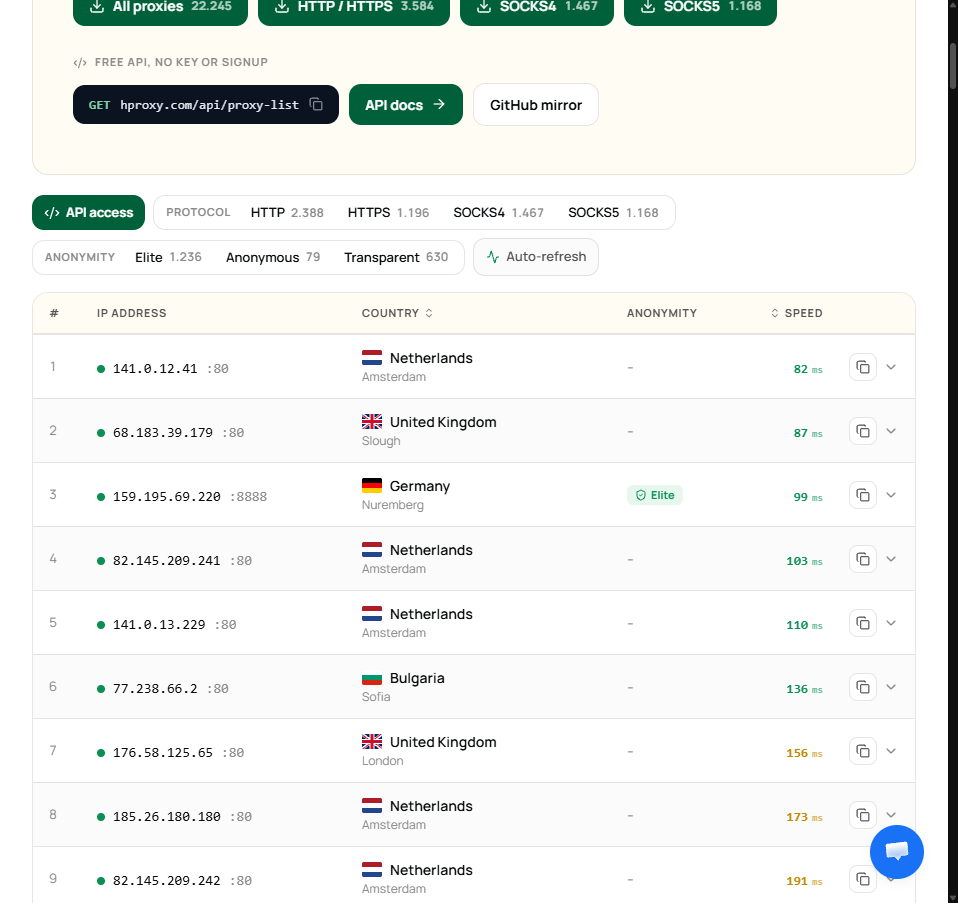
Two more pieces round it out. Our free proxy checker tests any entry, from our list or anyone else's, and tells you in one pass whether it is alive, fast, and actually hiding you. And when free stops being enough, which happens the moment a login, a payment, or a job with money on it enters the picture, our residential proxies start at $0.44/GB, pay as you go. The split is simple: free for disposable work, residential when it has to hold.
The short version
If you want the biggest free proxy lists ranked by usefulness, start with ProxyScrape for scale and an API, Geonode for a clean interface and JSON, and free-proxy-list.net when you just need a quick handful. Then run whatever you pull through a checker before trusting any of it. When you are ready, our free proxy list is re-checked every few minutes so you spend less time refreshing dead pages, and if the task actually matters, residential at $0.44/GB is one step away.