The shortest useful answer about ResidentialProxy: find out what their current published rate is, find out whether your balance expires, then measure success rate on your own target. Everything below expands those three steps.
The record we hold
ResidentialProxy operates from residentialproxy.io.
What we do not hold is a current, sourced price for ResidentialProxy. Rather than print a figure we cannot stand behind, this page leaves it out and tells you what to look for when you read their page yourself.
Copy down the entry rate, the commitment attached to the cheapest rate, the minimum top-up and the expiry rule. Those four turn a marketing figure into something you can compare.
What is on their front page
Read 9 September 2026, the homepage titles itself "Buy Fast Residential IP Proxies, Reliable ISP Proxy Network , ResidentialProxy.io". Their own summary of the product runs: "ResidentialProxy.io offers ultra-fast, secure, and affordable residential IP proxies powered by real ISP connections. Enjoy global coverage, high uptime, and anonymous browsing trusted by professionals worldwide."
Taken from the same page, on the same day:
The product lines named on that page are residential, datacenter, ISP or static residential, mobile, SOCKS5 and IPv6. They advertise 210 countries or locations. Payment methods mentioned: PayPal, crypto and cards. Support is advertised as around the clock. Their pricing page is titled "Pricing , ResidentialProxy.io".
All of the above is their copy, not our finding. A dated quotation is the weakest kind of evidence that is still evidence.
What they have built around the product
We crawled 66 pages of their site and found 8 blog pages, 1 pricing page, 29 location pages and 17 use-case pages.
Read it as a map of what they emphasise. It is our count, from our crawler, on the date shown, and it is the only figure on this page that neither of us can dispute.
The parts no marketing page answers
Ten million addresses, and none of them yours
Nobody audits pool totals in this market, and the counting rules differ between vendors. Even an accurate figure describes addresses that exist, not addresses you will be routed through. Treat it as a marketing unit rather than a capability.
The entry price is not the effective price
A starting rate is a marketing number. What you pay depends on the tier your volume lands in, the minimum purchase, and what happens to traffic you bought and did not use. An expiring balance quietly raises the price of every unit you did consume.
Threads, not gigabytes, are often the ceiling
Bandwidth is rarely the constraint on a real workload. Concurrent connections, requests per second and per-session caps are, and they are frequently buried in the documentation rather than the pricing page.
Side by side, with the blanks left blank
The table answers what we can answer and marks what we cannot:
| Question to ask | ResidentialProxy | HProxy |
|---|---|---|
| Entry price | Not verified by us, read their page | From $0.44/GB, pay as you go |
| Does unused balance expire? | On their own terms page | Never |
| Minimum commitment | Their terms page answers this | None |
| Identity checks | Check the current terms, this one moves | Card orders are screened, and verification is sometimes requested |
| Targeting | Their terms page answers this | Country, city and ISP |
| Free way to evaluate | Check the current terms, this one moves | Free proxy list and proxy checker |
Every unfilled cell above is a question to put to them directly, in writing, before money changes hands. Vendors answer those questions readily; comparison sites guess at them.
How to settle it yourself in ten minutes
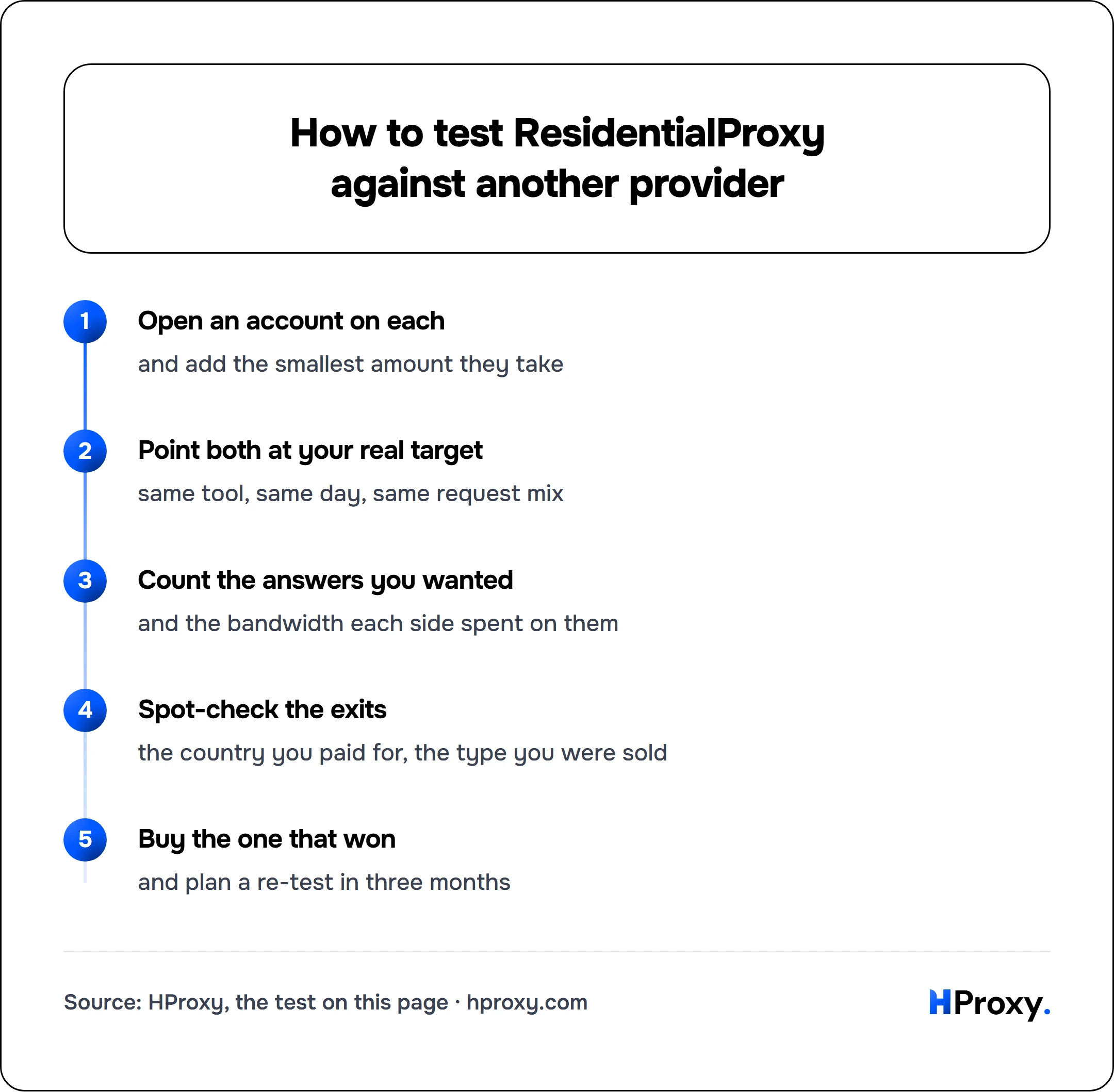
Run this before you commit any volume. It replaces every opinion on this page, including ours.
- Open an account on each and add the smallest amount they take. Skip the trial if a paid unit is cheap enough to buy outright.
- Point both at your real target, through your real tool, on the same day, with the same mix of requests.
- Count how many requests returned what you wanted, and how much bandwidth each side spent doing it.
- Spot-check the exits. Confirm they are in the country you paid for and the connection type you were sold.
- Buy the one that won on your target, and diarise a re-test in three months.
Open an account on each
and add the smallest amount they take
Point both at your real target
same tool, same day, same request mix
Count the answers you wanted
and the bandwidth each side spent on them
Spot-check the exits
the country you paid for, the type you were sold
Buy the one that won
and plan a re-test in three months
Who else is in this bracket
The same treatment, applied to the providers most often weighed against this one:
Our side of it
HProxy is pay as you go from $0.44 per GB on residential, with ISP, mobile and datacenter under one balance and no commitment attached to any of them. Run the test. If we lose on your target, we lose, and you have your answer.