ProxyRack (proxyrack.com) sells residential, ISP, mobile and datacenter proxies on monthly plans. It bills in four units: by the GB, by thread, by port or by IP. On 27 September 2026 residential cost $110 for 100 GB a month, and unmetered residential $300 for 100 threads. The terms name Secure Privacy Group Limited in Hong Kong. The alternatives table prices five sellers, read the same day.
The record, with dates
| date | what happened |
|---|---|
| 15 April 2012 | The current registration of proxyrack.com begins. |
| November 2020 | Its page says it has "607,452 proxies online right now". |
| 19 June 2021 | Its current terms take effect. |
| 27 September 2026 | Our check: live, with the plans below. |
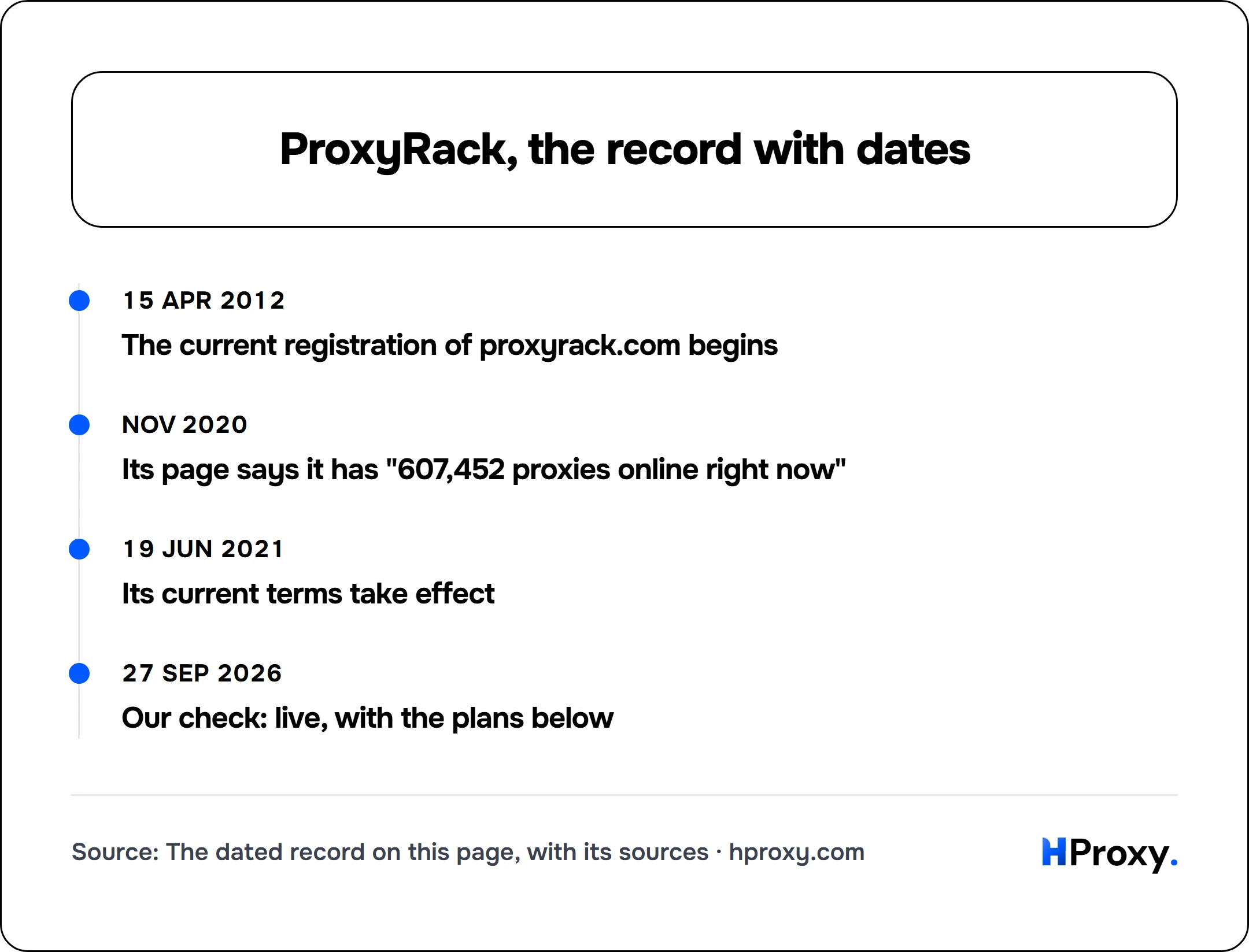
15 Apr 2012
The current registration of proxyrack.com begins
Nov 2020
Its page says it has "607,452 proxies online right now"
19 Jun 2021
Its current terms take effect
27 Sep 2026
Our check: live, with the plans below
Sources: the Verisign registry, the Internet Archive, the ProxyRack terms and our own check.
What it sells, and what it costs
Monthly prices, as placed on its product pages:
| product | billed by | price a month |
|---|---|---|
| residential | GB | $110 for 100 GB, $180 for 200 GB, $425 for 500 GB |
| unmetered residential | threads | $300 for 100, $750 for 500, $1,250 for 1,000, $4,500 for 5,000 |
| private residential | ports | $299.90 for 15, $459.90 for 25 |
| ISP | IPs | $1.25 each, $49.95 for 40, $1,050 for 1,000 |
| mobile | GB | $44 for 40 GB, $110 for 150 GB, $170 for 300 GB |
| datacenter, rotating | threads | $150 for 100, $480 for 500 |
| datacenter, shared | ports | $100 for 100, $300 for 500 |
Unmetered residential has "No GB limit" and "GEO targeting (country, city, ISP)", over HTTP, SOCKS and UDP. It claims 32M+ residential IPs in 140+ countries and 1.4M+ mobile IPs. A web scraping API costs $119 to $282 a month.
Two more things run on the site. A free proxy list is "updated every ten minutes". A peer program pays people "for every GB of internet bandwidth you share" through desktop software.
The fine print
- The trial. The homepage offers a $5, 3-day trial. The pricing page links a 7-day trial, and its price does not show as text.
- Refunds. Within 72 hours, and only for payments "via the Paddle merchant system (PayPal and Credit Cards)".
- After a trial. No unmetered refund goes to anyone who "had a free or paid trial" before.
- Premium plans. A 1 GB plan is refunded in full within 72 hours; other plans refund the unused GB.
- Monthly plans. The pages do not say whether unused GB carries over to the next month.
- The company. Secure Privacy Group Limited, Hong Kong, under Hong Kong law. The terms date from June 2021.
Where ProxyRack is the stronger choice
- Heavy traffic at a fixed price: residential with no GB limit, with city and ISP targeting.
- Cheap static IPs: $1.25 an IP when you build your own plan.
- Mobile at volume: 300 GB for $170 a month.
- UDP on its residential lines, which we offer on Premium only.
Where HProxy is different
| ProxyRack, 27 September 2026 | HProxy | |
|---|---|---|
| how you pay | monthly plans by GB, threads, ports or IPs | pay as you go per GB, from one balance |
| smallest residential plan | $110 for 100 GB a month | 1 GB of Lite at $0.50/GB |
| city and ISP targeting | on unmetered plans, from $300 a month | Premium, $1.49 for one GB |
| residential with no GB limit | yes, billed by threads | not sold; residential is billed by the GB |
| does traffic expire | monthly plans; carry-over not stated | never: the balance does not expire |
| refunds | 72 hours, Paddle payments only | a public refund policy |
| one static IP | $1.25 a month, build your own | static ISP at $2.70/IP per month |
| mobile | $44 for 40 GB a month | $1.50 per GB, 1 GB minimum |
The two models suit different jobs. Threads suit steady, heavy traffic. A balance by the GB suits traffic that comes in bursts. Our page on unlimited residential proxies explains why we sell only the second.
Five alternatives, priced the same day
Every rate below comes from each vendor pricing page, read from our server on 27 September 2026. A rate you cannot reach is not a price.
| provider | entry rate | lowest published rate | worth knowing |
|---|---|---|---|
| DataImpulse | $1 per GB: 5 GB for $5, for new users | $0.80 per GB at 1 TB for $800 | Traffic never expires. State, city, ZIP and ASN filters count at double the rate. |
| Evomi | $0.99 per GB pay as you go, from 15 GB | $0.49 per GB on the 100 GB plan at $49 a month | Pay-as-you-go data has no expiry. |
| Webshare | $3.50 for 1 GB a month, half a $7 list price | $1.40 per GB: 3,000 GB for $4,200 a month | Monthly traffic does not roll over. |
| SOAX | $5 per GB on the free Sandbox plan, tier 1 | from $0.85 per GB on the $3,000 a month plan | Credits on Sandbox and monthly plans expire after 60 days. |
| HProxy | $0.50/GB for 1 GB of Lite, country targeting | $0.44/GB at 2,000 GB+ | City and ISP targeting on Premium: $1.49 for one GB. |
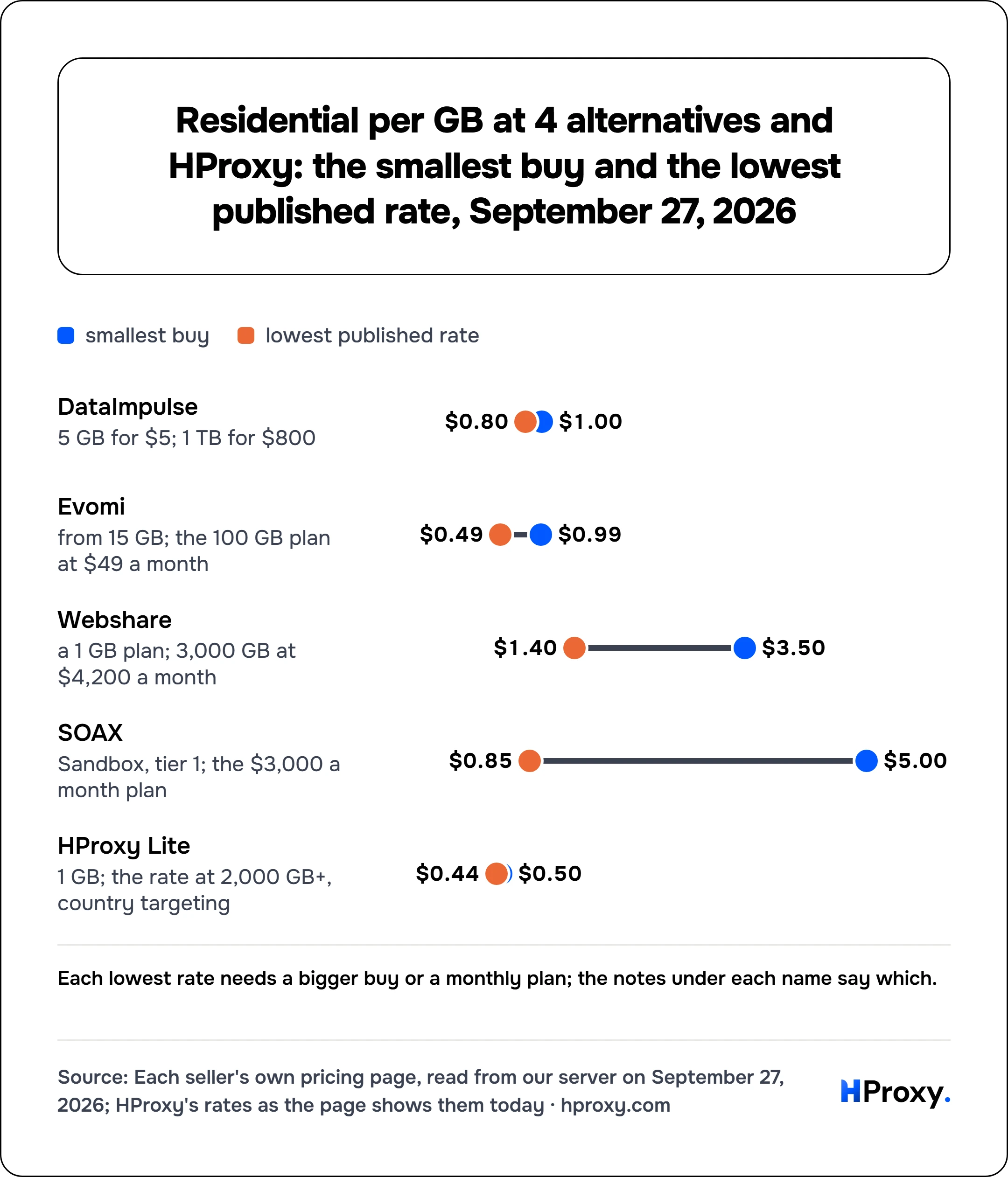
- smallest buy
- lowest published rate
Which one to pick
- You move a lot of data every month and want a fixed bill: ProxyRack unmetered residential is built for that.
- You need many static IPs: ProxyRack ISP proxies from $1.25 each are hard to beat.
- You buy residential a few GB at a time: a seller that sells 1 GB, such as our Lite at $0.50/GB.
- You need city or ISP targeting from one GB: our Premium pool at $1.49 for one GB.
Whichever seller you pick, test what you get with our free proxy checker. It checks HTTP and SOCKS proxies with no sign-up.
The limits of this record
We did not buy from ProxyRack, so nothing here measures its network. Its pool counts are its own claims, and the Trustpilot score is the one its homepage shows. Older price blocks still sit in its pricing data next to the ones its product pages show; we used the product pages. This page is due for a check by 27 December 2026.
Sources
Read on 27 September 2026, from our server:
- ProxyRack: the homepage, the product and pricing pages and their plan data, the refund policy, the terms, the free proxy list and the peer program page.
- Verisign, registry record for proxyrack.com, and Internet Archive captures from 2007 to 2026.
- DataImpulse, Evomi, Webshare and SOAX pricing pages, the DataImpulse targeting docs and the Webshare help center.
- HProxy, our product catalogue and sheets, and our legal and payment pages.