ProxyPanel (proxypanel.io) sells dedicated US 4G and 5G mobile proxies, and it is trading normally. One plan buys one proxy that can exit from any of 244 US locations on Verizon, AT&T or T-Mobile, with unlimited bandwidth. It costs $3 for three hours, $10 a day, $30 a week or $100 for 30 days. For the comparison, jump to the alternatives table.
ProxyPanel at a glance
| what we found on 27 September 2026 | |
|---|---|
| status | trading, the site answered normally |
| online since | domain registered 5 October 2020, shop archived from February 2021 |
| product | one dedicated mobile proxy, 4G and 5G |
| carriers | Verizon in 176 cities, AT&T in 29, T-Mobile in 39 |
| locations | 244, one active exit at a time, moves are free |
| price | $3 for 3 hours, $10 a day, $30 a week, $100 for 30 days |
| bandwidth | unlimited |
| protocols | HTTP and SOCKS5, user:pass or IP whitelist |
| payment | cards through Stripe, or crypto |
| refunds | all sales final, crypto never refunded |
| operator | not named; support on Telegram |
How ProxyPanel works
One plan buys one dedicated proxy, which its terms describe as backed by real mobile devices on carrier networks. The proxy is not pinned to a city: you point it at any of the 244 locations and move it whenever you like, one exit at a time, with the same credentials.
The IP rotates on a timer from 5 to 60 minutes, on demand through a change-IP link or the API, or stays the same for as long as you need. Every proxy speaks HTTP and SOCKS5, and its FAQ recommends SOCKS5 when you need raw TCP and UDP traffic. Its live sample marks each city as Open, Busy or Full, so a location can fill up.
Support runs on Telegram around the clock. Fleets, team sub-accounts, volume discounts and custom locations are arranged on Telegram too.
What ProxyPanel costs
Every price below comes from its homepage, read on 27 September 2026.
| pass | price | per day |
|---|---|---|
| 3 hours | $3 | |
| 24 hours | $10 | $10.00 |
| 7 days | $30 | $4.29 |
| 30 days | $100 | $3.33 |
Its page says the monthly plan saves 22 percent against paying by the week. Every pass includes all locations, all three carriers and unlimited bandwidth.
The price has come down. In February 2021 it sold 8 cities for $175 a month, $75 a week or $10 for a one-hour trial, saying "We actually own the modems". By December 2022 it covered more than 150 cities on three carriers for $30 a week or $100 a month. In December 2024 the page named only AT&T and T-Mobile and sold a one-hour trial for $1. The rebuilt site of 2026 lists 244 locations with Verizon again.
The fine print
All sales are final. Refunds come only at its discretion, for example when it cannot deliver. Crypto payments are never refunded, and a chargeback while you keep using the service is grounds for suspension. Your prepaid balance does not expire.
No uptime promise. Its terms offer no uptime guarantee or service level, promise no specific IP, carrier or network behaviour, and call rotation and relocation best effort.
Two trial statements. The homepage promises a free trial with no card, while its FAQ calls the trial a $3 three-hour pass.
Who you deal with. The terms speak of an operator without naming one, and they choose the law of the home state of that operator without naming the state either. One liability clause names "PROXYTOWER" instead of ProxyPanel.
Acceptable use. You must be 18 or older. Fraud, account takeover, attacks, spam and resale are banned, and it says it does not inspect the content of your sessions.
Where ProxyPanel is stronger
All of the US on one proxy. You get 244 locations on three carriers, and you can move the proxy as often as you like at no charge.
Unlimited bandwidth on a dedicated device. Heavy traffic costs the same as light traffic.
Short passes. Three hours for $3 lets you test a city or a carrier on your own target before paying for a whole month.
City and carrier choice. You pick the metro and the network for every proxy you run.
Rotation tools. A timer, a change-IP link and an API, on every plan.
Where HProxy differs
We sell proxies too, so read this part as the account of a competitor. Every HProxy fact here comes from our own product code and pages.
Mobile by the gigabyte. Our mobile proxies cost $1.50/GB, targeted by country, with sticky or rotating sessions. Which model costs less depends on how much you move: a flat device price favours heavy traffic, and a price per gigabyte favours light traffic.
Residential with finer targeting. Premium, our residential pool with state, city and ISP targeting, costs $1.49/GB for one gigabyte and $1.00/GB from 1,000 GB+. Lite targets by country at $0.50/GB for one gigabyte. Purchased gigabytes have no scheduled expiry date.
Payment and paperwork. We take cards, Alipay and thirty-two crypto options, and we ask for no documents at sign-up or at an ordinary checkout.
Where we are behind. We sell mobile by the gigabyte, not a dedicated device with unlimited bandwidth, we have no three-hour pass, and our mobile targets by country, with no choice of city or carrier.
The alternatives, side by side
One dedicated US mobile proxy. Every figure below comes from the page of each vendor, read on 27 September 2026.
| provider | shortest pass | one month | locations | carriers |
|---|---|---|---|---|
| ProxyPanel | $3 for 3 hours | $100 | 244, free moves | Verizon, AT&T, T-Mobile |
| ProxYou, US | $10 a day | $90 | 13 states | AT&T, T-Mobile, Verizon |
| MobileHop SingleHop | $5 an hour | $180 | two free moves | Verizon 5G |
| MobileHop MultiHop | $9 an hour | $225 | 50+, free moves | Verizon 5G |
| HProxy mobile | 1 GB at $1.50/GB | billed by the gigabyte | by country | no carrier choice |
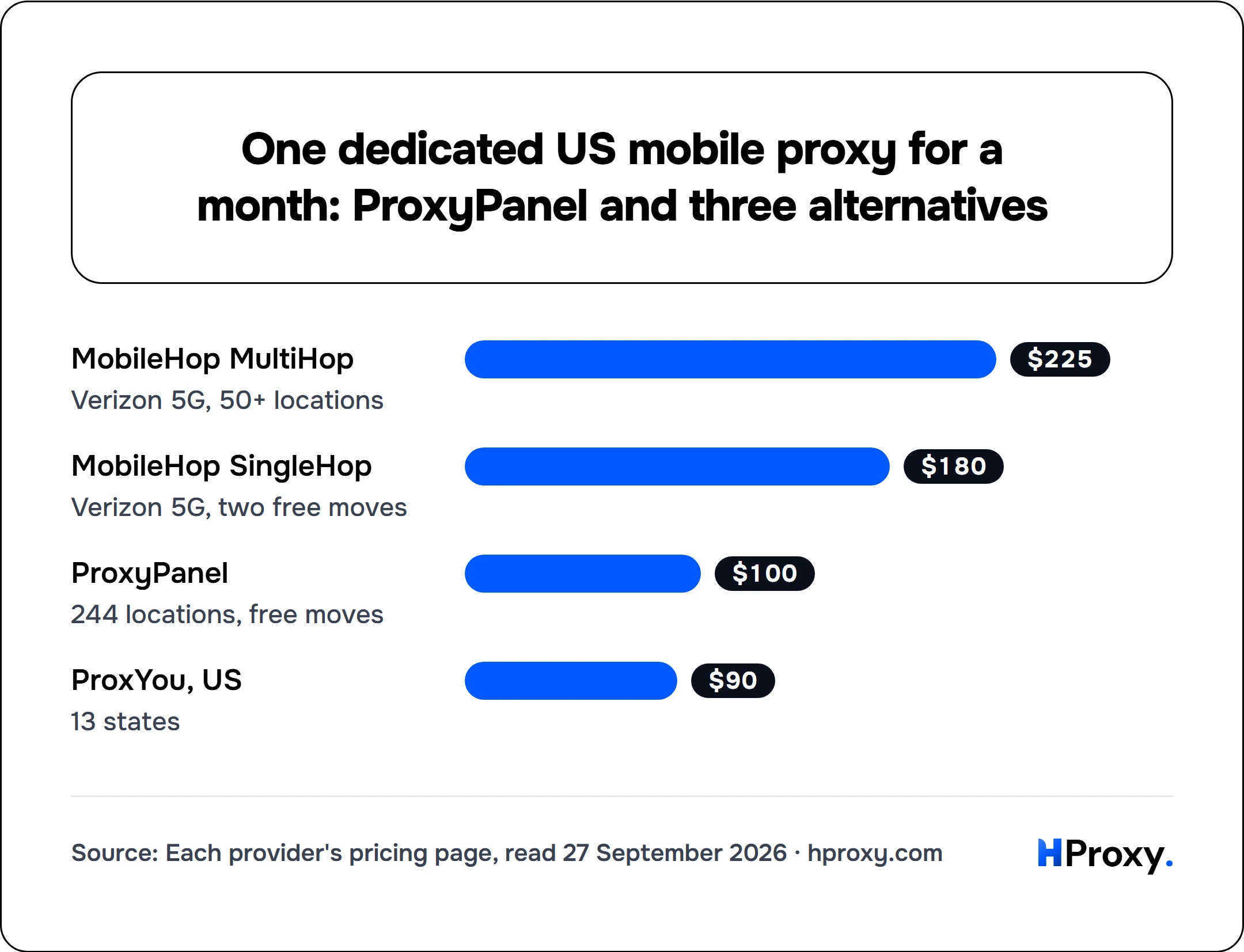
All three device sellers advertise unlimited bandwidth. ProxYou costs $10 less for a month, and ProxyPanel lists more locations for its $100. MobileHop charges more for a month on Verizon 5G and sells passes by the hour.
Who ProxyPanel suits
It suits a US operator who runs social accounts, rank tracking or scraping through a mobile IP, needs cities on more than one carrier, and moves enough data that unlimited bandwidth pays.
It suits you less if you need countries outside the US, a way back when a plan disappoints, a named company behind the service, or only a few gigabytes a month.
Before you commit
Buy the shortest pass first and point it at the site you care about, in the city you need. Our proxy checker shows whether an address answers, how fast, and from where, whoever sold it.
More comparisons on our blog: Hidemium, Hidemy and HomeIP.
The limits of this review
We did not test the ProxyPanel network, so this page makes no claim about speed or success rates. Its speed figures, such as an average latency under 0.6 seconds, are its own. Trustpilot refused our reader, and we found no independent review we could read.
Every figure here carries the day it was read, and this page is due for a check by 27 December 2026.
Sources
- ProxyPanel, homepage with its price data and FAQ, terms of service, acceptable use policy and privacy policy (last updated 10 June 2026). Read 27 September 2026.
- Internet Archive, captures of proxypanel.io from February 2021, December 2022, December 2024 and November 2025.
- Identity Digital, registry record for proxypanel.io. Read 27 September 2026.
- Scamadviser and Trustpilot pages about proxypanel.io, and its Telegram contact page. Read 27 September 2026.
- ProxYou, United States price data, and MobileHop, homepage plans. Read 27 September 2026.
- HProxy, our own product records, price table and terms.