
MarsProxies (marsproxies.com) sells residential, ISP, datacenter and mobile proxies, and its terms name the seller as Comet Tech Inc. of Panama. It began in 2021 as a sneaker proxy shop with prices in euros and turned into a general proxy seller in 2024. On 14 October 2026 its residential traffic cost $4.99 for 1 GB and $299 for 100 GB, the same as on 27 September, and the traffic does not expire. Its own status page counts 100% uptime for residential proxies over 90 days, and far less for ISP proxies in some regions. For a price check, see 100 GB at ten other sellers.
MarsProxies at a glance
| what we found on 14 October 2026 | |
|---|---|
| status | live; one partial outage in progress on its status page |
| seller | Comet Tech Inc., Panama, by its terms |
| residential | $4.99 for 1 GB, down to $1.65 a GB at 10,000 GB |
| ISP | $2.99 an IP for 30 days, from $1.35 for a day |
| datacenter | $1.99 an IP for 30 days, from $0.99 for a day |
| mobile | $8.49 a day, $95 for 30 days |
| traffic | never expires |
| uptime over 90 days | residential 100%; ISP 76.65% to 100% by region |
| refunds | only for a service that fails in its first day |
From sneaker proxies to a general seller
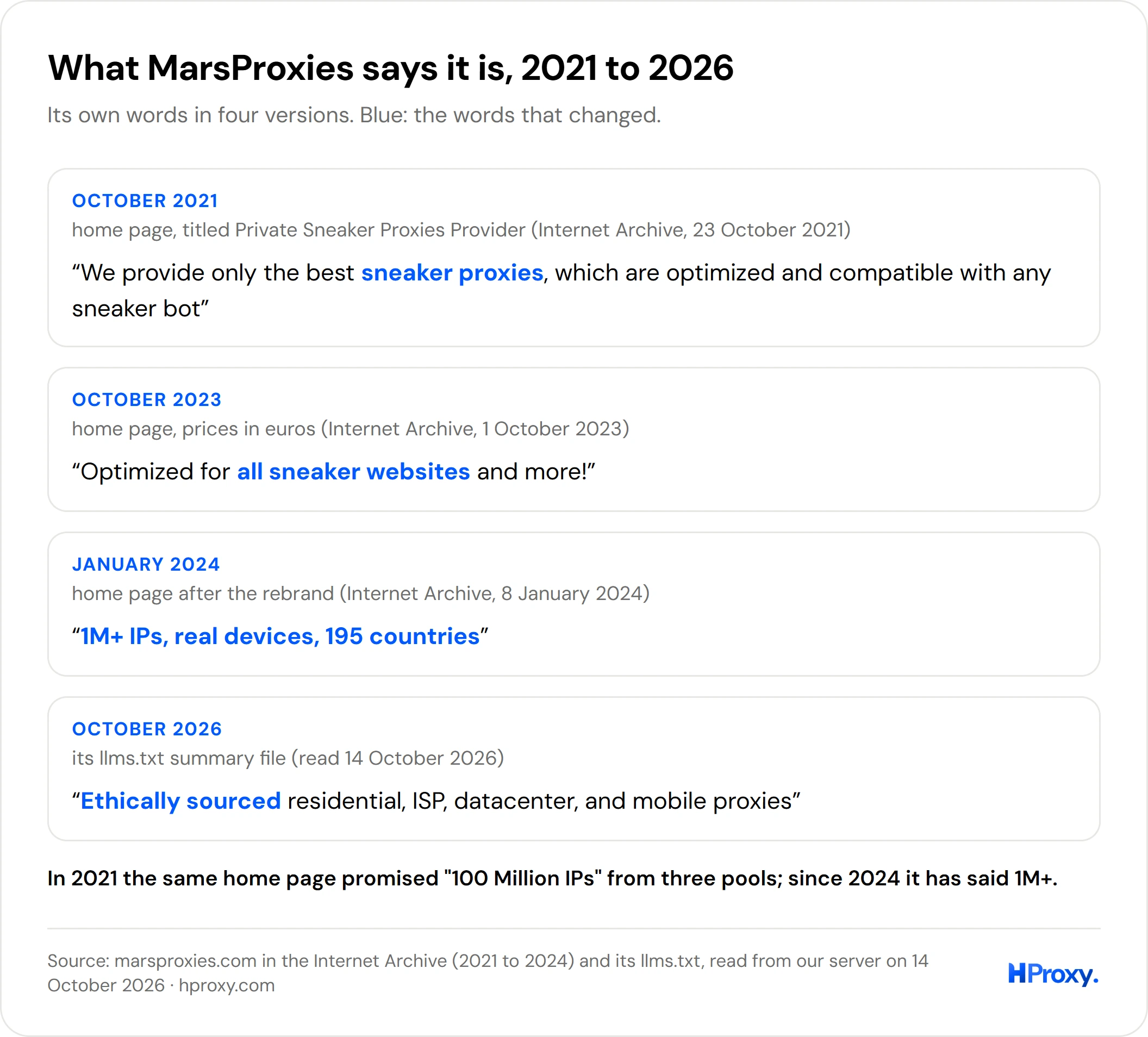
The domain marsproxies.com was registered on 11 January 2020 through GoDaddy. By October 2021 its home page carried the title "MarsProxies - Private Sneaker Proxies Provider" and offered proxies "compatible with any sneaker bot". Residential traffic cost €5.00 a GB, and a datacenter proxy €0.80 for a day or €1.80 for a month. The residential plan was "packed with over three different individual pools", it said, for "100 Million IPs". Two years later the shop still served sneaker buyers, at €3.00 a GB, and sold its datacenter proxies under the name Mars Obsidian Proxies.
A rebuilt site of January 2024 dropped the sneaker title and introduced "1M+ IPs, real devices, 195 countries", and by June 2024 its price page listed dollars. The terms of 8 April 2024, version 1.1, named Comet Tech Inc. of Panama as the seller, and so does every version since. By September 2025 the menu also listed datacenter IPv6 proxies from $0.22, marked NEW. Between February and August 2026 the IPv6 and sneaker lines left the menu, and the residential prices were rebuilt into twelve plans.
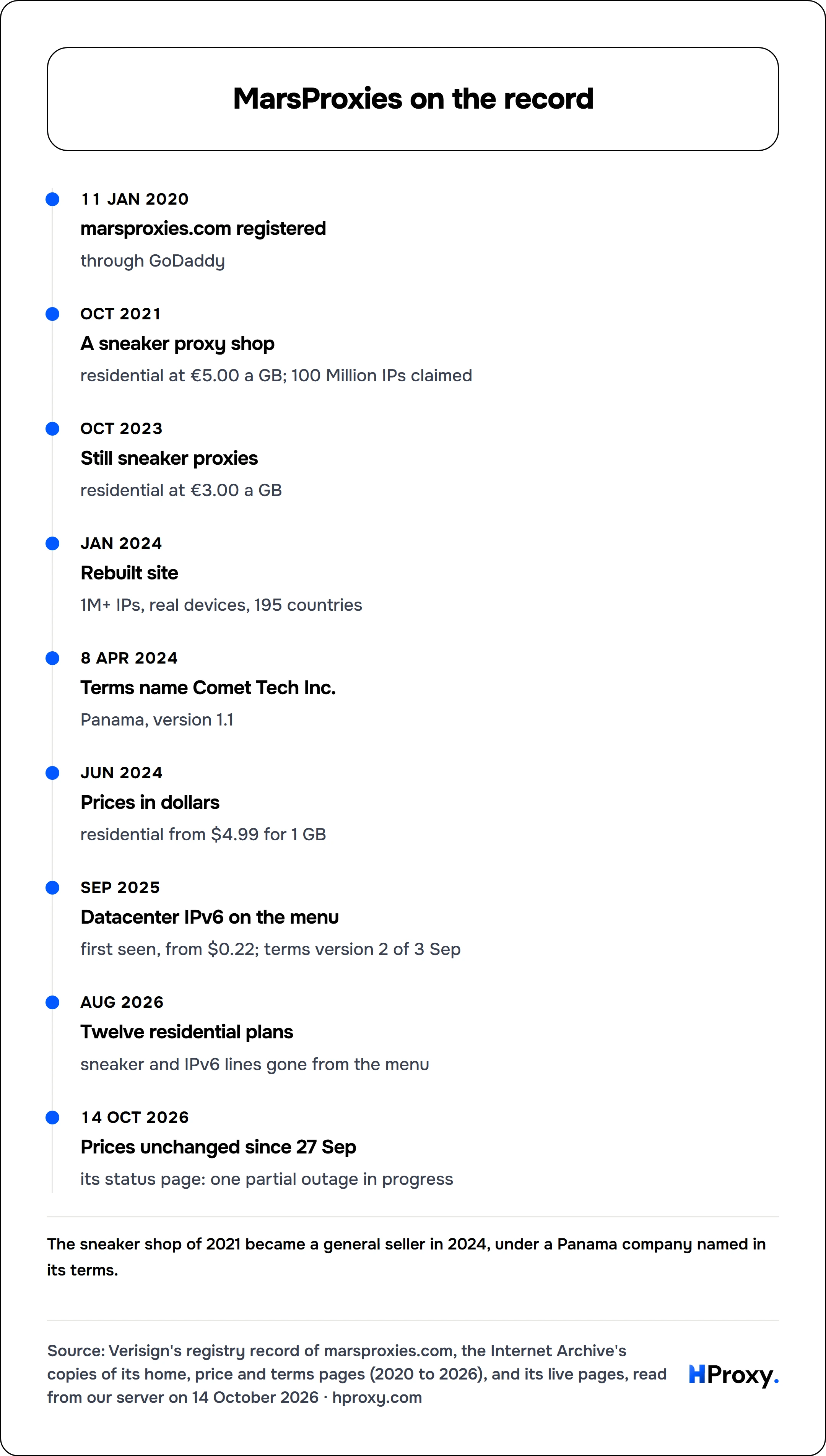
11 Jan 2020
marsproxies.com registered
through GoDaddy
Oct 2021
A sneaker proxy shop
residential at €5.00 a GB; 100 Million IPs claimed
Oct 2023
Still sneaker proxies
residential at €3.00 a GB
Jan 2024
Rebuilt site
1M+ IPs, real devices, 195 countries
8 Apr 2024
Terms name Comet Tech Inc.
Panama, version 1.1
Jun 2024
Prices in dollars
residential from $4.99 for 1 GB
Sep 2025
Datacenter IPv6 on the menu
first seen, from $0.22; terms version 2 of 3 Sep
Aug 2026
Twelve residential plans
sneaker and IPv6 lines gone from the menu
14 Oct 2026
Prices unchanged since 27 Sep
its status page: one partial outage in progress
What MarsProxies charges today
| product | smallest plan | largest plan |
|---|---|---|
| residential | 1 GB at $4.99 | 10,000 GB at $1.65 a GB |
| ISP | 1 IP at $2.99 for 30 days | 1,000 IPs at $2.09 each |
| datacenter | 1 IP at $1.99 for 30 days | 1,000 IPs at $1.19 each |
| mobile | $8.49 for a day | $95 an IP for 30 days |
Every tier on its four price pages matched what we read on 27 September. The residential page still shows two discount figures: "Save up to 67%" at the top, which matches its own table, and "up to 54%" in the text further down.
The price of a large amount has fallen. From June 2024 to February 2026 the archived price page sold residential traffic in bands, each at one rate, and the home page's "Gets as low as $3.49/GB" was the rate from 500 GB up. The twelve plans seen from August 2026 cut 100 GB from $399 to $299 and 1,000 GB from $3,490 to $2,100. The single gigabyte kept its price.
| amount | Jun 2024 to Feb 2026 | Aug to Oct 2026 |
|---|---|---|
| 1 GB | $4.99 | $4.99 |
| 10 GB | $4.49 a GB | $3.99 a GB |
| 100 GB | $3.99 a GB | $2.99 a GB |
| 500 GB | $3.49 a GB | $2.30 a GB |
| 1,000 GB | $3.49 a GB | $2.10 a GB |
| 10,000 GB | $3.49 a GB | $1.65 a GB |
What its own status page shows
MarsProxies keeps a public status page, status.marsproxies.com, with 90 days of history for each service. When we read it on 14 October 2026 its banner said "Partial Outage In Progress", for ISP proxies in South America. Residential proxies scored 100.00% in each of the five regions it lists: the US, the EU, Singapore, Japan and Australia. ISP proxies, its static residential addresses, ranged from 76.65% in Northern Europe to 100% in Africa. Datacenter proxies ran from 91.80% in North America to 100% in Oceania.
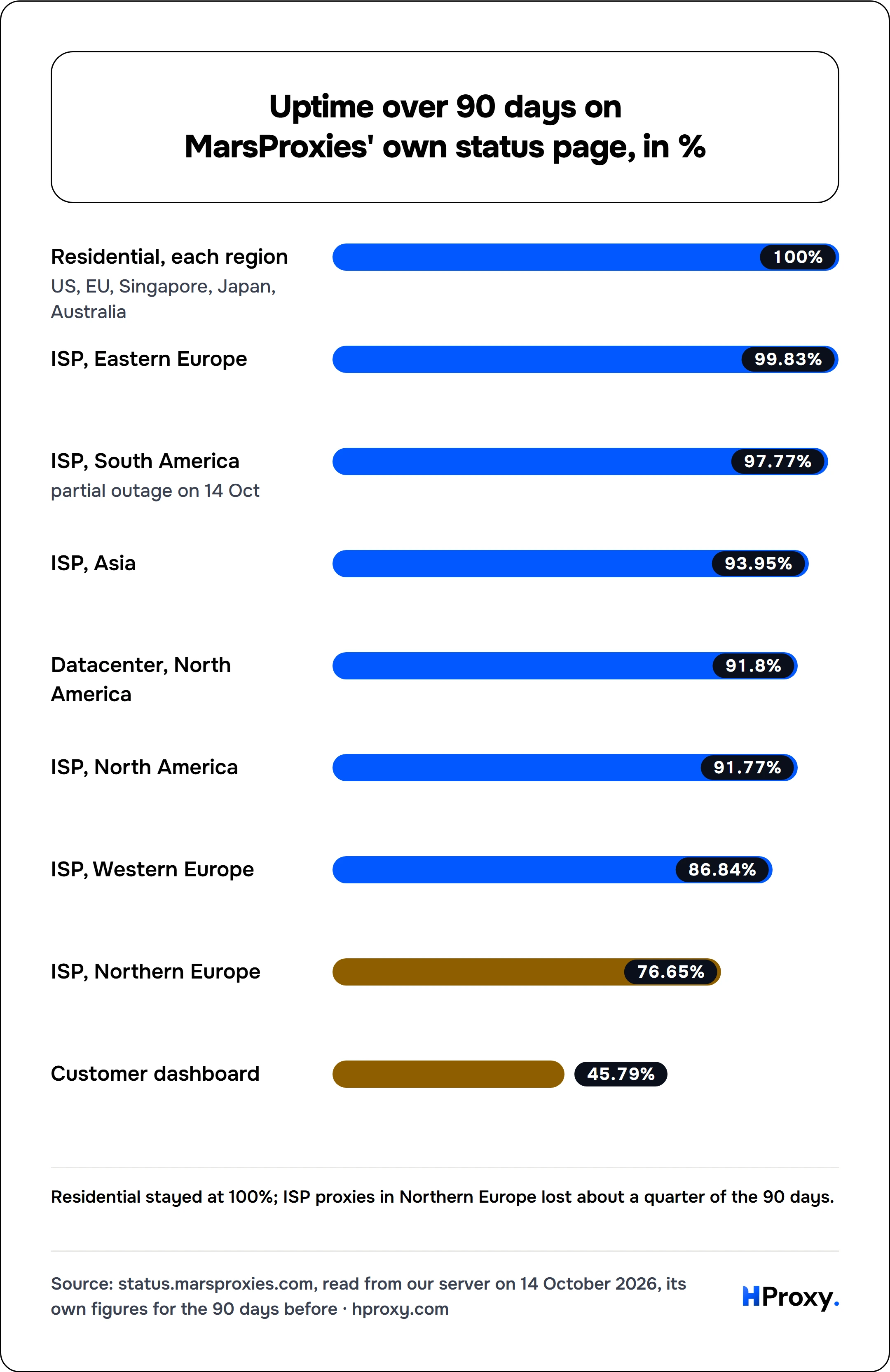
The low figures come from long partial outages, which the page logs one day at a time. ISP proxies in Northern Europe were in partial outage every day from 2 to at least 17 September. Datacenter proxies in Africa logged packet loss in South Africa for ten days in July, then a scheduled maintenance of its "DCH proxies" in eight countries from Turkey to Bulgaria, from 21 August to 4 September. The dashboard logged one partial outage of 885 hours that began on 31 July. A partial outage means part of a service failed, and the page does not say which part or how much.
The fine print
Refunds are rare. The terms make fees "non-cancelable and non-refundable". The one exception is a service that is inactive or defective in its first 24 hours and that the company cannot fix within the same period. Payments in cryptocurrency "are not eligible for any refunds, whether partial or full, under any circumstances".
No trial. Its FAQ says "We don't offer a free trial" and suggests buying the smallest plan to test.
Long sessions, day rentals. Sticky residential sessions last from 1 second to 7 days, and ISP, datacenter and mobile proxies can be rented for a single day.
Who takes the money. The terms list CoinGate, run by Decentralized, UAB, Paddle, run by Paddle.com Market Ltd., and Stripe among its payment providers.
Who runs it
Every version of the terms we found, from 8 April 2024 to the current one of 30 August 2026, names "Comet Tech Inc.", "incorporated in the Republic of Panama, registration number 155734567", at the Advanced Tower Building on Ricardo Arias Street in Panama City. Asked for that number in Panama on 14 October 2026, OpenCorporates answered that it "couldn't find a company with that number". The about page signs its founder's quote only as "Owner, MarsProxies", and we found no other brand that names Comet Tech Inc. Before 2024 the archive holds no terms page for the site, so the seller of the sneaker years remains unknown.
The about page of 27 September 2026 also listed "334,566 servers in multiple countries", "1M IPs in 190+ countries" and "344+ TB total data consumed". These are its own figures, and we could not check them.
100 GB at MarsProxies and ten other sellers
For our Novada comparison we priced 100 GB of residential traffic in one month for a new customer on ten sellers' own pages on 14 October 2026, before VAT. MarsProxies' plan of the same day adds an eleventh bar.
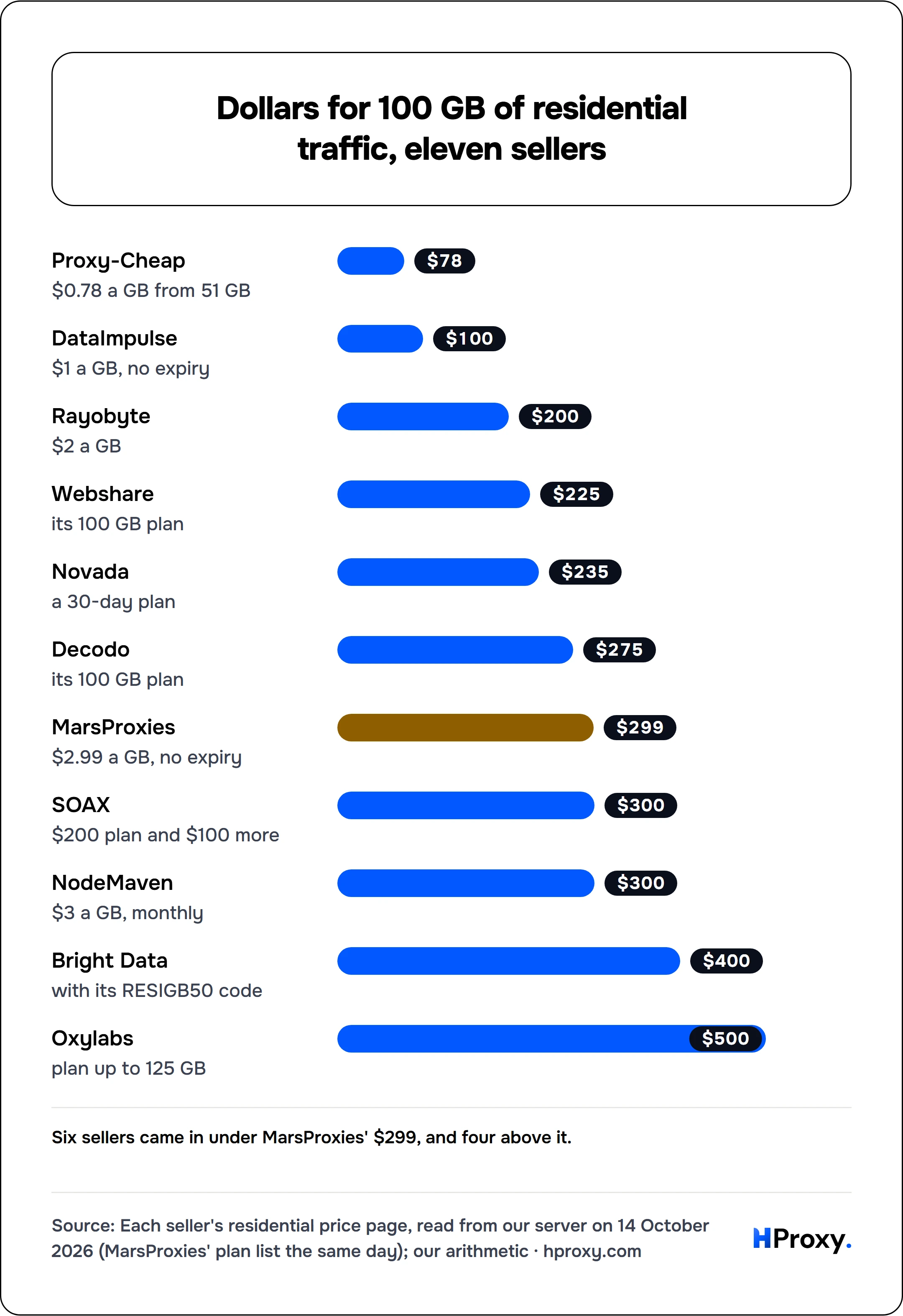
MarsProxies costs more than most at 100 GB. Its traffic does not run out, which DataImpulse also offers and a 30-day plan such as Novada's does not. Our pages on Proxy-Cheap, DataImpulse, Rayobyte, NodeMaven and Bright Data cover each seller's terms. For billing models side by side, see HProxy vs MarsProxies.
Where HProxy differs
This section is written by a rival seller, and each HProxy figure in it is taken from our own code and price table.
City targeting from one gigabyte. Premium, our pool with state, city and ISP targeting, costs $1.49/GB for one gigabyte, against $4.99 for 1 GB at MarsProxies.
By country for less. Lite targets by country at $0.50/GB for one gigabyte, and purchased gigabytes have no scheduled expiry date, as with MarsProxies traffic.
Static addresses by the week. A static ISP address costs $2.70/IP and a dedicated IPv4 address $1.58/IP for a month, and both can be rented for a single week.
Mobile by the gigabyte. Rotating mobile traffic, targeted by country, costs $1.50/GB, for jobs that move little data.
A seller you can look up in Germany. The company behind HProxy is entered in the German commercial register, as our imprint sets out.
Where we are behind. Our Premium sessions hold for up to 24 hours against MarsProxies' 7 days, and we rent nothing by the day.
Who MarsProxies suits
It suits a buyer who wants residential traffic that never runs out, sticky sessions of up to 7 days, or a datacenter or mobile address for a single day. Before buying ISP proxies, open its status page for the region you need, since the 90-day record ranges from 76.65% to 100%. It suits you less if you want a refund after testing, a lower price for 100 GB, or a seller registered in the European Union.
Before you commit
Buy the smallest amount first, since the refund window covers only a service that fails in its first day. Whoever you buy from, our proxy checker tells you within seconds whether an address answers, from which country and how fast.
What we could not find out
We do not know who sold MarsProxies before April 2024: the archive holds no terms page before then, and the prices were in euros. We could not see Comet Tech Inc.'s owners or directors, since OpenCorporates had no record and we did not search Panama's own registry. The status page does not say how much of a service failed during a partial outage. We bought no plan and ran no test of the network, so its pool size and its server count remain its own claims. We plan to check MarsProxies again by 14 January 2027.
Sources
- MarsProxies, marsproxies.com: home page, the four price pages, its llms.txt and its status page, read from our server on 14 October 2026; about page, terms of 30 August 2026 and privacy policy, read on 27 September 2026.
- marsproxies.com in the Internet Archive: home pages of 2020 to 2025, residential price pages of June 2024 to August 2026, terms of April 2024 and September 2025, and the privacy policy of April 2024.
- Verisign's registry record for marsproxies.com, 27 September 2026; OpenCorporates, 14 October 2026.
- The residential price pages of Proxy-Cheap, DataImpulse, Rayobyte, Webshare, Novada, Decodo, SOAX, NodeMaven, Bright Data and Oxylabs, read on 14 October 2026 for our Novada comparison.
- HProxy: the product records, price table, terms and imprint behind every figure we give for ourselves.