Rich Proxies (richproxies.com) is a US shop for ISP proxies, aimed at sneaker, ticketing, gaming and social media buyers. On 27 September 2026 its site showed automated readers only a Cloudflare check, while its API server answered and its Discord server counted 5,814 members. The shop looks alive, but its current prices were out of reach. The last prices we could read date from January 2025, and every figure below carries that date. For the comparison, jump to the alternatives table.
Rich Proxies at a glance
| what we found | |
|---|---|
| status, 27 September 2026 | site behind a Cloudflare check, API server and Discord invite working |
| domain | registered 2 May 2021, paid up to 2 May 2027 |
| operator | "Rich Proxies", under US law by its terms |
| main product | US ISP proxies in five cities |
| ISP price, January 2025 | $1.52 to $2.85 an IP a month, from 25 or 50 IPs |
| residential, January 2025 | $6 a GB for 1 GB over 30 days |
| refunds | none after delivery |
| renewal | automatic, unless you switch it off |
| support | Discord, Telegram and email |
What Rich Proxies sold, and for whom
Its first archived shop, from June 2023, sold "dedicated residential ISP proxies" hosted in Ashburn, Virginia and in London. The buyers were sneaker resellers: each line listed the shops it worked on, from Nike and Shopify to Footsites and Hibbett. Support ran in a Discord server, and the footer read "© 2022 - 2023 Rich Proxies".
By January 2025 the shop covered five US cities: Virginia, New York, Los Angeles, Chicago and Seattle. Each city had twelve lines named for a target, such as ticketing with Ticketmaster and AXS, sneaker shops, the game Growtopia, social media and scraping. Custom states and cities took up to a week to deliver. It also sold residential proxies, mobile proxies and servers, and claimed more than 2,400 customers.
What Rich Proxies charged in January 2025
These prices come from the archived homepage of 25 January 2025. Each line was priced per IP a month, with a lower rate for a whole private subnet of 253 addresses.
| line | per IP a month | smallest order | per IP in a 253-IP subnet |
|---|---|---|---|
| Lite, sneaker shops, HTTP only | $1.52 | 25 IPs | $1.40 |
| Growtopia, HTTP blocked | $1.52 | 25 IPs | $1.40 |
| Select, sneaker shops | $1.92 | 25 IPs | $1.80 |
| 0 Fraud Score | $1.95 | 25 IPs | $1.80 |
| Signature, sneaker shops | $2.24 | 50 IPs | $2.12 |
| Growtopia, all green | $2.24 | 25 IPs | $2.12 |
| Fixed Line | $2.32 | 25 IPs | $2.16 |
| Event, ticketing | $2.48 | 25 IPs | $2.28 |
| Ultra, sneaker shops | $2.52 | 50 IPs | $2.32 |
| Flawless | $2.54 | 50 IPs | $2.44 |
| Social Media | $2.58 | 50 IPs | $2.48 |
| Scraping | $2.85 | 50 IPs | $2.69 |
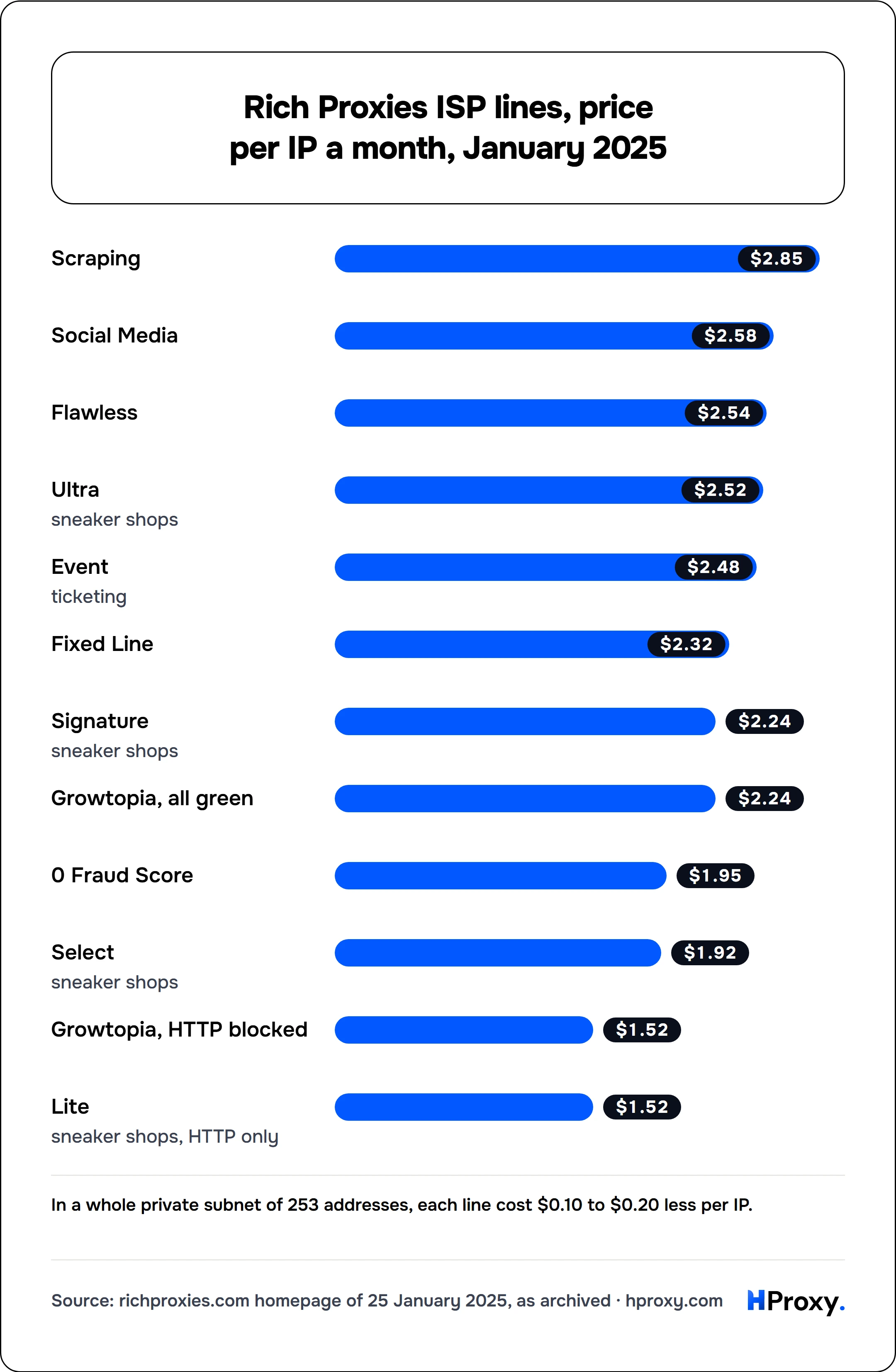
At those unit prices, the smallest order came to $38 a month for 25 Lite IPs and $142.50 for 50 Scraping IPs. Every city carried the same prices, but stock was thin outside Virginia and New York. Every Los Angeles and Seattle line was marked sold out, and eleven of twelve in Chicago.
The same prices already stood in June 2023 for the four sneaker lines: Ultra $2.52, Signature $2.24, Select $1.92 and Lite $1.52.
Residential Global cost $6 a GB for 1 GB over 30 days, with country, state and city targeting across a claimed 20 million IPs. Larger plans were priced by a server call that the archive did not keep. Residential Pro replaced banned IPs for you, ran over HTTP only in nine countries, and showed no price in the capture.
The fine print
These rules come from its terms, as archived on 28 January 2025.
No refunds, no disputes. Its terms rule out refunds "under ANY" circumstance once an order is delivered. The buyer agrees not to dispute the charge, and a threat of a chargeback can end the plan.
Plans renew on their own. Each plan is a subscription that renews within three hours of its end date. You switch renewal off in the client portal, and a renewal you forgot is not refunded.
No promise against bot protection. Most ISP cards carried the line "Not guaranteed to work with new site protections". The terms add no refunds or replacements for blocks by bot protection, and the Growtopia lines said "No replacements when banned".
Who you deal with. The terms name the operator only as "Rich Proxies" and choose the laws of the USA. We found no company form, address or registration number.
Payment. Its terms speak of card chargebacks, and its DNS carries a verification record for Cryptomus, a crypto payment gateway.
Where Rich Proxies is stronger
City choice for ISP. Five US cities, plus custom states and cities on request.
Whole subnets. A private subnet of 253 addresses at a lower rate per IP, for buyers who want one clean range.
Lines named for the target. Separate lines for ticketing, sneaker shops, Growtopia, social media and scraping, each with its own claims.
Low unit prices at scale. In January 2025 its cheapest line cost $1.52 an IP a month, if that price still holds.
Protocols. HTTP and SOCKS5 with UDP on most ISP lines, and both IP and user:pass logins.
Where HProxy differs
We sell proxies too, so read this part as the account of a competitor. Every HProxy fact here comes from our own product code and pages.
One address, no minimum. Our static ISP starts at one dedicated address, with unlimited bandwidth, at $2.70/IP for a month. US addresses are on sale, picked by country rather than by city.
Residential without a monthly clock. Our purchased gigabytes have no scheduled expiry date. Lite targets by country at $0.50/GB for one gigabyte. Premium, our pool with state, city and ISP targeting, costs $1.49/GB for one gigabyte and $1.00/GB from 1,000 GB+.
Sessions and UDP. Premium sticky sessions last from 3 minutes to 24 hours, and SOCKS5 lines carry UDP.
Payment and paperwork. We take cards, Alipay and thirty-two crypto options, and we ask for no documents at sign-up or at an ordinary checkout.
Where we are behind. We sell no private subnets, no lines tuned to ticketing or sneaker sites, and no choice of US city for ISP addresses.
The alternatives, side by side
One static ISP address for a month. The Rich Proxies row is its last readable price from January 2025; every other figure comes from the page of each vendor, read on 26 September 2026.
| provider | smallest buy | per address, one month | note |
|---|---|---|---|
| Rich Proxies | 25 IPs | $1.52 to $2.85 | January 2025, five US cities |
| ArnProxy | 1 address | $2.50 | US price, 24 locations |
| Oxylabs | 10 addresses for $16 | $1.60 | shared by up to 3 users |
| ProxyScrape | 5-proxy trial for $5.92 | from $1.65 | 17 locations |
| Massive | 10 addresses for $30 | $3.00 | United States only |
| Decodo | 3 addresses for $9.99 | $3.33 | dedicated, plus VAT |
| HProxy | 1 address | $2.70/IP | dedicated, kept as long as you renew |
For one or two addresses, ArnProxy and HProxy sell single IPs. For a large block in one US city, Rich Proxies was built for it, if its stock and prices still stand. Our reviews of Oxylabs, Decodo, Massive and ProxyScrape cover their terms in full.
Who Rich Proxies suits
It suits a reseller who runs sneaker or ticket bots on US sites and wants dozens of addresses in one city at a low unit price. Such a buyer also accepts its terms: no refunds, automatic renewal, and no promise against bot protection.
It suits you less if you need a handful of addresses, a country outside the US, a way back when an order disappoints, or a seller you can name. Its site did not open for automated readers, so check the live prices yourself before you plan around ours.
Before you commit
Open the shop in a normal browser and compare its prices with the January 2025 table above. Turn automatic renewal off in the client portal if you want to test one month. Our proxy checker shows whether an address answers, how fast, and from where, whoever sold it, and the same checks run on our free proxy list.
More comparisons on our blog: Px6, Qg.net and Quantumproxies.
The limits of this review
We did not test the Rich Proxies network, and its live site showed us only a Cloudflare check, so every Rich Proxies price and rule here comes from archived pages of June 2023 and January 2025. Prices may have changed since. Scamadviser rates the domain "average to good", Trustpilot refused our reader, and we found no independent review we could read.
Every figure here carries the day it was read or archived, and this page is due for a check by 27 December 2026.
Sources
- Rich Proxies, richproxies.com and api.richproxies.com, checked 27 September 2026.
- Internet Archive, captures of the Rich Proxies homepage of 9 June 2023 and 25 January 2025, and of its terms of 28 January 2025.
- Verisign, registry record for richproxies.com, and its public DNS records. Read 27 September 2026.
- Scamadviser and Trustpilot pages about richproxies.com, and the Telegram page of @richproxies. Read 27 September 2026.
- ArnProxy, Oxylabs, Decodo, Massive and ProxyScrape, ISP price pages. Read 26 September 2026.
- HProxy, our own product records, price table, United States page and terms.