A comparison written by a competitor is worth reading only if it says where the competitor loses. That rule shapes this page about Px6, and the last section names the reader who should stay put.
What we can and cannot tell you about Px6
The company behind the name sits at px6.me. We carry them as a proxy provider.
A price is missing here on purpose. We have not captured a sourced rate for Px6 recently enough to publish one, and a stale number in this market is a wrong number.
Copy down the entry rate, the commitment attached to the cheapest rate, the minimum top-up and the expiry rule. Those four turn a marketing figure into something you can compare.
What Px6 says about itself today
Read 9 September 2026, the homepage titles itself "Buy proxy. Personal anonymous IPv4/IPv6, MTproto proxies / PROXY6.net". The description they publish for search engines reads: "Proxy service. Buy proxy, personal and anonymous. IPv4, IPv6 proxy. HTTPs, Socks5 proxy. MTproto - Telegram proxy. Proxy for social networks"
Reading the same page for the things buyers actually ask about:
The product lines named on that page are SOCKS5 and IPv6. Their pricing page is titled "Buy proxy / PROXY6.net".
Treat all of it as advertising, because it is. Its value is that it is dated and quotable, which is more than most comparison pages offer.
How much site there is
Our own crawl reached 70 of their pages, last run 18 June 2026. The mix was 23 blog pages and 1 pricing page.
That mix tells you how the company sells. Heavy location pages mean a geography-led pitch, heavy blog means a search-led one, and a single pricing page usually means one simple offer or one sales call.
Where the interest in Px6 goes
The Keyword Planner puts brand demand at 10 a month: 10 a month for a review of them. Figures read from Google Keyword Planner on 9 September 2026.
Weighted towards people checking whether to trust it. A comparison that ignores that and opens with a pitch has misread the room.
What the advertised numbers cannot tell you
The expiry question
Find out whether unspent traffic rolls over, expires, or expires only on some plans. The answer changes the effective rate by more than most of the price differences buyers spend their time arguing about.
Why a cheap address is often a used one
A shared address arrives with a history you did not create and cannot see. For read-only work it rarely matters. For anything that keeps a session, it is the most common cause of unexplained failure.
Who pays for the requests that fail
Some vendors bill every request, some bill only successful ones, and the difference is the whole comparison once a target starts blocking. A cheap rate with a fifty percent success rate is twice its advertised price.
What separates them, in a table
The rows below are the ones that change what you pay and whether the job runs:
| Question to ask | Px6 | HProxy |
|---|---|---|
| Entry price | Not verified by us, read their page | From $0.44/GB, pay as you go |
| Does unused balance expire? | Worth confirming in writing before you commit | Never |
| Minimum commitment | Their terms page answers this | None |
| Identity checks | Check the current terms, this one moves | Card orders are screened, and verification is sometimes requested |
| Targeting | Their terms page answers this | Country, city and ISP |
| Free way to evaluate | Check the current terms, this one moves | Free proxy list and proxy checker |
Nothing in that table settles the decision on its own. It narrows the field to two or three, and then measurement finishes the job.
A test worth more than this comparison
Do this once and you will never need a comparison page for this decision again.
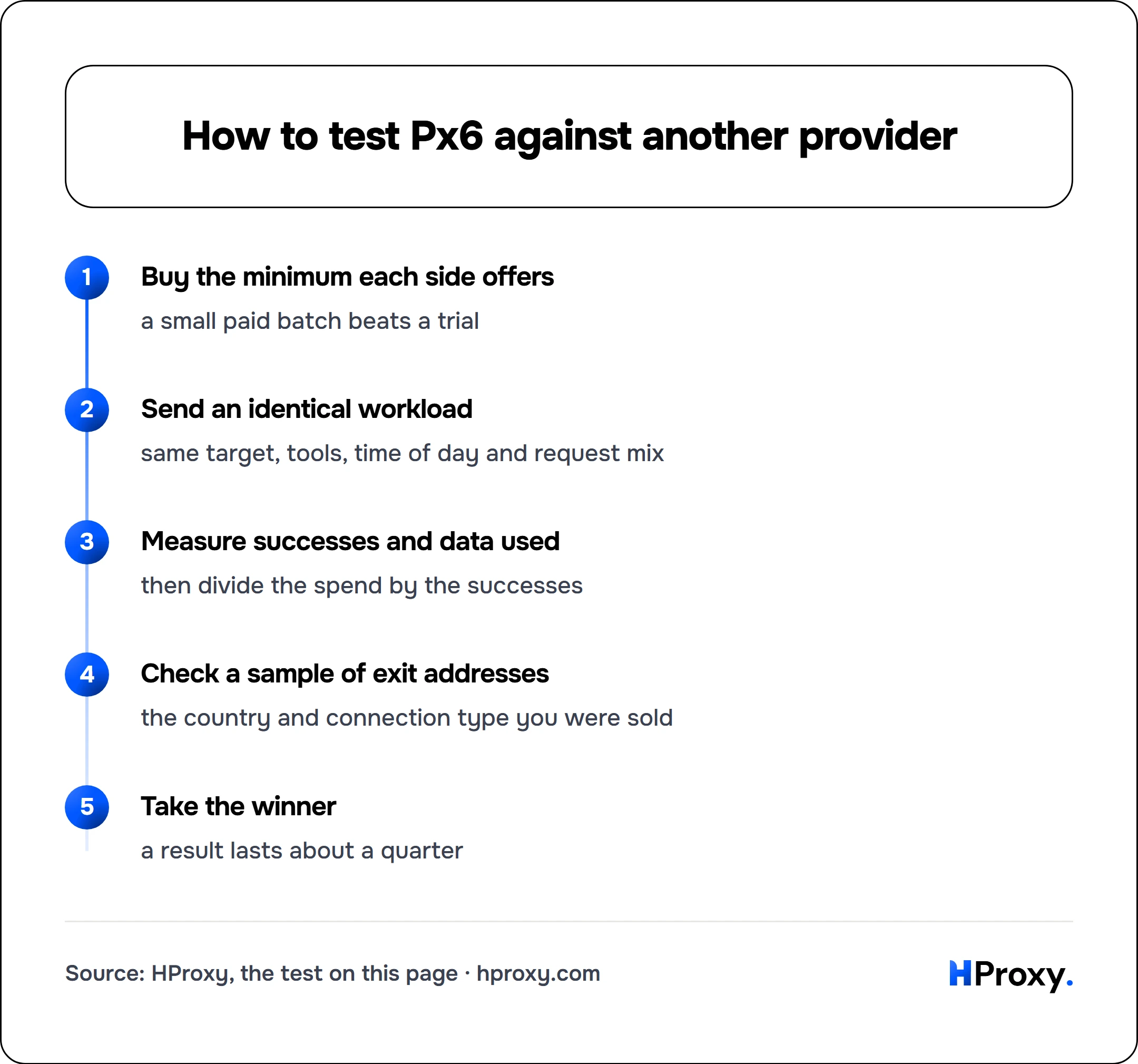
- Buy the minimum each side offers. Prefer a small paid batch over a trial, because trial traffic does not always ride the same pool.
- Send an identical workload through each: same target, same tooling, same time of day, same request mix.
- Measure what came back correctly and what it consumed, then divide the spend by the successes.
- Push a sample of exit addresses through an independent checker and confirm the country and connection type are what was advertised.
- Take the winner and set a reminder to run this again, since a result has a shelf life of about a quarter.
Buy the minimum each side offers
a small paid batch beats a trial
Send an identical workload
same target, tools, time of day and request mix
Measure successes and data used
then divide the spend by the successes
Check a sample of exit addresses
the country and connection type you were sold
Take the winner
a result lasts about a quarter
Others in this market
Nearest alternatives by product shape rather than by who pays us, since nobody does:
The competing offer, for completeness
We are the pay as you go option in this market. Residential from $0.44 per GB, ISP and datacenter per address, mobile alongside them, all from one balance with nothing to forfeit. That model wins on irregular volume and loses on very large steady volume, which is worth knowing before you test.