Massive advertises residential proxies from $4.9 per GB. The cheapest plan you can actually buy is $80 a month for 10 GB, which works out at $8.00 per GB. Reaching the advertised rate needs the $490 plan, six times the money. That gap is the whole story of this pricing page, and the rest of it is unusually good. Every figure below was read from their pricing page on 9 September 2026.
We run a competing network, so weigh our reading accordingly. The plans are theirs and the arithmetic is ours.
The short version
Four plans run from $80 for 10 GB to $490 for 100 GB, which is $8.00 down to $4.90 per GB. The advertised from-price is the top plan, not the entry one. There is no way to buy a single gigabyte, so the real minimum is $80. In exchange, every plan states that unused bandwidth rolls over to the next month, which almost nothing else in this market does.
What Massive publishes
Four self-serve plans, read from the pricing page on 9 September 2026. The per-GB figure is theirs, and we checked it against the plan price.
Massive residential plans
| Plan | Per month | Bandwidth | Stated per GB | Our check |
|---|---|---|---|---|
| Starter | $80 | 10 GB | $8.00 | $8.00 |
| Builder | $225 | 30 GB | $7.50 | $7.50 |
| Scaler | $385 | 70 GB | $5.50 | $5.50 |
| Pro | $490 | 100 GB | $4.90 | $4.90 |
joinmassive.com pricing page, read 9 September 2026, with our own division
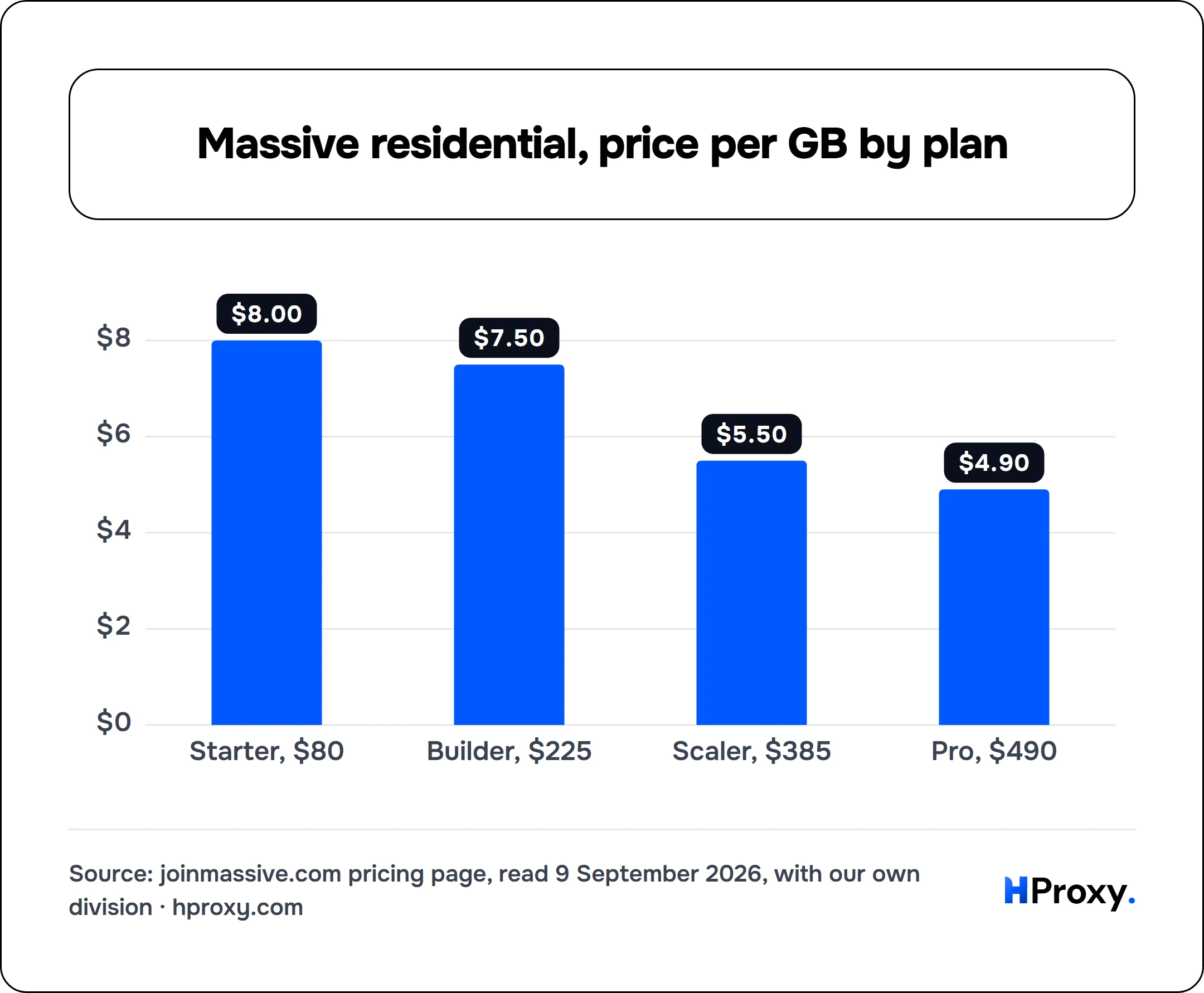
Every stated rate matches the arithmetic exactly. That sounds like a low bar, and after a week of reading pricing pages it is not.
Support differs across the ladder as well. Starter and Builder carry email support, while Scaler and Pro add 24/7 Slack. Pro also adds a named account manager.
The advertised rate is the top plan
Their navigation lists the product as "Residential Proxies, From $4.9/GB". That figure is the Pro plan, which costs $490 a month.
A buyer arriving at the plan cards meets $8.00 per GB instead. The advertised number is 39 percent below what the entry plan charges.
Nothing about that is hidden, since all four rates sit on the same page. It is still worth naming, because a from-price that needs a sixfold spend is a destination.
The ladder itself is shallow by the standards of this market. Six times the money buys ten times the bandwidth, and the rate improves by 39 percent.
There is no single gigabyte
This is the structural point, and it decides who this page suits. The smallest thing you can buy is $80.
A team wanting to test 2 GB against a target has one option, which is to buy 10. A team using 4 GB in a slow month has paid for 10 either way.
Two things soften that. The commitment is one month, since every card states cancel anytime, and the bandwidth is not lost.
The rollover is the best term on the page
Every plan card states that unused bandwidth rolls over to the next month. That single line separates this vendor from most of the market.
We priced a dozen other products this week, and most of the subscriptions whose terms we could read forfeit what you do not use. The SerpApi teardown worked that through, where a 60 percent usage month raised the rate by two thirds.
Here that penalty does not apply. Buying 100 GB and using 60 leaves 40 GB waiting rather than 40 GB gone.
That changes how the $80 minimum should be read. It is a large first step, and it is not a monthly forfeit.
We found no stated limit on how long a rolled-over gigabyte survives. That gap is recorded at the end rather than assumed either way.
The other products, as published
The pricing page carries five tabs and the navigation summarises them. We could read the residential plan cards in full and only the starting figures for the rest.
Massive product starting rates
| Product | Advertised from |
|---|---|
| Residential proxies | $4.9 per GB |
| Residential enterprise | $3.2 per GB |
| ISP proxies | $1.8 per IP |
| Web Render API | $0.80 per CPM |
| LLM Render API | $4.00 per CPM |
joinmassive.com navigation, read 9 September 2026
Two of those deserve a note. Residential Enterprise at $3.2 per GB sits below every self-serve plan, and no tier detail is published for it.
The Web Render API at $0.80 per thousand requests is a per-request price rather than a per-gigabyte one. It compares directly against the scraping APIs we converted this week, and it compares well.
The market, converted to one number
Here is the reason to read a pricing teardown rather than a pricing page. Thirteen residential rates from six vendors, all read in the same week, all in the same unit.
Cost per GB of residential bandwidth, across the market
| Where you buy it | Tier | Per GB |
|---|---|---|
| Scrapfly, binary traffic | Pro plan | about $10.00 |
| ZenRows | Build, $16 | $8.89 |
| Massive | Starter, $80 | $8.00 |
| Apify | Free or Starter | $8.00 |
| Massive | Builder, $225 | $7.50 |
| Apify | Business | $7.00 |
| Massive | Scaler, $385 | $5.50 |
| Massive | Pro, $490 | $4.90 |
| Webshare | 1 GB, monthly | $3.50 |
| Massive | Enterprise, quoted | from $3.20 |
| Octoparse | add-on | $3.00 |
| ZenRows | Scale, $456 | $2.28 |
| Webshare | 3,000 GB, monthly | $1.40 |
| HProxy | one gigabyte, no plan | $0.50/GB |
six vendor pricing pages and our own live price list, all read 9 September 2026
Our own gigabyte is flat from the first one, drawn from a balance rather than a plan. The volume floor is $0.44/GB once you reach 2,000 GB+. A rate is not a pool though, and no table settles which network works on your target. That is why we publish the method rather than a verdict.
What the price does not tell you
Massive puts more weight on how its network is sourced than most vendors do. That is a real difference and it does not show up in a per-gigabyte figure.
The pricing page lists a SOC 2 Type 1 audit, GDPR and CCPA compliance, and AppEsteem certification. It adds a 99.9 percent uptime SLA and verified consent through their SDK. It also describes the network as real consumer devices in 195 or more countries.
We have not audited any of that and we make no claim about it. We note it because the rate is only part of what these plans sell.
The same caution runs the other way. A compliance page is not a success rate on your target, and neither is ours.
Who this pricing suits
Massive suits steady monthly bandwidth users above about 30 GB. The rollover term makes a slightly oversized plan cheap to hold, which is rare.
It suits teams who need the compliance paperwork. SOC 2 and a named account manager are what the higher tiers actually add, alongside the rate.
It suits small or occasional use poorly. The floor is $80 a month, and a 2 GB job pays for 10 GB in the month it runs.
It suits price-led buyers less well than the from-price suggests. At $8.00 per GB the entry plan sits near the top of the thirteen rates above.
The neighbouring conversions sit in our Webshare teardown and the residential proxy price study.
What we could not verify
We could read the four residential plan cards in full, and only the starting rates for the rest. Their tier detail sits behind separate tabs that we could not open cleanly.
No limit is stated on how long rolled-over bandwidth survives. On a term this favourable, that boundary is worth asking about before you rely on it.
Residential Enterprise is listed from $3.2 per GB with no published tiers. It appears to sit behind a sales conversation rather than self-serve checkout.
We found no general free trial on the pricing page. Their resources menu advertises a startup programme offering 1TB free for three months. No eligibility rules are attached to it there.
Prices move. Every figure here was read on 9 September 2026, so check the live page before committing.
Sources
- Massive, pricing page plan cards, read 9 September 2026. The four residential plans with their monthly prices, bandwidth, per-GB rates, support levels and the rollover statement.
- Massive, pricing page, read 9 September 2026. The cancel anytime term stated on every plan card.
- Massive, site navigation, read 9 September 2026. Starting rates for residential, residential enterprise, ISP proxies, the Web Render API and the LLM Render API.
- Massive, pricing page, read 9 September 2026. The compliance list covering SOC 2 Type 1, GDPR, CCPA, AppEsteem, the uptime SLA and consent through their SDK.
- Massive, resources menu, read 9 September 2026. The startup programme offering 1TB free for three months.
- Apify, ZenRows, Octoparse, Webshare and Scrapfly pricing pages and documentation, all read 9 September 2026, for the market comparison table.
- Our own arithmetic on those published figures, 9 September 2026, shown in every table above.