Shifter (shifter.io) sells residential proxies, static ISP proxies and two scraping APIs on monthly plans. It says it has run since 2012, and until about 2020 the business traded as Microleaves. On 27 September 2026 its site was live and taking orders. City targeting cost $0.75 a GB from 200 GB, and the smallest plan cost $10 for 5 GB. For the comparison, jump to the alternatives table.
Shifter at a glance
| what we found on 27 September 2026 | |
|---|---|
| status | live, plans on sale, sign-up by email, Google or GitHub |
| domain | registered 4 June 2017, paid up to 4 June 2027 |
| earlier name | Microleaves, renamed around 2020 |
| operator | no company named in its terms, which follow California law |
| residential | three pools: city targeting, country only, worldwide mix |
| residential price | $10 for 5 GB a month, down to $0.10 a GB at 25 TB |
| ISP | seven countries, from $10 a month for four IPs |
| protocols | HTTP(S) and SOCKS5 |
| refunds | 72 hours, first purchase, under half the traffic used |
| payment | cards, USDT or USDC, PayPal in some regions |
What Shifter sells
Residential proxies in three pools. Every plan runs through one gateway, and Full Geo is the largest pool, which Shifter puts at more than 205 million IPs, with targeting by country, state, city and ASN. Country Geo and Non-Geo share a second network that Shifter puts at more than 31 million IPs. Country Geo targets by country only, and Non-Geo mixes IPs from around the world.
Rotation and sessions. By default each request gets a new IP, while a session id in the user name holds one IP for 120 seconds, or longer with a time setting. Connections at once are unlimited, and if no IP matches a narrow filter, the gateway falls back to a broader pool unless you ask for strict matching.
Blocked sites. Its documentation blocks banking portals, government services, explicit adult content and most mail servers, and it blocks outbound mail with no exceptions.
ISP proxies. Fixed IPs with unlimited traffic in the US, Canada, the UK, France, Germany, Spain and Italy, over HTTP(S).
Two APIs. A web scraping API from $44 a month for 100,000 credits, and a search results (SERP) API from $44 a month for 5,000 calls.
Older customers may still hold port plans, which rotate on a timer and target by country, while new sign-ups get the plans below.
What Shifter charges
Every plan below is a monthly subscription, shown as a discount off a higher list price with no end date on the page. The included traffic resets each cycle, and extra traffic is billed from your wallet at the plan rate.
| Full Geo plan | a month | traffic | per GB |
|---|---|---|---|
| Spark | $10 | 5 GB | $2.00 |
| Launch | $20 | 10 GB | $2.00 |
| Boost | $30 | 20 GB | $1.50 |
| Surge | $40 | 32 GB | $1.25 |
| Starter | $50 | 50 GB | $1.00 |
| Basic | $100 | 100 GB | $1.00 |
| Business | $149 | 200 GB | $0.75 |
| Growth | $299 | 400 GB | $0.75 |
| Scale to Max | $599 to $7,499 | 800 GB to 10 TB | $0.75 |
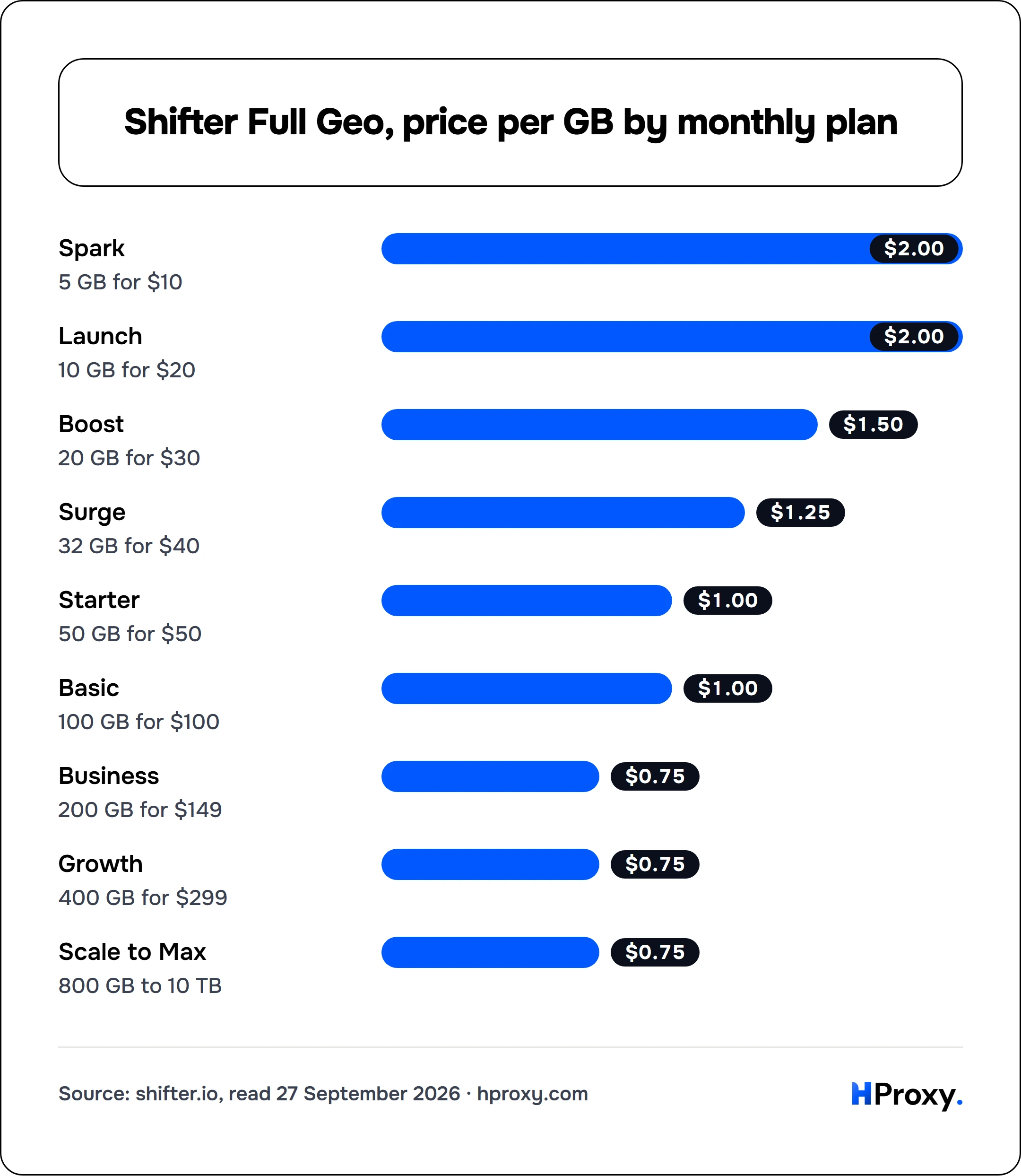
The list prices behind those discounts run from $25 for Spark to $10,000 for Max. That makes the cut 60 percent on Spark and 71 percent on Starter.
Country Geo starts at $99 a month for 165 GB, or $0.60 a GB, and falls to $0.48 a GB from 998 GB. Non-Geo starts at $249 for 996 GB, or $0.25 a GB, and reaches $0.10 a GB at 25 TB for $2,499.
| ISP plan | a month | IPs | per IP |
|---|---|---|---|
| Spark | $10 | 4 | $2.50 |
| Boost | $20 | 10 | $2.00 |
| Starter | $42 | 25 | $1.68 |
| Business | $140 | 100 | $1.40 |
| Growth | $252 | 200 | $1.26 |
| Max | $3,500 | 5,000 | $0.70 |
That table shows six of its twelve ISP plans, and every ISP price is shown as 30 percent off a list price.
The fine print
Monthly and automatic. Plans renew each month until you cancel, and a cancelled plan runs to the end of its cycle with no money back for the unused part.
Refunds. Its billing page promises money back within 72 hours of a first purchase, if less than half the plan traffic is used. Its terms rule out chargebacks and give thirty days to raise a billing error.
A trial, or not. Every plan button says "Start Free Trial", and the pricing page says new customers get a residential trial that turns into a paid plan. Its documentation says "No free trial", only the money-back guarantee.
Pages that disagree. The homepage offers sticky sessions "up to 60 minutes", the pricing page "from 1 to 30 minutes", and the documentation a default of 120 seconds. The pricing page also lists SOCKS4, which the homepage and the documentation leave out.
Who you deal with. The terms name no company, only "Provider", and choose California law with arbitration in San Francisco. They describe each customer as "a legal business entity", and they allow IP addresses to come from outside contractors.
Limits of use. Its scraping services may not be used on Twitter or X. Banking, government, adult and mail traffic is blocked, as above.
Payment. Cards, USDT or USDC on Ethereum or BNB Smart Chain, PayPal in some regions, and wire transfer for Enterprise plans. The terms ask for your name, billing address, phone number and card details, and we found no identity check described.
From Microleaves to Shifter
Shifter dates itself to 2012, but its domain is younger. In December 2018 shifter.io was a parked domain. By December 2020 it carried a proxy shop headed "Join The Web’s Largest Proxy Network". The same headline and description had stood on microleaves.com in 2019.
Microleaves sold proxies from at least 2015. That year its page read "Reverseproxies becomes Microleaves" and offered proxies that changed IP every ten minutes. In 2019 its rotating plans started at $124.99 for 10 ports. Today reverseproxies.com forwards to shifter.io, and it shares an IP address and name servers with microleaves.com.
In July 2022 Krebs on Security reported that Microleaves was being renamed Shifter.io. Its PR manager told Krebs that new owners had bought the company three years earlier: Super Tech Ventures, a private equity firm in Taiwan. The same report said Microleaves had exposed its user database and had since fixed the flaw.
The report also said antivirus firms had long classed Microleaves software as adware or a potentially unwanted program, and that Kaspersky flagged it as a trojan. Microleaves said its software was installed with user consent. Malwarebytes still lists a detection for software "published by Microleaves LTD".
Those findings date from 2022 and earlier, and they describe the Microleaves software. The Shifter pages we read do not mention Microleaves or say how its residential IPs are obtained, and we found nothing newer on how the pool is built today.
Where Shifter is stronger
City targeting at volume. $0.75 a GB with city and ASN targeting from $149 for 200 GB, holding all the way to 10 TB.
A cheap worldwide pool. Non-Geo falls to $0.10 a GB at 25 TB, for jobs where the location does not matter.
ISP at scale. Seven countries and plans from 4 to 5,000 IPs, down to $0.70 an IP.
Control. A new IP per request and unlimited connections at once on every plan, plus ASN targeting and strict matching on Full Geo.
One account for proxies and APIs. A scraping API and a SERP API sit next to the proxies.
Where HProxy differs
We sell proxies too, so read this part as the account of a competitor. Every HProxy fact here comes from our own product code and pages.
No monthly clock. Our purchased gigabytes have no scheduled expiry date, so traffic you do not use this month is still there next month. Premium, our pool with state, city and ISP targeting, costs $1.49/GB for one gigabyte and $1.00/GB from 1,000 GB+.
By country for less. The Shifter Country Geo pool starts at $99 a month for 165 GB, or $0.60 a GB. Our Lite pool also targets by country, at $0.50/GB for one gigabyte with no plan, 17 percent below that rate.
Longer sessions. Premium sticky sessions last from 3 minutes to 24 hours, and SOCKS5 lines carry UDP.
One ISP address. Our static ISP starts at one dedicated address with unlimited bandwidth, at $2.70/IP for a month. The smallest Shifter ISP plan holds four IPs.
Payment and paperwork. We take cards, Alipay and thirty-two crypto options, and we ask for no documents at sign-up or at an ordinary checkout.
Where we are behind. The Shifter city rate of $0.75 a GB from 200 GB is below our Premium price at every volume, where our lowest is $1.00/GB from 1,000 GB+. We also sell no worldwide pool at its Non-Geo prices, and no scraping API.
The alternatives, side by side
Residential proxies with city targeting, at the smallest buy. Every figure comes from the page of each vendor, read on 26 or 27 September 2026.
| provider | smallest buy | per GB at that size | how it is billed |
|---|---|---|---|
| Shifter Full Geo | 5 GB for $10 | $2.00 | monthly plan |
| DataImpulse | 5 GB for $5 | $2.00 with city filters | never expires; filtered traffic counts double |
| NST Prime | 50 GB | $1.60 | package valid 30 days |
| Decodo | 1 GB | $4.00 plus VAT | pay as you go from a wallet |
| Oxylabs | 5 GB for $30 | $6.00 | monthly plan, VAT may apply |
| HProxy Premium | 1 GB | $1.49/GB | no plan, no scheduled expiry |
At 200 GB a month, the Shifter rate of $0.75 a GB is the lowest city rate among these six. Of the published prices, only NST Prime goes lower, at $0.70 a GB from 5 TB. For a few gigabytes at a time, or traffic that must outlast the month, the rows without a monthly plan fit better. Our reviews of DataImpulse, NST, Decodo and Oxylabs cover their terms in full.
Who Shifter suits
It suits a team that sends hundreds of gigabytes a month and wants city or ASN targeting at $0.75 a GB. It also suits large jobs that need no location, on its Non-Geo pool, and buyers of ISP proxies by the hundred. Such a buyer is fine with monthly plans that renew.
It suits you less if you buy a few gigabytes at a time, want traffic that outlasts the month, or need to know the company you pay. Read the history above and decide whether it matters for your use.
Before you commit
Start with the smallest plan, Spark at $10, and ask support whether your account gets a trial. If you want your money back, ask within 72 hours and before half the traffic is used. Cancel before the renewal date if you only want one month. Our proxy checker shows whether an address answers, how fast, and from where, whoever sold it, and the same checks run on our free proxy list.
The limits of this review
We did not test the Shifter network. Every price and rule here comes from its own pages as they stood on 27 September 2026, and pool sizes are its own claims. The history rests on one report from 2022, archived pages and the DNS records of today. Trustpilot refused our reader, and the one outside review we could read dates from late 2023 and describes port plans that new customers can no longer buy.
Every figure here carries the day it was read, and this page is due for a check by 27 December 2026.
Sources
- Shifter, shifter.io: homepage, about page, price pages for residential proxies, ISP proxies and both APIs, terms, and its billing and residential documentation. Read 27 September 2026.
- Internet Archive, copies of shifter.io from December 2018, December 2020, January 2023 and January 2025, and of microleaves.com from August 2015, December 2019 and December 2023.
- Identity Digital, registry record for shifter.io, and the public DNS records of shifter.io, microleaves.com and reverseproxies.com. Read 27 September 2026.
- Krebs on Security, "Breach Exposes Users of Microleaves Proxy Service", 28 July 2022, read in its archived copy.
- Malwarebytes, detection page for PUP.Optional.Microleaves. Read 27 September 2026.
- Proxyway, review of Shifter from late 2023. Read 27 September 2026.
- DataImpulse, NST, Decodo and Oxylabs, residential price pages. Read 26 and 27 September 2026.
- HProxy, our own product records, price table and terms.