People arrive at a free proxy list comparison for one of two reasons: the price moved, or the thing stopped working. This page assumes you are in one of those two positions with ProxySpace and wants to be useful in ten minutes rather than impressive in thirty.
The record we hold
The domain is proxyspace.pro. They are filed here as a free proxy list.
ProxySpace is not in our priced record, so nothing about their rate appears below. That gap is stated rather than filled, which is the only honest option available.
Look for the tier you would actually land in, not the one at the bottom of the table, and find the expiry and failed-request clauses before the rate impresses you.
How ProxySpace presents itself
Read 9 September 2026, the homepage titles itself "ProxySpace.pro - Unblocking the internet, one connection at a time". The description they publish for search engines reads: "ProxySpace.pro offers a free, fast, and reliable proxy service. Our list of public proxies are updated every 20 minutes, you can use proxies to access blocked websites or scrape webpages. Unleash your creativity and let your imagination be your only limit."
The rest of what the page puts in writing:
We found no separate pricing page linked from the homepage, which usually means the price arrives by quotation.
All of the above is their copy, not our finding. A dated quotation is the weakest kind of evidence that is still evidence.
Longevity, on the public record
The domain was registered on 6 April 2022, through Porkbun LLC, which makes it about 4 years old. Registry data as of 9 September 2026. It is paid up until 6 April 2027.
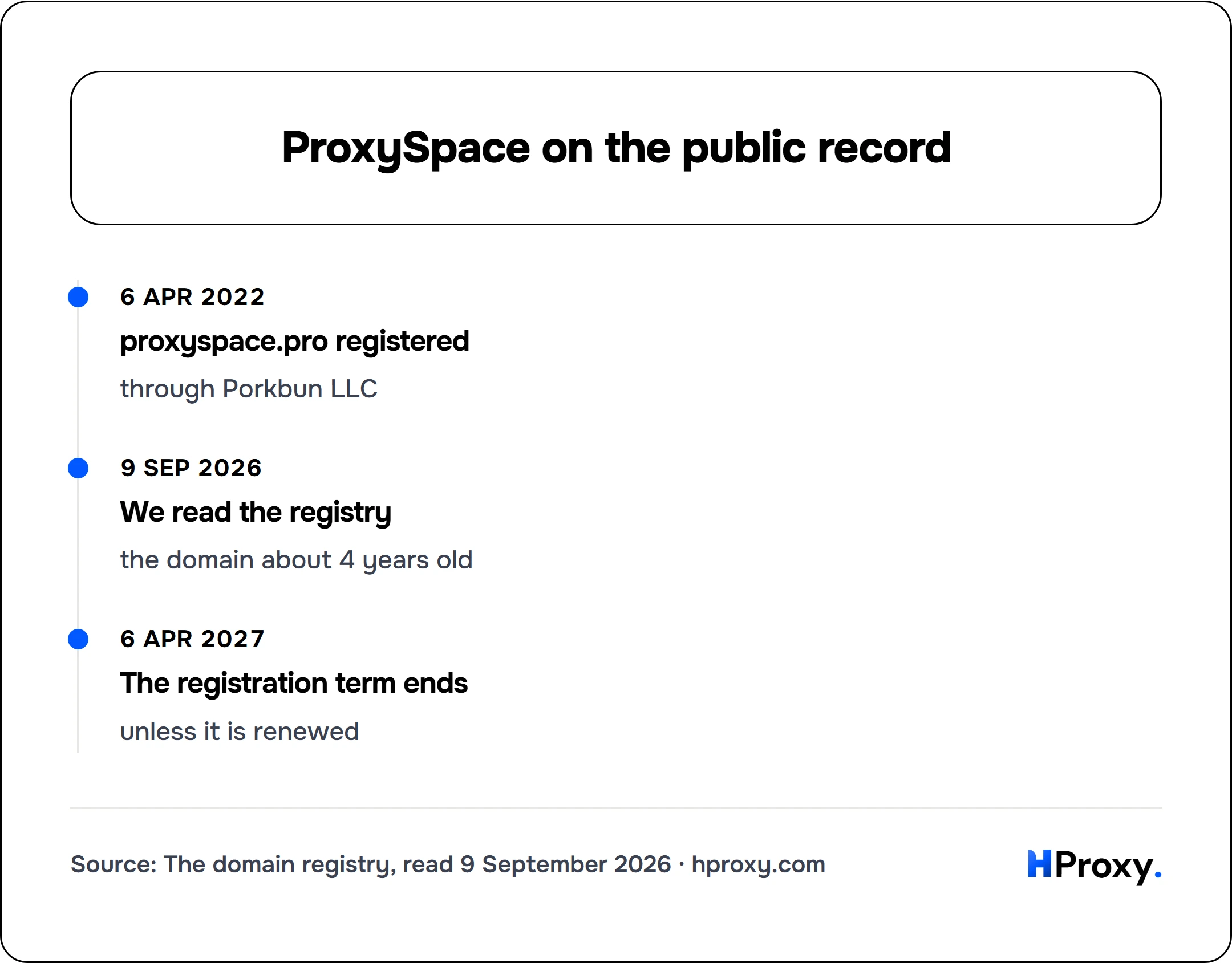
6 Apr 2022
proxyspace.pro registered
through Porkbun LLC
9 Sep 2026
We read the registry
the domain about 4 years old
6 Apr 2027
The registration term ends
unless it is renewed
Age is not quality. A long registration does not make a network good, and a new one does not make it bad. What it does rule out is the shortest-lived pattern in this market, which is a site that appears, sells, and is gone inside a year.
Ownership of the list
We checked this one by hand on 6 September 2026. It is a list, and we record the operator as independent.
It appears to be independently operated. That is the better case for neutrality, and it says nothing about whether the addresses work.
The Internet Archive has it from 21 June 2022 to 24 January 2026, about 5 years of coverage. The domain was registered 6 April 2022 through Porkbun LLC.
The number that matters, and that no list page prints, is how many entries still work. Ours is public: 589,918 proxies discovered, and 4,023 alive on 2026-08-11. Those that worked, then stopped, lasted a median 10 days, counting only addresses with fewer than 20 of them, without Amazon's networks or one June evening when our checker failed (measured 2026-09-28). Apply that decay to any undated list you are reading.
What the advertised numbers cannot tell you
What passes through, and what is kept
Anything routing your traffic can read it unless it is encrypted end to end, and can alter anything that is not. Assume the operator sees the metadata and decide whether that is acceptable for the work.
A country count is not coverage
Country totals are counted generously across this whole market. A country with a handful of addresses counts the same as one with hundreds of thousands. If your work depends on one location, test that location before you switch.
What happens when it breaks at two in the morning
Every provider works when nothing is wrong. The difference shows up on the day a subnet gets flagged or a gateway stops answering. Before committing volume, send one real question through the support channel and time the reply.
What separates them, in a table
The rows that matter, with our own answers stated plainly:
| Question to ask | ProxySpace | HProxy |
|---|---|---|
| Entry price | Not verified by us, read their page | From $0.44/GB, pay as you go |
| Does unused balance expire? | On their own terms page | Never |
| Minimum commitment | Their terms page answers this | None |
| Identity checks | Check the current terms, this one moves | Card orders are screened, and verification is sometimes requested |
| Targeting | Read their current terms | Country, city and ISP |
| Free way to evaluate | Worth confirming in writing before you commit | Free proxy list and proxy checker |
We would rather show an incomplete table than a confident wrong one. Anything we could not source is left for you to read at the source, with the date you read it.
A test worth more than this comparison
Do this once and you will never need a comparison page for this decision again.
- Start with the smallest purchase each vendor allows, so the test costs less than the decision it replaces.
- Use your own scraper and your own target. A benchmark against a neutral site measures nothing you will experience.
- Measure what came back correctly and what it consumed, then divide the spend by the successes.
- Push a sample of exit addresses through an independent checker and confirm the country and connection type are what was advertised.
- Buy the one that won on your target, and diarise a re-test in three months.
Who else is in this bracket
The same treatment, applied to the providers most often weighed against this one:
- ProxyServers.pro alternatives
- PubProxy alternatives
- Socks 24 alternatives
- Socks-Proxy.net alternatives
- Spys.me alternatives
- SSLProxies alternatives
Our side of it
HProxy is pay as you go from $0.44 per GB on residential, with ISP, mobile and datacenter under one balance and no commitment attached to any of them. Run the test. If we lose on your target, we lose, and you have your answer.