You can settle this yourself for less than the price of lunch. That is the argument of this page, and the sections before the test exist to tell you what to measure once you start.
The record we hold
Socks 24 operates from socks24.org. Our classification for them is free proxy list.
What we do not hold is a current, sourced price for Socks 24. Rather than print a figure we cannot stand behind, this page leaves it out and tells you what to look for when you read their page yourself.
Read their page for the reachable rate rather than the headline, the minimum spend, the expiry clause and the billing treatment of blocked requests. Write down the date, because all four move.
What the registration record shows
The domain was registered on 7 September 2010, through united-domains GmbH, which makes it about 16 years old. Those dates come from a registry query on 9 September 2026. Their registration is booked through 7 September 2027.
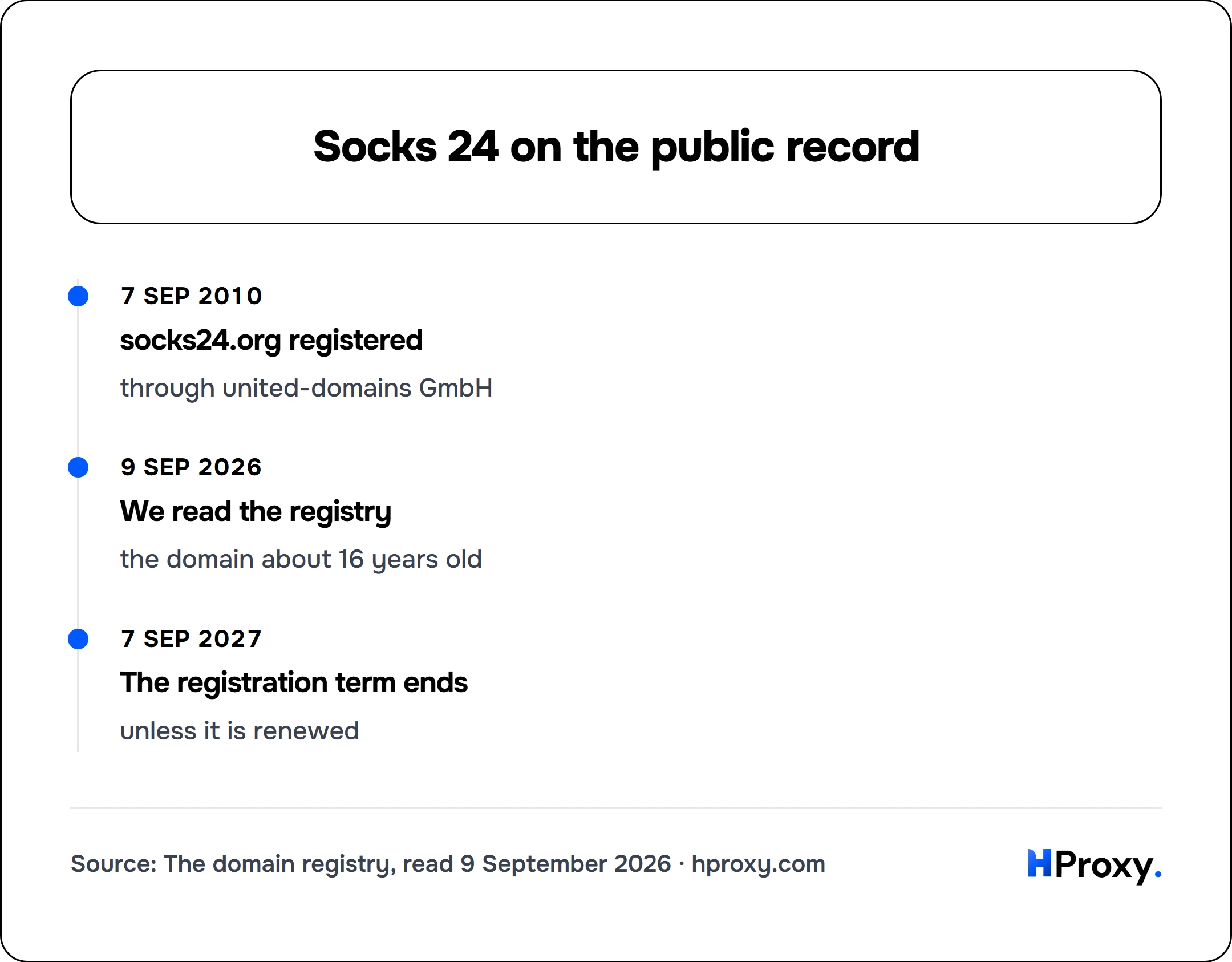
7 Sep 2010
socks24.org registered
through united-domains GmbH
9 Sep 2026
We read the registry
the domain about 16 years old
7 Sep 2027
The registration term ends
unless it is renewed
Age is not quality. A long registration does not make a network good, and a new one does not make it bad. What it does rule out is the shortest-lived pattern in this market, which is a site that appears, sells, and is gone inside a year.
Whose list this is
We checked this one by hand on 6 September 2026. It is a list, and we record the operator as independent. Evidence recorded: http 200, title "Socks 24"; https no answer. Old blog-style SOCKS list.
As far as we can establish it is run independently rather than by a proxy vendor. That usually means it survives on advertising, which shapes the site rather than the data.
The Internet Archive has it from 10 September 2010 to 21 April 2026, about 17 years of coverage. The domain was registered 7 September 2010 through united-domains GmbH.
Every list in this category has the same underlying problem, which is decay. We measure it on our own network and publish it: 4,023 alive on 2026-08-11, out of 589,918 ever discovered. Those that worked, then stopped, lasted a median 10 days, counting only addresses with fewer than 20 of them, without Amazon's networks or one June evening when our checker failed (measured 2026-09-28). A list is only as good as its last check.
The parts no marketing page answers
What passes through, and what is kept
Free and cheap services are paid for somehow. Read the privacy policy for what is retained, for how long, and whether traffic is inspected or altered. This matters more than speed for anything involving an account.
Networks age, so re-test quarterly
Supply changes hands quietly in this industry. The network behind a brand can be replaced with no announcement, which is why a benchmark is a perishable good and a re-test is cheap insurance.
A pool total is not a promise
The number that matters is how many usable exits you can reach in the one country your job needs, this week. A pool total averages that away, which is why two providers with similar totals produce opposite results on the same site.
Side by side, with the blanks left blank
The table answers what we can answer and marks what we cannot:
| Question to ask | Socks 24 | HProxy |
|---|---|---|
| Entry price | Not verified by us, read their page | From $0.44/GB, pay as you go |
| Does unused balance expire? | On their own terms page | Never |
| Minimum commitment | Their terms page answers this | None |
| Identity checks | Check the current terms, this one moves | Card orders are screened, and verification is sometimes requested |
| Targeting | Their terms page answers this | Country, city and ISP |
| Free way to evaluate | Check the current terms, this one moves | Free proxy list and proxy checker |
Two notes on that table. The rows we left for you to check are not evasions: those terms change, and printing a stale figure is exactly the failure this page is trying to avoid. And no table can hold the number that should decide your purchase, which is the success rate on your own target.
A test worth more than this comparison
Do this once and you will never need a comparison page for this decision again.
- Buy the minimum each side offers. Prefer a small paid batch over a trial, because trial traffic does not always ride the same pool.
- Send an identical workload through each: same target, same tooling, same time of day, same request mix.
- Log successes, failures and gigabytes used. Cost per successful request is the figure you are after.
- Verify a slice of the exits independently. Country labels in this market are self-reported and are not always right.
- Take the winner and set a reminder to run this again, since a result has a shelf life of about a quarter.
The other names that come up
Other providers in the same bracket, priced and dated the same way:
- Free Proxy List alternatives
- Freeproxy alternatives
- FreeProxyList.cc alternatives
- Freeproxylists alternatives
- fyvri/fresh-proxy-list alternatives
- Geonix alternatives
Our side of it
HProxy is pay as you go from $0.44 per GB on residential, with ISP, mobile and datacenter under one balance and no commitment attached to any of them. Run the test. If we lose on your target, we lose, and you have your answer.