Choosing a free proxy list on price alone is the most common and most expensive mistake in this market, because a cheap request that fails costs more than a dearer one that works. That framing runs through the whole page.
What is on file for PubProxy
Their site is pubproxy.com. Category, as we track it: free proxy list.
We price the providers we can source and date, and PubProxy is not currently one of them. The rest of this page is about what to check when you read their pricing yourself.
The four figures worth copying down are the rate without a commitment, the smallest purchase allowed, what happens to unspent balance, and whether a failed request still costs money.
How long PubProxy has been trading
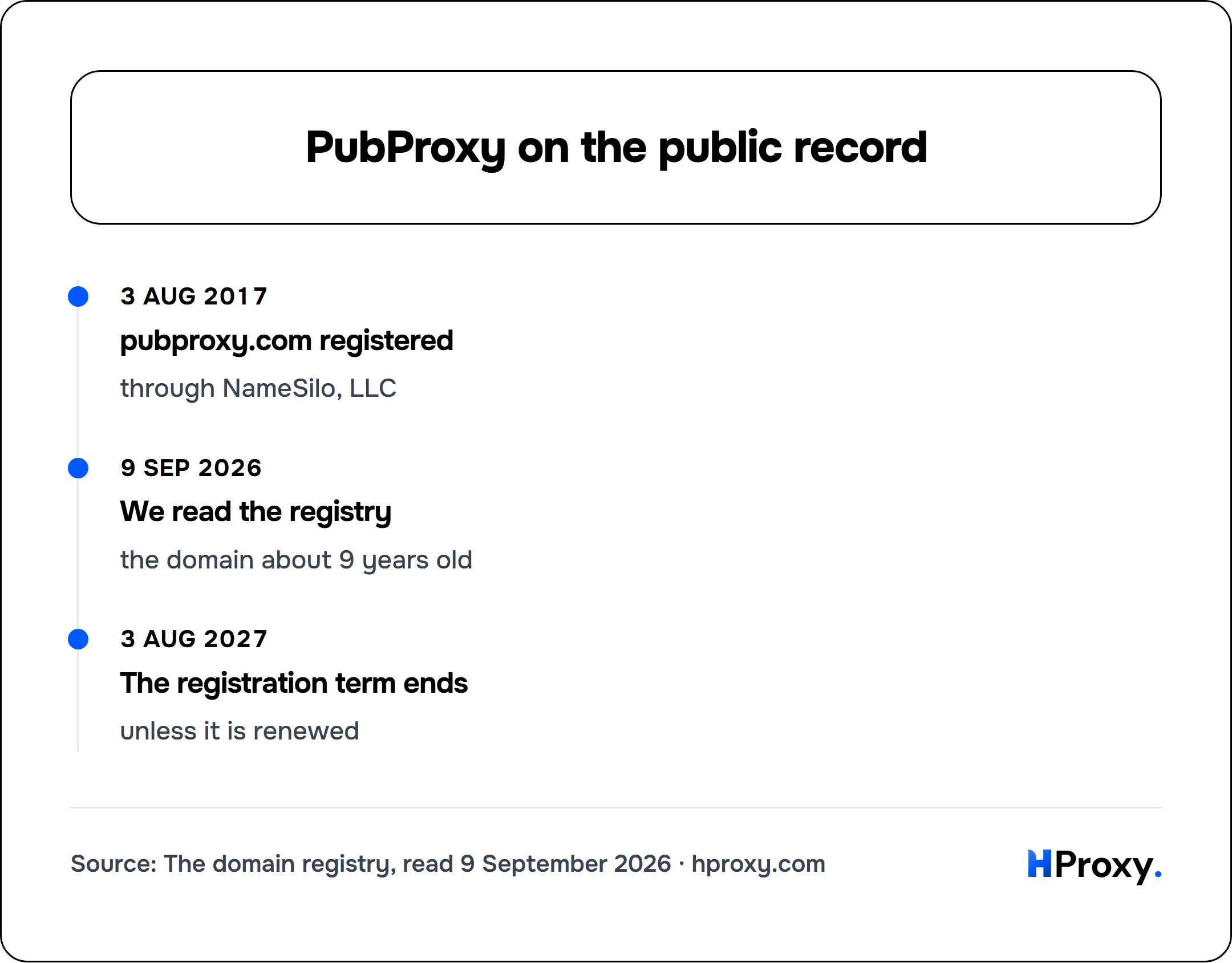
The domain was registered on 3 August 2017, through NameSilo, LLC, which makes it about 9 years old. Checked against the registry on 9 September 2026. The registration currently runs to 3 August 2027.
3 Aug 2017
pubproxy.com registered
through NameSilo, LLC
9 Sep 2026
We read the registry
the domain about 9 years old
3 Aug 2027
The registration term ends
unless it is renewed
This proves nothing about the product. It is a cheap check against the one failure mode that costs buyers real money in this market, which is paying a provider that will not exist in six months.
The operator, and why it matters
We checked this one by hand on 6 September 2026. It is an API, and we record the operator as independent. We could not settle its status with confidence, which is itself worth knowing before relying on it. Evidence recorded: http 200 "Free Proxy API Access"; https no answer.
It appears to be independently operated. That is the better case for neutrality, and it says nothing about whether the addresses work.
The Internet Archive has it from 18 December 2014 to 20 January 2026, about 11 years of coverage. The domain was registered 3 August 2017 through NameSilo, LLC.
Every list in this category has the same underlying problem, which is decay. We measure it on our own network and publish it: 4,023 alive on 2026-08-11, out of 589,918 ever discovered. Those that worked, then stopped, lasted a median 10 days, counting only addresses with fewer than 20 of them, without Amazon's networks or one June evening when our checker failed (measured 2026-09-28). A list is only as good as its last check.
What you still do not know after reading their site
Why an old benchmark is wrong
Every review of this market, this one included, is a photograph of a moving thing. Read the date on any comparison you find, and discount it heavily once it is more than a few months old.
Coverage in the one country you need
Ask for the pool size in your country rather than in total, and expect the answer to be vague. Where it is not published, the ten minute test at the end of this page settles it for a few dollars.
Support is a product feature
Test the support channel before you need it. Ask something specific and technical, and judge both the speed and whether the answer came from somebody who understood the question.
The two of us, on the questions that matter
Set the two side by side on the questions that decide the outcome, rather than on feature counts:
| Question to ask | PubProxy | HProxy |
|---|---|---|
| Entry price | Not verified by us, read their page | From $0.44/GB, pay as you go |
| Does unused balance expire? | Their terms page answers this | Never |
| Minimum commitment | On their own terms page | None |
| Identity checks | Not published clearly, ask before paying | Card orders are screened, and verification is sometimes requested |
| Targeting | On their own terms page | Country, city and ISP |
| Free way to evaluate | Not published clearly, ask before paying | Free proxy list and proxy checker |
The useful part of that table is the left column. Take those six questions to any provider in this market and the answers will sort them faster than any review.
The measurement that outranks every review
This costs less than a coffee and produces the only evidence that applies to your workload.
- Fund both accounts with the least money each will accept, and note what that minimum was, because it is part of the comparison.
- Aim both at the page that matters to you rather than a test endpoint, and keep every other variable fixed.
- Write down two numbers per provider: the share of requests that succeeded, and the traffic it cost.
- Take a handful of the addresses you were given and verify their country and type against a checker you do not control.
- Keep the winner, and repeat the whole thing quarterly, because pools age.
Where else buyers look
If this one does not fit, these are the nearest comparable providers we have written up, each on the same terms as this page.
What we sell, stated plainly
Our position is narrow. Residential from $0.44 per GB, no subscription, no expiry on the balance, and a public record of what our free network actually does. A provider unwilling to be measured is telling you something, and so is one that asks to be.