Comparison

ProxyServers.pro alternatives, checked for how many entries are alive

A ProxyServers.pro alternative, judged by a competitor who says so up front: the record we hold, the gaps in it, and the test that outranks this page.

HProxy Team··4 min read
HProxy.Comparison

Free proxies won't hold up here.

Shared datacenter IPs get flagged and dropped fast. When it has to hold, gaming, streaming, accounts, you need mobile and residential IPs that read as a real device, from $0.44/GB, pay as you go.

See plans & pricing

People arrive at a free proxy list comparison for one of two reasons: the price moved, or the thing stopped working. This page assumes you are in one of those two positions with ProxyServers.pro and wants to be useful in ten minutes rather than impressive in thirty.

What we can and cannot tell you about ProxyServers.pro

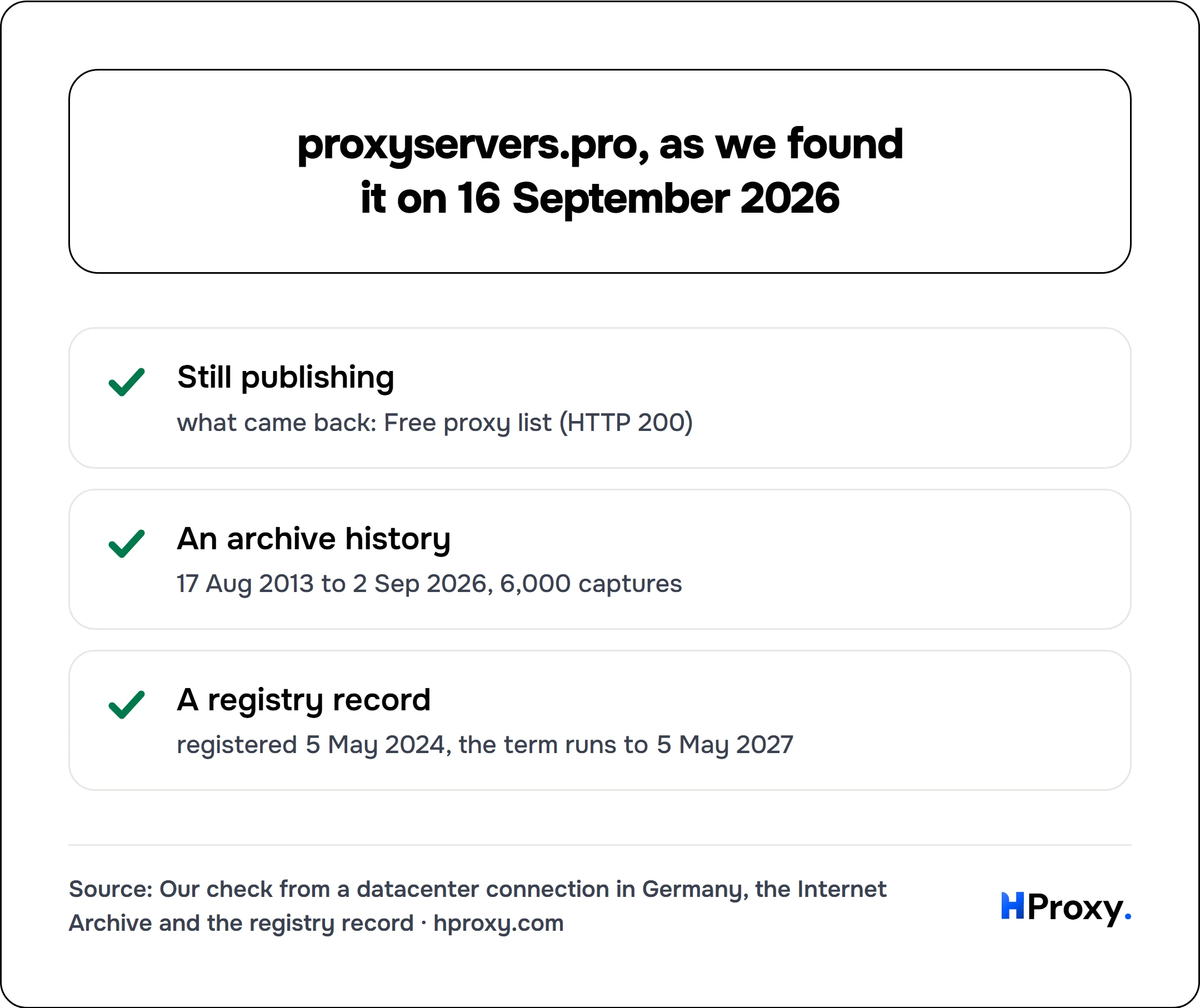
The company behind the name sits at proxyservers.pro. We carry them as a free proxy list.

ProxyServers.pro is not in our priced record, so nothing about their rate appears below. That gap is stated rather than filled, which is the only honest option available.

Note the price, the unit it is quoted in, the minimum, and the expiry. Unit and expiry are where most comparisons in this market quietly go wrong.

What ProxyServers.pro says about itself today

Read 9 September 2026, the homepage titles itself "Free proxy list, Free proxy, anonymizer, unblock telegram youtube gayfuror facebook". The one-paragraph pitch on their own page: "Free proxy, anonymizer, unblock telegram youtube gayfuror facebook"

What else that page states, without interpretation:

Their pricing page is titled "Free proxy list, Free proxy, anonymizer, unblock telegram youtube gayfuror facebook".

All of the above is their copy, not our finding. A dated quotation is the weakest kind of evidence that is still evidence.

What the registration record shows

The domain was registered on 5 May 2024, through Edomains LLC, which makes it about 2 years old. Registry data as of 9 September 2026. It is paid up until 5 May 2027.

Age is not quality. A long registration does not make a network good, and a new one does not make it bad. What it does rule out is the shortest-lived pattern in this market, which is a site that appears, sells, and is gone inside a year.

Whose list this is

We checked this one by hand on 6 September 2026. It is a list, and we record the operator as independent.

As far as we can establish it is run independently rather than by a proxy vendor. That usually means it survives on advertising, which shapes the site rather than the data.

The Internet Archive has it from 17 August 2013 to 19 January 2026, about 13 years of coverage. The domain was registered 5 May 2024 through Edomains LLC.

Every list in this category has the same underlying problem, which is decay. We measure it on our own network and publish it: 4023 alive right now out of 589918 ever discovered, median lifespan 145 hours. A list is only as good as its last check.

What the advertised numbers cannot tell you

What passes through, and what is kept

Anything routing your traffic can read it unless it is encrypted end to end, and can alter anything that is not. Assume the operator sees the metadata and decide whether that is acceptable for the work.

A country count is not coverage

Country totals are counted generously across this whole market. A country with a handful of addresses counts the same as one with hundreds of thousands. If your work depends on one location, test that location before you switch.

What happens when it breaks at two in the morning

Every provider works when nothing is wrong. The difference shows up on the day a subnet gets flagged or a gateway stops answering. Before committing volume, send one real question through the support channel and time the reply.

What separates them, in a table

The rows that matter, with our own answers stated plainly:

Question to askProxyServers.proHProxy
Entry priceNot verified by us, read their pageFrom $0.44/GB, pay as you go
Does unused balance expire?Check the current terms, this one movesNever
Minimum commitmentTheir terms page answers thisNone
Identity checksCheck the current terms, this one movesCard orders are screened, and verification is sometimes requested
TargetingRead their current termsCountry, city and ISP
Free way to evaluateWorth confirming in writing before you commitFree proxy list and proxy checker

We would rather show an incomplete table than a confident wrong one. Anything we could not source is left for you to read at the source, with the date you read it.

How to settle it yourself in ten minutes

Run this before you commit any volume. It replaces every opinion on this page, including ours.

  1. Buy the minimum each side offers. Prefer a small paid batch over a trial, because trial traffic does not always ride the same pool.
  2. Send an identical workload through each: same target, same tooling, same time of day, same request mix.
  3. Log successes, failures and gigabytes used. Cost per successful request is the figure you are after.
  4. Verify a slice of the exits independently. Country labels in this market are self-reported and are not always right.
  5. Keep whichever pool won on your job. Re-run this whenever success rate drops or the bill moves.

Others in this market

Nearest alternatives by product shape rather than by who pays us, since nobody does:

Our side of it

HProxy is pay as you go from $0.44 per GB on residential, with ISP, mobile and datacenter under one balance and no commitment attached to any of them. Run the test. If we lose on your target, we lose, and you have your answer.

Frequently asked questions

How do I compare two providers fairly?
Match the units first, because residential is billed per gigabyte, datacenter and ISP per address, and mobile per day or per port. Then compare the rate you can actually reach today rather than the volume tier behind a commitment. Finish by measuring the success rate on your own target, since a cheap request that fails costs more than a dearer one that works.
Is a cheaper provider usually worse?
Not reliably. Price in this market reflects the supply model and the sales overhead as much as the network. What price does not tell you is the success rate on your target, and that is the figure that decides whether the cheaper option was cheap or expensive. Measure before assuming either way.
How is HProxy different?
The models differ more than the products do. HProxy is pay as you go from a balance you top up when you want, the balance does not expire, there is no subscription unless the optional discount suits you, and residential starts at $0.44 per GB with city and ISP targeting included. Whether that beats a tiered plan depends on your usage pattern, which a short test settles.
Do I have to talk to sales or sign a contract to switch?
Not with us. You can sign up, add funds and send traffic without a call, a minimum or a subscription. Whether another provider requires any of those is on their own pricing page and is worth reading, because a required commitment is part of the price even when it is not part of the rate.
How often should I re-test a provider?
Quarterly is a reasonable rhythm for most workloads, and immediately after a noticeable drop in success rate. Pools are rebuilt, suppliers change and detection improves, so a benchmark from last year describes a network that no longer exists.

Proxies that don't die mid-job

Residential, ISP, datacenter and mobile, verified by the same engine that runs tens of millions of checks. They read as a real device and hold up under load. Pay as you go, and your balance never expires. $0.44/GB is the 2,000 GB+ rate; a single gigabyte is $0.50/GB, with no minimum order.

129M+ proxy checks run · 100+ countries · HTTP / HTTPS / SOCKS · re-checked every few minutes · no signup