ProxyOmega is trading at proxyomega.com, run by PROXYOMEGA LTD in London. It sells six products on one account: residential and mobile traffic by the gigabyte, unlimited residential plans by port or by speed, IPv6 by thread and US static ISP addresses. Residential costs $3.00 a GB for small top-ups and falls to $1.40 at 5,000 GB, and the credits never expire. The like-for-like prices are in the alternatives table.
Is ProxyOmega legit? The record in one table
| what we read on 27 September 2026 | |
|---|---|
| website | proxyomega.com answers normally, behind Cloudflare |
| company | PROXYOMEGA LTD, London, incorporated 7 November 2022; its terms fall under Delaware law |
| products | residential and ISP, mobile, unlimited residential, IPv6 and US static ISP |
| price | residential from $3.00 a GB, down to $1.40 at 5,000 GB |
| payment | card through Stripe, or crypto through CoinGate |
| refunds | rules per product; none on crypto payments or balance deposits |
| domain | registered 30 December 2020 |
| reviews | 4.1 of 5 from 19 Trustpilot reviews in a copy from January 2024; the live page could not be read |
The company is on the UK register as active, and the shop has sold proxies under this name since 2021. It asks for two-factor sign-in on every account.
What ProxyOmega sells, and what it costs
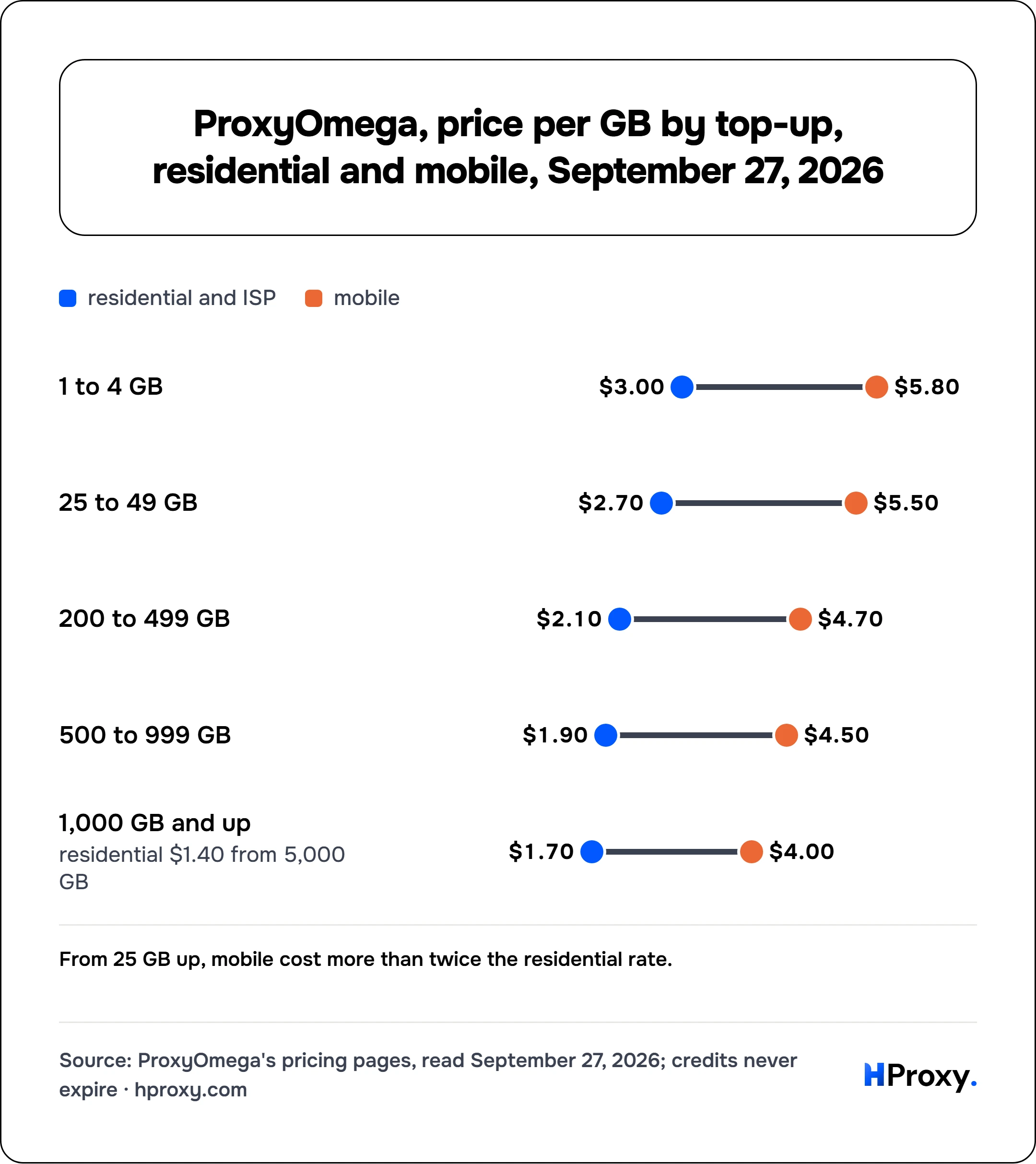
Prices come from its pricing pages, read on 27 September 2026. The two per-gigabyte products are priced by the size of each top-up, and their credits never expire.
| top-up | residential and ISP, per GB | mobile, per GB |
|---|---|---|
| 1 to 4 GB | $3.00 | $5.80 |
| 25 to 49 GB | $2.70 | $5.50 |
| 200 to 499 GB | $2.10 | $4.70 |
| 500 to 999 GB | $1.90 | $4.50 |
| 1,000 GB and up | $1.70, and $1.40 from 5,000 GB | $4.00 |
- residential and ISP
- mobile
Residential traffic covers more than 200 countries with state, city and ASN targeting, and a session can hold one address for up to 60 hours. A first purchase of 2 GB or more adds up to 5 GB free. Mobile traffic comes from 4G and 5G carriers in 113 countries, targeted by country.
The other products are priced this way:
- Unlimited by port: $51.99 for five ports over 30 days, or $5.99 for a day, on a pool of 2 million IPs with country targeting.
- Unlimited by speed: $149 a day or $1,549 for 30 days at 200 Mbps, with state and city targeting.
- Static ISP: $3.25 per US IP a month for 5 to 9 IPs, down to $2.59 from 100.
- IPv6: from $0.05 per thread a day, and 1,000 threads cost $900 for 30 days.
The fine print that decides the cost
Refunds depend on the product. The refund policy of 28 July 2026 rules out refunds on residential and mobile data "once the data allocation is activated". Unlimited plans have windows of 24 hours for listed failures, or 2 hours on the premium plan when credentials never arrive.
Crypto and deposits are final. Its policy says crypto payments "are not refundable under any circumstances", and money added to the account balance cannot be withdrawn.
Evidence for any claim. A refund request needs screenshots, logs or network traces, and the company checks them against its own server records.
One account per person. Duplicate accounts can be closed, and their balances kept.
Delaware law. The terms fall under the laws of Delaware, although the company is registered in England.
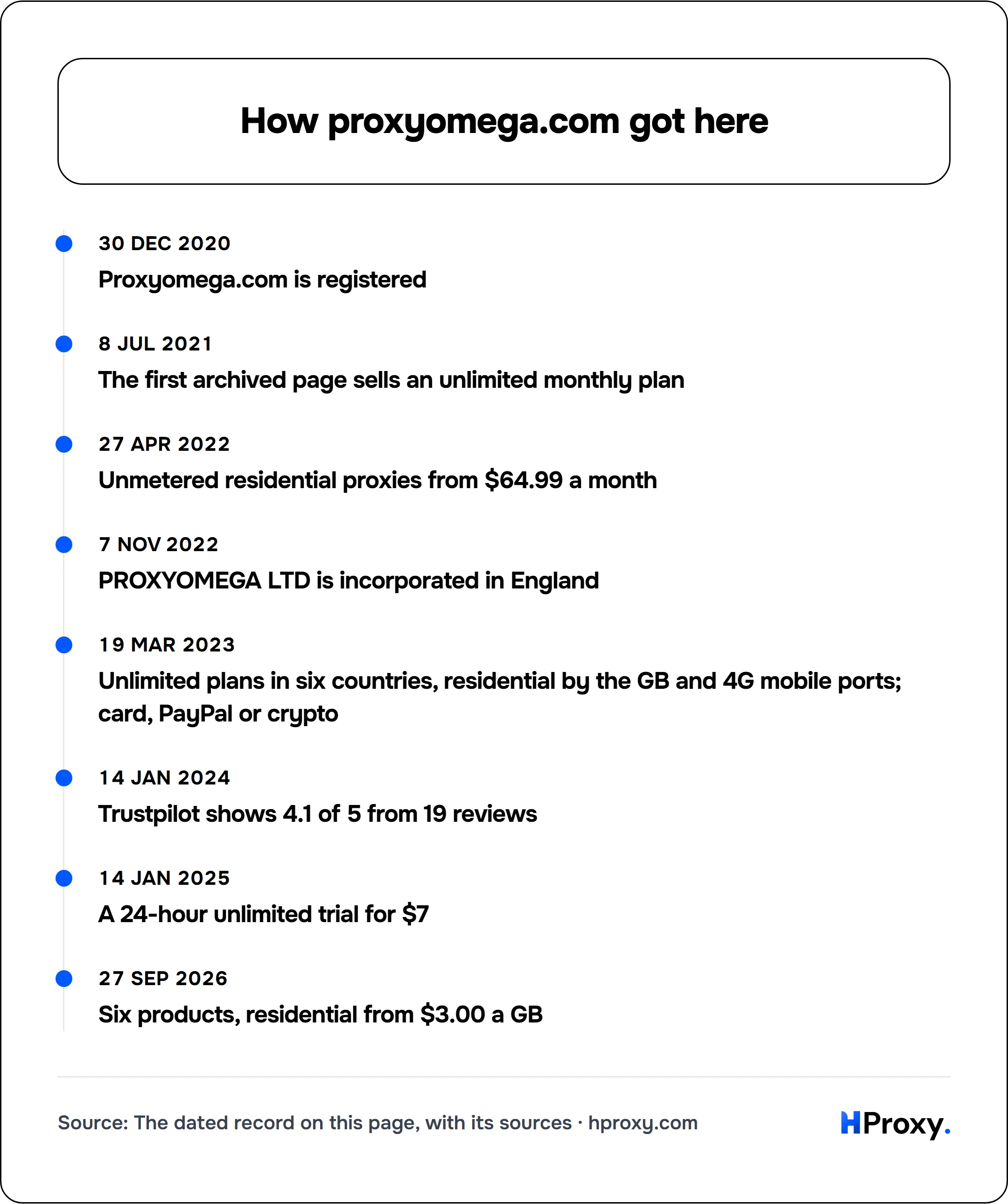
How proxyomega.com got here
| date | what the record shows |
|---|---|
| 30 December 2020 | proxyomega.com is registered |
| 8 July 2021 | the first archived page sells an unlimited monthly plan |
| 27 April 2022 | unmetered residential proxies from $64.99 a month |
| 7 November 2022 | PROXYOMEGA LTD is incorporated in England |
| 19 March 2023 | unlimited plans in six countries, residential by the GB and 4G mobile ports; card, PayPal or crypto |
| 14 January 2024 | Trustpilot shows 4.1 of 5 from 19 reviews |
| 14 January 2025 | a 24-hour unlimited trial for $7 |
| 27 September 2026 | six products, residential from $3.00 a GB |
30 Dec 2020
Proxyomega.com is registered
8 Jul 2021
The first archived page sells an unlimited monthly plan
27 Apr 2022
Unmetered residential proxies from $64.99 a month
7 Nov 2022
PROXYOMEGA LTD is incorporated in England
19 Mar 2023
Unlimited plans in six countries, residential by the GB and 4G mobile ports; card, PayPal or crypto
14 Jan 2024
Trustpilot shows 4.1 of 5 from 19 reviews
14 Jan 2025
A 24-hour unlimited trial for $7
27 Sep 2026
Six products, residential from $3.00 a GB
Sources: the domain registry, Companies House, the Internet Archive and its own pages, read 27 September 2026.
ProxyOmega alternatives for residential traffic
The fair comparison is the smallest purchase and the lowest rate each vendor prints, from each pricing page. ProxyOmega was read on 27 September 2026, the others a day earlier.
| provider | smallest purchase | lowest rate printed, and what it needs | unused traffic |
|---|---|---|---|
| ProxyOmega | $3.00 a GB, from 1 GB | $1.40 a GB, 5,000 GB or more | kept, credits never expire |
| Webshare | $3.50 for a 1 GB plan | $1.40 a GB, 3,000 GB at $4,200 a month | resets monthly |
| Rayobyte | $3.50 a GB, from 1 GB | $0.50 a GB, 5,000 GB or more by contact | kept on pay as you go |
| Evomi | $0.99 a GB, from 15 GB | $0.49 a GB, the 100 GB plan at $49 a month | kept on pay as you go |
| DataImpulse | $5 for 5 GB, $1.00 a GB | $0.80 a GB, 1 TB for $800 | kept |
| HProxy Residential Lite, country targeting | $0.50/GB, from 1 GB | $0.44/GB at 2,000 GB+ | kept, the balance never expires |
| HProxy Residential Premium, state, city and ISP targeting | $1.49/GB, from 1 GB | $1.00/GB at 1,000 GB+ | kept, the balance never expires |
ProxyOmega targets states, cities and ASNs, so its like-for-like row on our side is Premium, at $1.49 per GB from the first gigabyte. Both of ours are on our residential price table.
For mobile traffic, Rainproxy charged $3.10 for 1 GB and $2.00 a GB at 500 GB on 27 September 2026, and Evomi $3.98 a GB pay as you go and $2.20 on its largest plans a day earlier. Our mobile proxies cost $1.50/GB, targeted by country, from 1 GB. For a fixed address, our ISP proxies cost $2.70 per IP for a month.
Where ProxyOmega is the better buy
Unlimited traffic. Its unlimited plans start at $5.99 a day for five ports, with no meter on the data.
Very long sessions. A residential session can hold one address for up to 60 hours.
A bonus on the first purchase. A first residential top-up of 2 GB or more adds up to 5 GB free.
Where HProxy is the better fit
Unspent money comes back. Our refund policy returns wallet top-ups you have not spent within 14 days, to the card or crypto wallet that paid. Its balance deposits and crypto payments are never paid back.
Mobile from 1 GB. Our mobile proxies cost $1.50/GB from the first gigabyte. Its mobile costs $5.80 a GB for top-ups under 5 GB.
More ways to pay. Our payment options page lists cards, 32 crypto assets and networks, Alipay, Pix and more. It takes card and crypto.
A company in Germany. Our imprint names Obsidian UG in Herford, Germany. ProxyOmega is registered in England, with its terms under Delaware law.
Before you commit
Buy a small ProxyOmega top-up and a single gigabyte of our Premium traffic, then run the same job through both. Check the exits in our proxy checker first. Our free proxy list and the checker need no account.
The limits of this record
We did not test ProxyOmega, so nothing here grades speed or success. Its pages disagree in places: sessions of up to 24 or up to 60 hours, and a lowest mobile rate of $4.40 or $4.00. We used its price tables. The live Trustpilot page could not be read. This page is due for a check by 27 December 2026.
Other providers we cover
More pages in this series: GhostBrowser.com, GlobalByte.io, GlobalProxies.net, GloryCloud.com, Gologin.com and GonzoProxy.com.
Sources
Every source below was read on 27 September 2026, except the pricing pages of Webshare, Rayobyte, Evomi and DataImpulse, read a day earlier.
- ProxyOmega: homepage, the pricing pages of its six products, terms of service, refund policy and acceptable use policy.
- Companies House, the record of PROXYOMEGA LTD, company 14465923.
- Verisign, the registry record for proxyomega.com.
- Internet Archive, captures of proxyomega.com from 8 July 2021 to 16 June 2026, and of its Trustpilot page from 14 January 2024.
- Webshare, Rayobyte, Evomi, DataImpulse and Rainproxy, pricing pages.
- HProxy, our own product catalog, price table, refund policy, payment options and imprint.