ProxyLTE (proxylte.com) sold US mobile proxies from 2018, on cellular (LTE) and home WiFi connections. On 27 September 2026 its site showed no page: Cloudflare returned error 526, which means the certificate on its own server could not be validated. Everything below about what it sold comes from copies in the Internet Archive, the latest readable ones from 2022 and January 2023. For replacements, jump to the alternatives table.
ProxyLTE at a glance
| what we found | |
|---|---|
| status | error 526 on 27 September 2026; nothing readable archived since January 2023 |
| operator | no company named |
| domain | registered 9 October 2017, held until October 2030 |
| product | US mobile proxies, LTE and WiFi |
| protocols | HTTPS and SOCKS5 |
| rotation | a new IP every 30 minutes, if enabled |
| smallest plan in 2022 | 25 ports for $20 a day |
| payment | Bitcoin and Litecoin |
| refunds | none, except a proxy offline within an hour |
| support | Telegram, Jabber and ICQ |
What ProxyLTE sold
Mobile proxy ports. Plans of 25 to 1,000 ports on US mobile devices, with 10 unique IPs for each port, rented by the day, week or month. You chose HTTPS or SOCKS5 and a connection type: cellular, broadband WiFi or both.
Single proxies. Proxies picked one by one by region, ISP, ZIP code, speed and a spam score, rented for 24 hours after a one-time deposit of $49.
Social and exclusive plans. Proxies sold for social media, and exclusive plans of 250 to 1,000 ports priced on request.
In December 2022 its device list showed about 1,640 cellular and 3,940 WiFi devices, across all 50 states and Washington, D.C.
What ProxyLTE charged in 2022
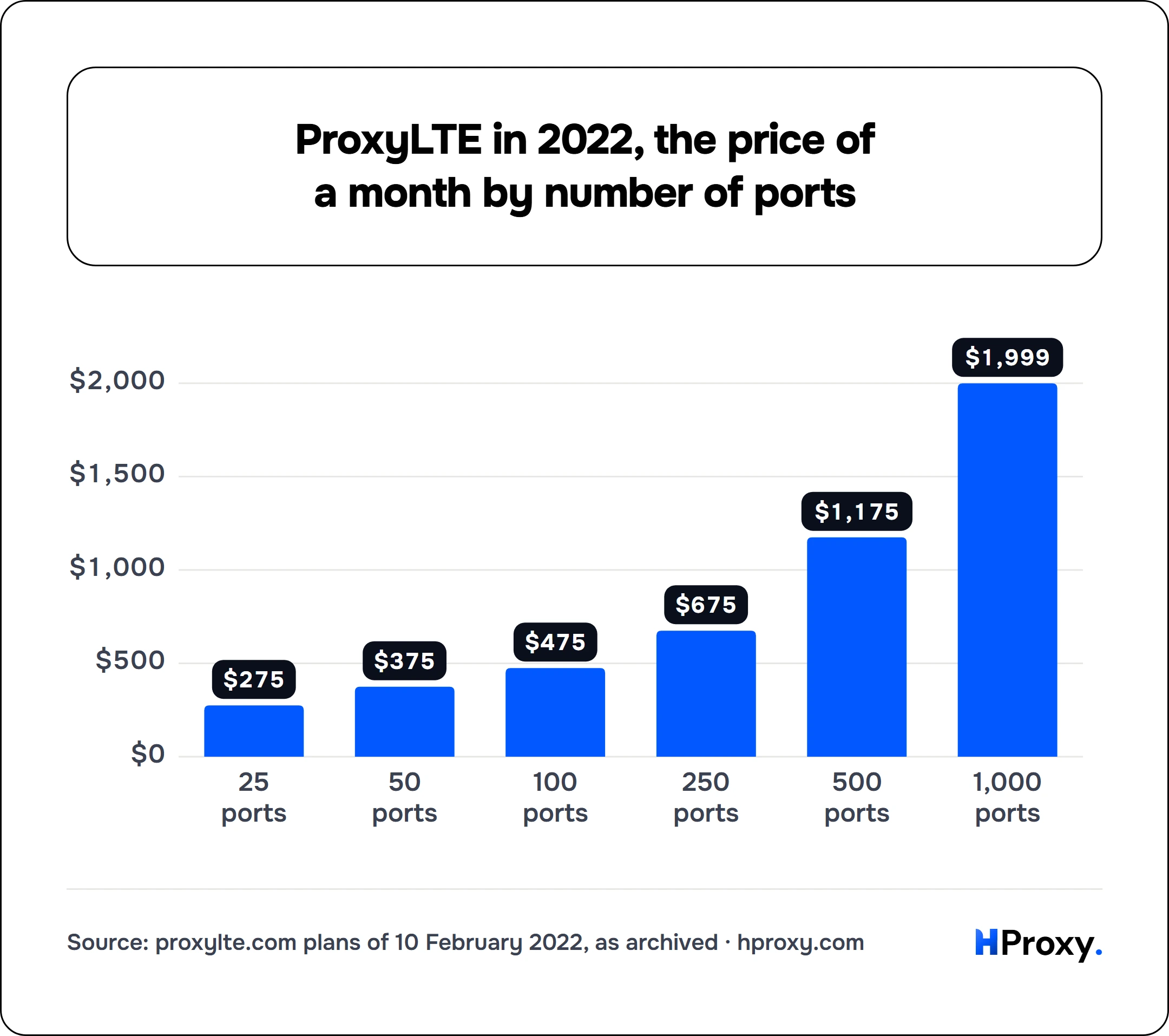
These are the plans its app loaded on 10 February 2022, as the Internet Archive holds them.
| ports | a day | a week | a month |
|---|---|---|---|
| 25 | $20 | $99 | $275 |
| 50 | $30 | $150 | $375 |
| 100 | $45 | $199 | $475 |
| 250 | $75 | $275 | $675 |
| 500 | $100 | $449 | $1,175 |
| 1,000 | $150 | $599 | $1,999 |
Basic plans had a cap: its app said it did not allow permanent traffic above 12 Mb/s on them.
The fine print in 2022
No refunds. "We do not offer refunds. Make sure you test our services with smaller plans at first." A single proxy that went offline within an hour could still be refunded.
Crypto only. "We accept BTC and LTC for payment."
Support by messenger. A free test plan went through Telegram, Jabber or ICQ, and no company name appears anywhere in its text.
What happened to the site
Readable copies run from March 2018 to August 2022, and parts of its app were archived until January 2023. From August 2023 to May 2024 the archive shows only a Cloudflare check, and in February 2025 an error 522, meaning its server did not answer. In February 2026 it shows another check page.
On 27 September 2026 the site answers with error 526. The domain is still registered, until October 2030, and we found no statement from ProxyLTE about closing.
What ProxyLTE did well
US mobile by ZIP code. Single proxies filtered by region, ISP and ZIP code, with a spam score shown before you rented them.
Bulk ports by the day. 1,000 ports for $150 a day suited short, heavy jobs.
Where HProxy differs
We sell proxies too, so read this part as the account of a competitor. Every HProxy fact here comes from our own product code and pages.
Mobile by the gigabyte. Rotating mobile traffic, targeted by country, costs $1.50/GB, from one gigabyte and with no daily or monthly plan to buy.
Residential with city targeting. Premium, our pool with state, city and ISP targeting, costs $1.49/GB for one gigabyte, with sessions held from 3 minutes to 24 hours.
A named company and more ways to pay. Our imprint names the company behind HProxy. We take cards, Alipay and thirty-two crypto options, and ask for no documents at sign-up or at an ordinary checkout.
Where we are behind. We sell no US mobile ports by the day and no single proxies picked by ZIP code.
The alternatives, side by side
Mobile proxies at the smallest buy, each read from the page of its vendor on 26 or 27 September 2026.
| provider | smallest buy | price |
|---|---|---|
| Proxyou | 1 US mobile port for 1 day | $10 |
| ProxyPanel | 1 dedicated mobile proxy for 24 hours | $10 |
| Proxywing | 1 mobile proxy for 1 day | from $4 |
| Buypersonalproxy | 1 US mobile proxy for 1 day | $20 |
| DataImpulse | 2.5 GB of mobile traffic, new users | $5 |
| HProxy mobile | 1 GB, by country | $1.50/GB |
Our reviews of Proxyou, ProxyPanel, Proxywing, Buypersonalproxy and DataImpulse cover their terms in full.
Who needs a replacement
Anyone who ran US mobile ports through ProxyLTE, for social media tools or data collection, needs a new source, since the site does not load. Match the unit first: a port by the day suits steady long sessions, while mobile traffic by the gigabyte suits bursts.
Before you commit
Test a day of mobile proxies on your own target before paying for a month. Our proxy checker shows whether an address answers, how fast, and from where, whoever sold it.
The limits of this review
We could not reach ProxyLTE, so we did not test its network or ask it about its status. Everything here about its products, prices and terms comes from Internet Archive copies of 2018 to January 2023, and those prices date from February 2022. The device counts are its own figures.
Every figure here carries the day it was read, and this page is due for a check by 27 December 2026.
Sources
- ProxyLTE, proxylte.com: the live site, which answered with Cloudflare error 526. Read 27 September 2026.
- Internet Archive, copies of proxylte.com and its app: homepages of 2018 and 2022, app text archived from 2022 to January 2023, the plan list of 10 February 2022, the device list of 17 December 2022, and the check and error pages of 2023 to 2026.
- Verisign, registry record for proxylte.com. Read 27 September 2026.
- Proxyou, ProxyPanel, Proxywing, Buypersonalproxy and DataImpulse, mobile price pages. Read 26 and 27 September 2026.
- HProxy, our imprint, our own product records, price table and terms.