BuyPersonalProxy is trading at buypersonalproxy.com, where it has sold private proxies since at least 2017. Most of its range is rented by the address for a month. One datacenter proxy costs $3.99, and one ISP proxy $5.99. Rotating residential traffic costs $9.99 for 1 GB. Its legal page names NETWORLD COMMUNICATIONS S.R.L., a company in Bucharest, Romania. The like-for-like prices are in the alternatives table.
Is BuyPersonalProxy legit? The record in one table
| what we read on 27 September 2026 | |
|---|---|
| website | buypersonalproxy.com forwards to its www address, which answers normally, behind Cloudflare |
| company | NETWORLD COMMUNICATIONS S.R.L., Bucharest, company number RO42681692 |
| domain | registered 12 January 2016 |
| products | datacenter, ISP, static and rotating residential, and US mobile proxies, plus a VPN |
| payment | cards, wallets and bank payments through Stripe, Alipay and crypto |
| refunds | none: "All sales are final. We do not offer refunds." |
| trial | one datacenter proxy for 24 hours, free, on request |
| Trustpilot | not readable: the page refused our server, and the archive holds no copy |
It is a long-running shop with a named company behind it. The archive shows US datacenter proxies on sale in 2017, and the footer counts from 2016. Its refund policy is the line to read before you pay.
What BuyPersonalProxy sells, and what it costs
Static proxies are rented by the address for a month, with unlimited traffic. Each package below is one price for the whole month, from the plan cards read on 27 September 2026:
| static proxy, one month | 1 address | 100 addresses | 1,000 addresses |
|---|---|---|---|
| datacenter, in five countries | $3.99 | $189.99 | $1,399.99 |
| ISP | $5.99 | $279.99 | $1,799.99 |
| premium ISP, 10 Gbps ports | $7.99 | $399.99 | $2,699.99 |
| static residential | $9.99 | $449.99 | $2,999.99 |
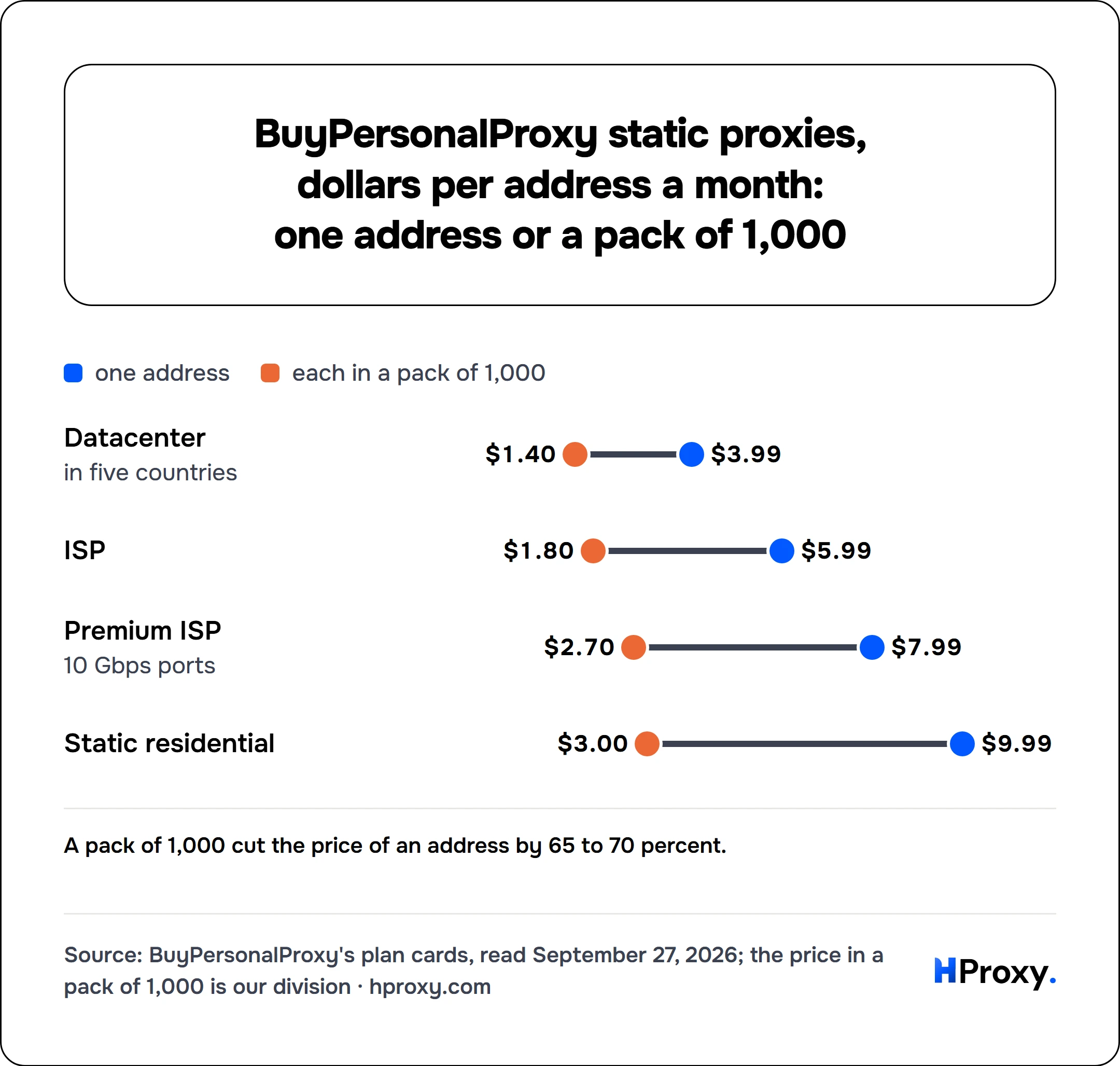
- one address
- each in a pack of 1,000
A datacenter day pass costs $5 for 10 addresses and runs up to 200 for $100. Shared datacenter proxies, each used by up to 3 customers, cost $15 a month for 25.
Rotating residential traffic is sold by the gigabyte. It costs $9.99 for 1 GB and $99.90 for 10 GB. A pack of 100 GB costs $799.99, and 1,000 GB cost $4,999.99, or $5 a GB. Country, state and city targeting are included, and sticky sessions last up to 24 hours. The homepage quotes "$ 5.99 per GB" for the same 1,000 GB plan.
US mobile proxies from T-Mobile, AT&T and Verizon are rented by the day. The homepage says $20 a day, while the order form showed $40.00 for one AT&T proxy for one day. Every plan works over HTTP(S) and SOCKS5, except mobile, which takes HTTPS and SOCKS5 only.
The fine print that decides the cost
No refunds, and no withdrawals. Its policy is short: "All sales are final. We do not offer refunds." Money added to the account balance "cannot be withdrawn from your account under any circumstances".
Targeting can multiply the traffic. On the rotating pool, ISP targeting deducts 5 times the traffic. ASN targeting deducts 6 times, and a fraud score filter 7 times. Combined filters reach "up to 15×". At the 1,000 GB rate, a gigabyte sent with ISP targeting costs $25.
Late renewal costs extra. If a plan expires and support renews it by hand, "a $1.00 fee per IP will be applied".
Blocks are your risk. It is "not held responsible for any potentials bans, blocks or problems" on a proxy. Use that gets an address flagged counts as abuse.
Mobile needs an operator. Mobile orders are switched on by its team in live chat, and "All sales are final and not refundable."
Its FAQ answers are AI-generated. Its legal page says the FAQ sections "are AI-generated and may contain inaccuracies". We took prices from the plan cards, not from the FAQ.
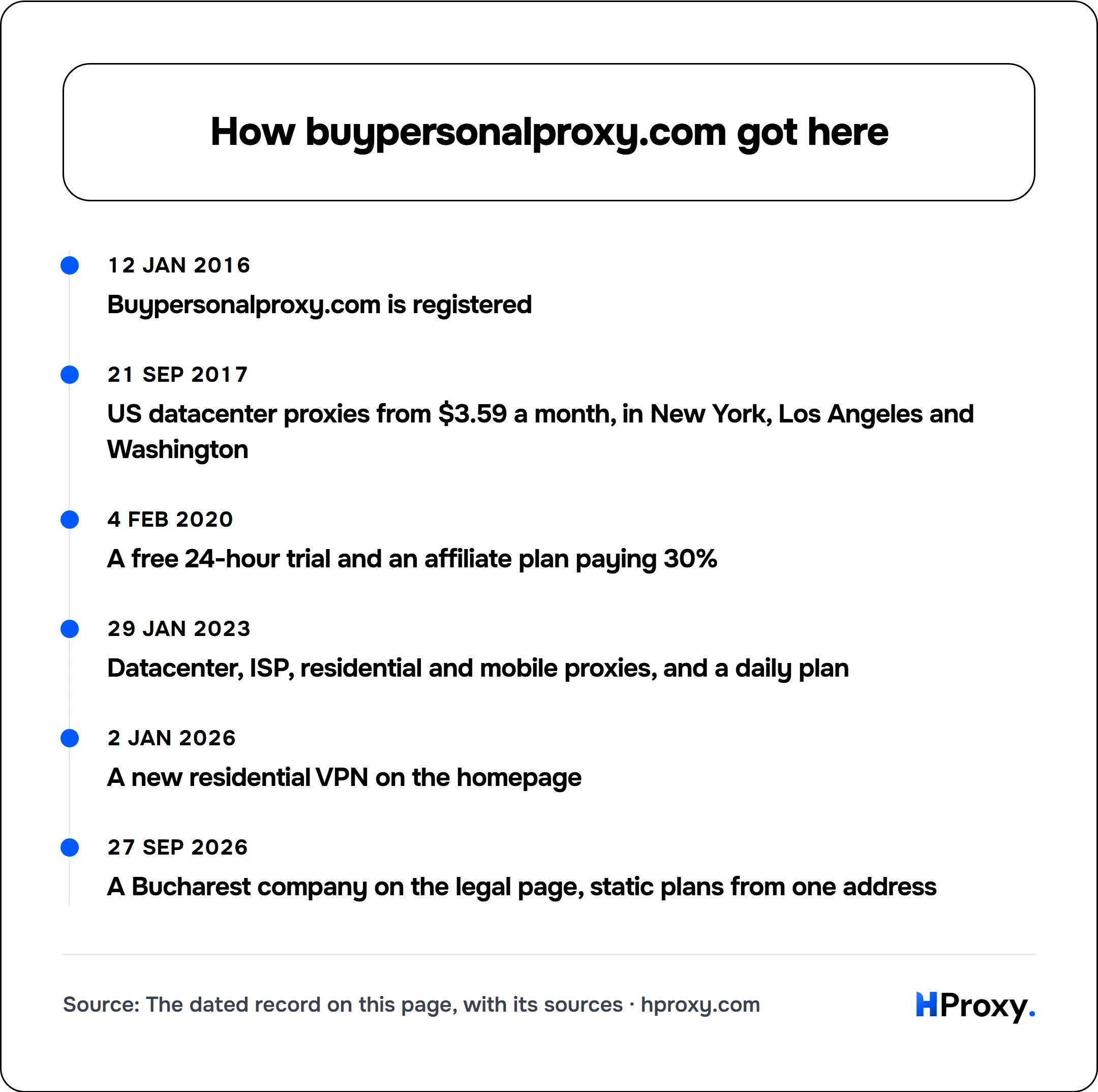
How buypersonalproxy.com got here
| date | what the record shows |
|---|---|
| 12 January 2016 | buypersonalproxy.com is registered |
| 21 September 2017 | US datacenter proxies from $3.59 a month, in New York, Los Angeles and Washington |
| 4 February 2020 | a free 24-hour trial and an affiliate plan paying 30% |
| 29 January 2023 | datacenter, ISP, residential and mobile proxies, and a daily plan |
| 2 January 2026 | a new residential VPN on the homepage |
| 27 September 2026 | a Bucharest company on the legal page, static plans from one address |
12 Jan 2016
Buypersonalproxy.com is registered
21 Sep 2017
US datacenter proxies from $3.59 a month, in New York, Los Angeles and Washington
4 Feb 2020
A free 24-hour trial and an affiliate plan paying 30%
29 Jan 2023
Datacenter, ISP, residential and mobile proxies, and a daily plan
2 Jan 2026
A new residential VPN on the homepage
27 Sep 2026
A Bucharest company on the legal page, static plans from one address
Sources: the domain registry, the Internet Archive and its own pages, read 27 September 2026.
BuyPersonalProxy alternatives for static ISP proxies
Every figure comes from the pricing page of each vendor. BuyPersonalProxy was read on 27 September 2026, the others a day earlier. The fair comparison is the price of one address for a month, and how many you must buy.
| provider | per IP a month | smallest order | who else uses the address |
|---|---|---|---|
| BuyPersonalProxy ISP | $5.99, or $1.80 each in the pack of 1,000 | 1 address | no one, by its pages |
| BuyPersonalProxy premium ISP | $7.99, or $2.70 each in the pack of 1,000 | 1 address | no one, by its pages |
| Webshare | $0.30 shared, $2.10 dedicated | 20 addresses | shared unless you pay for dedicated |
| Evomi | $1.00 shared, $2.50 private, $4.50 virgin | not stated | graded by how many customers used it |
| Rayobyte | $5.00, falling to $4.60 at 1,000 | 5 addresses | not stated on its pricing page |
| HProxy | $2.70/IP | 1 address, for a week, a month or 3 months | no one: one dedicated IP |
Our static ISP proxies are one dedicated address each, with unlimited traffic. For datacenter work, our IPv4 proxies cost $1.58 per IP a month from one address, also by the week.
For rotating traffic, the same comparison runs per gigabyte:
| provider | first gigabyte | lowest rate printed, and what it needs | unused traffic |
|---|---|---|---|
| BuyPersonalProxy rotating | $9.99, 1 GB | $5.00 a GB, 1,000 GB for $4,999.99 | kept, by its FAQ |
| Webshare | $3.50, 1 GB plan | $1.40 a GB, 3,000 GB at $4,200 a month | resets monthly |
| Rayobyte | $3.50, from 1 GB | $0.50 a GB, 5,000 GB or more by contact | kept on pay as you go |
| Evomi | $0.99, from 15 GB | $0.49 a GB, the 100 GB plan at $49 a month | kept on pay as you go |
| DataImpulse | $1.00, 5 GB for $5 | $0.80 a GB, 1 TB for $800 | kept |
| HProxy Residential Lite, country targeting | $0.50/GB, from 1 GB | $0.44/GB at 2,000 GB+ | kept, the balance never expires |
| HProxy Residential Premium, state, city and ISP targeting | $1.49/GB, from 1 GB | $1.00/GB at 1,000 GB+ | kept, the balance never expires |
With state and city targeting included, its like-for-like row on our side is Premium, at $1.49 per GB from the first gigabyte. Both of ours are on our residential price table.
Where BuyPersonalProxy is the better buy
Datacenter by the day. Ten addresses for 24 hours cost $5, which suits a single drop or a short job.
A free trial of a real address. One dedicated datacenter proxy for 24 hours costs nothing, once, after its team approves the request.
Many kinds of static address. Datacenter, ISP, premium ISP on 10 Gbps ports and static residential, each from a single address.
Cheap shared addresses. Twenty-five datacenter addresses, each shared by up to 3 users, cost $15 a month.
A long record. The shop has traded since at least 2017, with a registered company named on its legal page.
Where HProxy is the better fit
Unspent money comes back. Our refund policy returns wallet top-ups you have not spent within 14 days. Residential traffic you have not routed comes back too. BuyPersonalProxy refunds nothing, and its balance cannot be withdrawn.
Static addresses by the week. Our static ISP and IPv4 datacenter proxies rent from one address for a week as well as a month. BuyPersonalProxy rents them by the month, or datacenter by the day from 10 addresses.
Mobile by the gigabyte. Our mobile proxies are sold by the gigabyte, at $1.50/GB, so a light job pays for the traffic it uses. BuyPersonalProxy rents mobile proxies by the day, switched on by an operator.
Before you commit
Ask for the free BuyPersonalProxy trial, and buy one of our static ISP addresses for a week. Then run the same job through both. Check the exits in our proxy checker first. To try a set-up before paying anyone, our free proxy list and the checker need no account.
The limits of this record
We did not measure the BuyPersonalProxy network, so nothing here grades speed or success. Its uptime and pool size are its own claims. Its FAQ is AI-generated by its own account. We used it only for facts the plan cards do not show, and said so where we did.
The homepage and the product page disagree on the rotating rate at 1,000 GB. The homepage and the order form also disagree on the mobile day. We used the product page and the order form. No Trustpilot rating could be read. This page is due for a check by 27 December 2026.
Other providers we cover
Pages on other proxy brands: Jiguangdaili.com, Jinglingip.cn, Juliangip.com and JustProxy.biz.
Sources
Every source below was read on 27 September 2026, except the pricing pages of the alternatives, read a day earlier.
- BuyPersonalProxy: homepage, the datacenter, ISP, premium ISP, static residential, rotating residential and mobile pages, and its trial, payment, about, help and legal pages.
- Verisign, the registry record for buypersonalproxy.com.
- Internet Archive, captures of buypersonalproxy.com from 21 September 2017 to 2 January 2026.
- Webshare, Evomi, Rayobyte and DataImpulse, pricing pages.
- HProxy, our own product catalog, price table and refund policy.