A free mobile proxy is close to a myth on public proxy lists. On 26 September 2026 at 21:00 UTC, our pool had tracked 822,586 free proxy entries since May, and our IP data classed 91 of them as mobile. Eleven of those ever passed a check, and one was working when we looked. The free mobile address that does exist is your own phone. Share its data with your computer by hotspot or USB, and sites see a carrier address. The other offers we found under that name are trials with conditions and apps with terms worth reading first.
Two things people mean by "free mobile proxy"
Search results mix two questions. Some people want a proxy that works on their phone. Others want a mobile address: an IP that belongs to a mobile carrier, the kind a phone gets on 4G or 5G. Google suggests both, from "free mobile proxy for android" to "free mobile proxy list".
If you want a proxy on your phone, the Android setup guide and the iPhone setup guide show the settings. Free proxies for Android covers which free ones still answer. The rest of this page is about the second question: a free IP from a mobile network. What that kind of proxy is and how it differs from others is in what is a mobile proxy.
Why a mobile address is harder to block
A carrier does not have to give each phone its own public IPv4 address. It can put many customers behind one shared address, a design the IETF calls carrier-grade NAT. RFC 6888 describes it as a way "to share the same IPv4 address among several subscribers". One design for mobile networks, written with T-Mobile USA as RFC 6877, gives the phone only a private IPv4 address and leaves the rest to a translator in the network.
This sharing matters to anyone who wants a proxy. When one address stands for many people, blocking it hits all of them. RFC 6269 spells out the effect on a site that bans addresses after failed logins. One user "may block out other users who have not made any previous attempts", and with sharing at large scale, such "penalty box solutions to service abuse simply will not work".
What the free lists actually hold
Our verification engine keeps checking the public proxies it finds, and the results feed our free proxy list. On 26 September 2026 at 21:00 UTC we asked its database, read-only, how many of those proxies sit on mobile addresses. The mobile label comes from our IP data. We publish it as counts only, never per address.
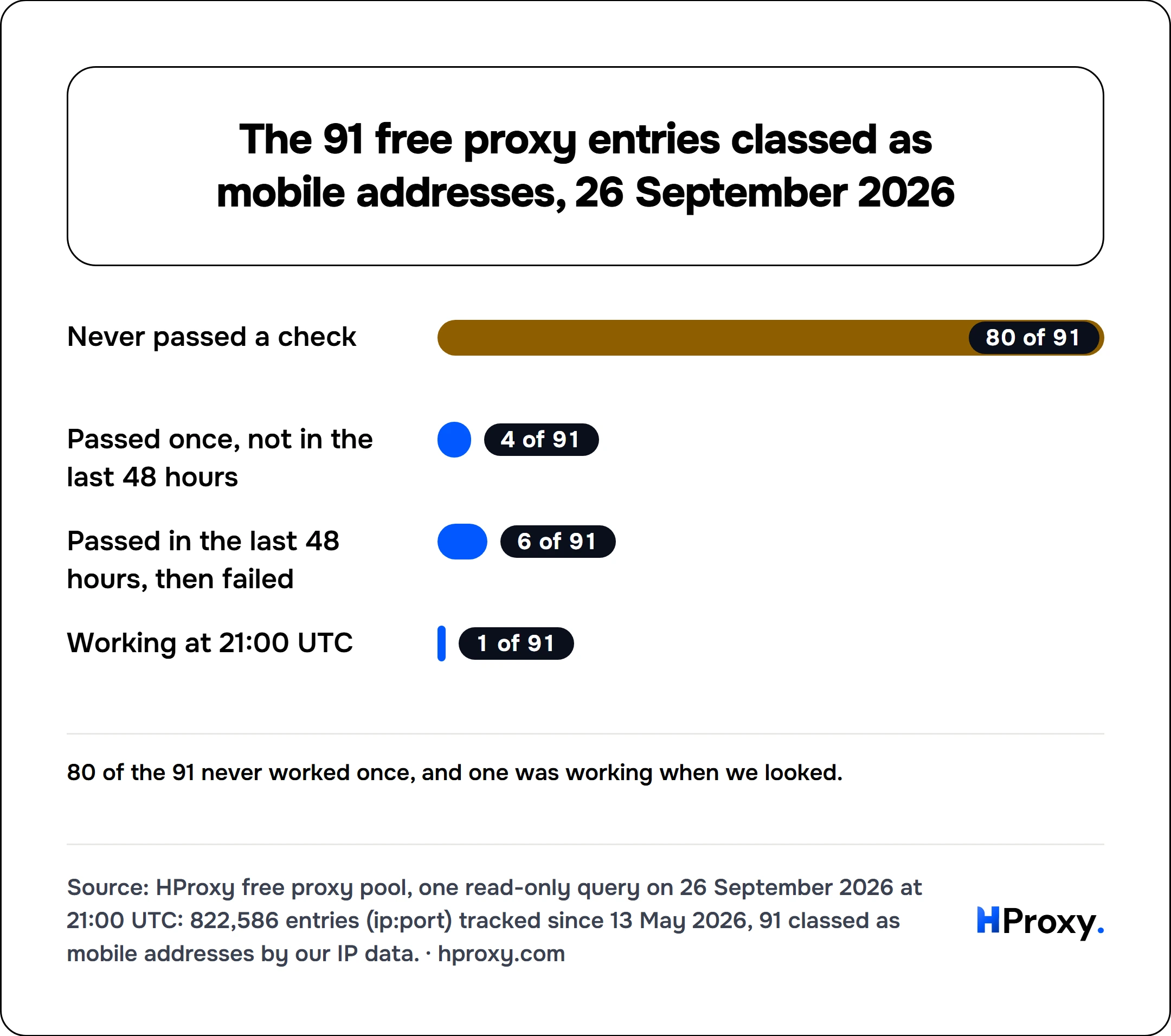
The 91 entries sat in 23 countries on 34 networks. The 17 in the United States never passed a single check. The eleven that did were not steady either: they passed between 14.1 and 54.7 percent of their checks, with a median of 28.1 percent. None of them carried SOCKS5, and most of the 91 listened on port 80 or 8080.
For scale, 13,106 free proxies of every kind were working at the moment of the query, and 8,633 of those were classed as datacenter. A mobile address on a free list is about one entry in nine thousand. Our free residential proxies page finds the same pattern for home addresses.
Why the lists hold almost no mobile addresses
A public proxy has to accept connections from strangers. A device behind carrier-grade NAT cannot do that on its own. RFC 6269 says that when a carrier NAT is in the path, a port "must also be opened in the CGN". It adds that inbound connections to well-known ports "will not work in the general case".
The data fits that. The networks of large telecom groups, China Mobile among them, carry thousands of free proxies, and almost none of those sit on mobile addresses.
Telecom networks in our free proxy pool, 26 September 2026
| Network | Entries | Mobile |
|---|---|---|
| Viettel Group, AS7552 | 6,776 | 0 |
| China Mobile, AS9808 | 506 | 0 |
| Globe Telecom, AS132199 | 376 | 0 |
| MTN SA, AS16637 | 273 | 0 |
| Globe Telecom, AS4775 | 162 | 0 |
| Bharti Airtel, AS9498 | 103 | 0 |
| Safaricom, AS37061 | 85 | 0 |
| Reliance Jio, AS55836 | 68 | 0 |
HProxy free proxy pool, one read-only query on 26 September 2026 at 21:00 UTC.
So a telecom name in an IP lookup is a hint, not proof of a mobile address. You can browse the entries of the largest network in the table on our Viettel Group network page. Our query classed none of its 6,776 entries as mobile, and 699 as datacenter.
The free routes to a mobile address, and the catch of each
Four routes to a free mobile address
| Route | What you get | The catch |
|---|---|---|
| Your own phone | Your carrier address on your computer | Your plan, your name; carriers may limit sharing |
| A seller trial | A short look at a paid pool | Conditions attached, or a paid test |
| An app on a phone | Your phone, reachable from elsewhere | A fee later, or strangers routed through you |
| A public free list | Almost nothing | One working mobile entry in our pool |
Apple and Android help pages; seller pages read on 26 September 2026; Google Threat Intelligence Group, July 2026; HProxy free proxy pool on 26 September 2026.
Your own phone, shared by hotspot or USB
The one free mobile address you can count on is the one in your pocket. Both phone makers document how to share it. Apple says Personal Hotspot "uses the cellular data connection of an iPhone or iPad" to give other devices internet. Android Help says "You can use your phone's mobile data to connect another phone, tablet, or computer to the internet." Turn on the hotspot, join it from your computer, and sites see your carrier address.
The catches come from the same pages. Apple notes that Personal Hotspot "requires a wireless carrier that supports Personal Hotspot" and that "additional fees may apply". Android warns that "some mobile carriers limit or charge extra for tethering". An Android hotspot takes up to 10 devices, and a Mac cannot tether with an Android phone by USB.
It is also one address, and it is yours. Even when many customers share an address, a carrier can trace a connection back to one of them by logging port numbers, as RFC 6269 notes. Use your own line for your own accounts, never as cover.
Trials from mobile proxy sellers
The sellers we read all attach conditions. On 26 September 2026 one large provider offered a 7-day trial to verified companies only. For individuals, the same page promised a 3-day money-back guarantee in one place and a 3-day free trial in another. Another seller of mobile proxies charged $9 for a single 24-hour test instead of a free trial. Read which one you are getting, because a refund window is a purchase, not a trial.
Apps that turn a phone into a proxy
Some apps make your own Android phone into a proxy you can reach from other devices. On 26 September 2026 one of them offered a 48-hour free trial, then a subscription of $9 to $12.50 plus your SIM plan, with no iPhone support. You still pay for the line, and the app only makes it reachable.
Other apps work the other way round and route strangers through your phone. Researchers at Google wrote in July 2026 that home devices join proxy networks when users "unknowingly download applications containing hidden proxy code". The owners can then have their own traffic "flagged as suspicious, or blocked by their service providers". The FBI described the same pattern in 2024: free VPN apps bundled with a proxy backdoor, installed on devices "without their consent", in a network of over 19 million IP addresses. Google advises official app stores, a look at the permissions of any VPN or proxy app, and Google Play Protect switched on. More on the risks of free proxies is in are free proxies safe.
Public free lists
The numbers above are the answer: one working mobile entry, found in a pool of 822,586. Some free proxy access is also worse than unreliable. In 2025 the FBI warned that criminals exploit the backdoors of the BADBOX 2.0 botnet "by either selling or providing free access to compromised home networks".
How to check whether an address is mobile
Look up the address with our IP lookup. It shows the country, the network (ASN) and its operator, and whether the address reads as datacenter or residential. A telecom name there is a hint, as the table above shows, and not proof of a mobile address. To test a proxy itself, the proxy checker reports its status, speed, anonymity, country and network in one pass.

What free cannot give you
Measured, the answer is short. At 21:00 UTC on 26 September 2026, one free proxy on a mobile address was working, against 13,106 free proxies of every kind. A mobile address that stays up and holds a session is a paid product. HProxy mobile proxies run on genuine carrier networks and are billed per gigabyte, from $1.50/GB.
Sources
- IETF, RFC 6888: Common Requirements for Carrier-Grade NATs (CGNs), April 2013.
- IETF, RFC 6269: Issues with IP Address Sharing, June 2011, sections 5.2 and 13.1.
- IETF, RFC 6877: 464XLAT, April 2013, co-written with T-Mobile USA.
- Apple Support, Connect to the Personal Hotspot of an iPhone or iPad, published 7 May 2026.
- Android Help, Share a mobile connection by hotspot or tethering on Android, read 26 September 2026.
- Google Threat Intelligence Group, post on the continued disruption of malicious residential proxy networks, Google Cloud blog, 2 July 2026.
- FBI, Guidance on the 911 S5 Residential Proxy Service, public service announcement, 29 May 2024.
- FBI, public service announcement I-060525-PSA on the BADBOX 2.0 botnet, 5 June 2025.
- HProxy free proxy pool, one read-only query on 26 September 2026 at 21:00 UTC: entries tracked since 13 May 2026, mobile and datacenter classes from our IP data, published as counts only.
- Trial and app terms: the sellers' own pages, read on 26 September 2026 (not linked).