We keep a record of what providers in this market charge and what happens to them over time. This page is the part of that record covering ProxyGuys, written up for somebody deciding today.
The record we hold
The company behind the name sits at proxyguys.com.
ProxyGuys is not in our priced record, so nothing about their rate appears below. That gap is stated rather than filled, which is the only honest option available.
Note the price, the unit it is quoted in, the minimum, and the expiry. Unit and expiry are where most comparisons in this market quietly go wrong.
What ProxyGuys says about itself today
Read 9 September 2026, the homepage titles itself "USA 5G Mobile Proxies, Premium Real Mobile IPs - ProxyGuys". Their own summary of the product runs: "Real USA 5G mobile proxies in 50+ US cities. 40,60 Mbps speeds, unlimited bandwidth, instant rotation. No residential, no datacenter , real mobile IPs only."
The rest of what the page puts in writing:
The product lines named on that page are residential, datacenter and mobile. Payment methods mentioned: crypto and cards. Support is advertised as around the clock. We found no separate pricing page linked from the homepage, which usually means the price arrives by quotation.
Those are claims, and claims are free. They earn their place here only because the date makes them checkable later.
What the registration record shows
The domain was registered on 5 July 2019, through NameCheap, Inc, which makes it about 7 years old. Registry data as of 23 April 2026. The Internet Archive holds 20 snapshots of the site, the earliest from July 2007. It is paid up until 5 July 2028.
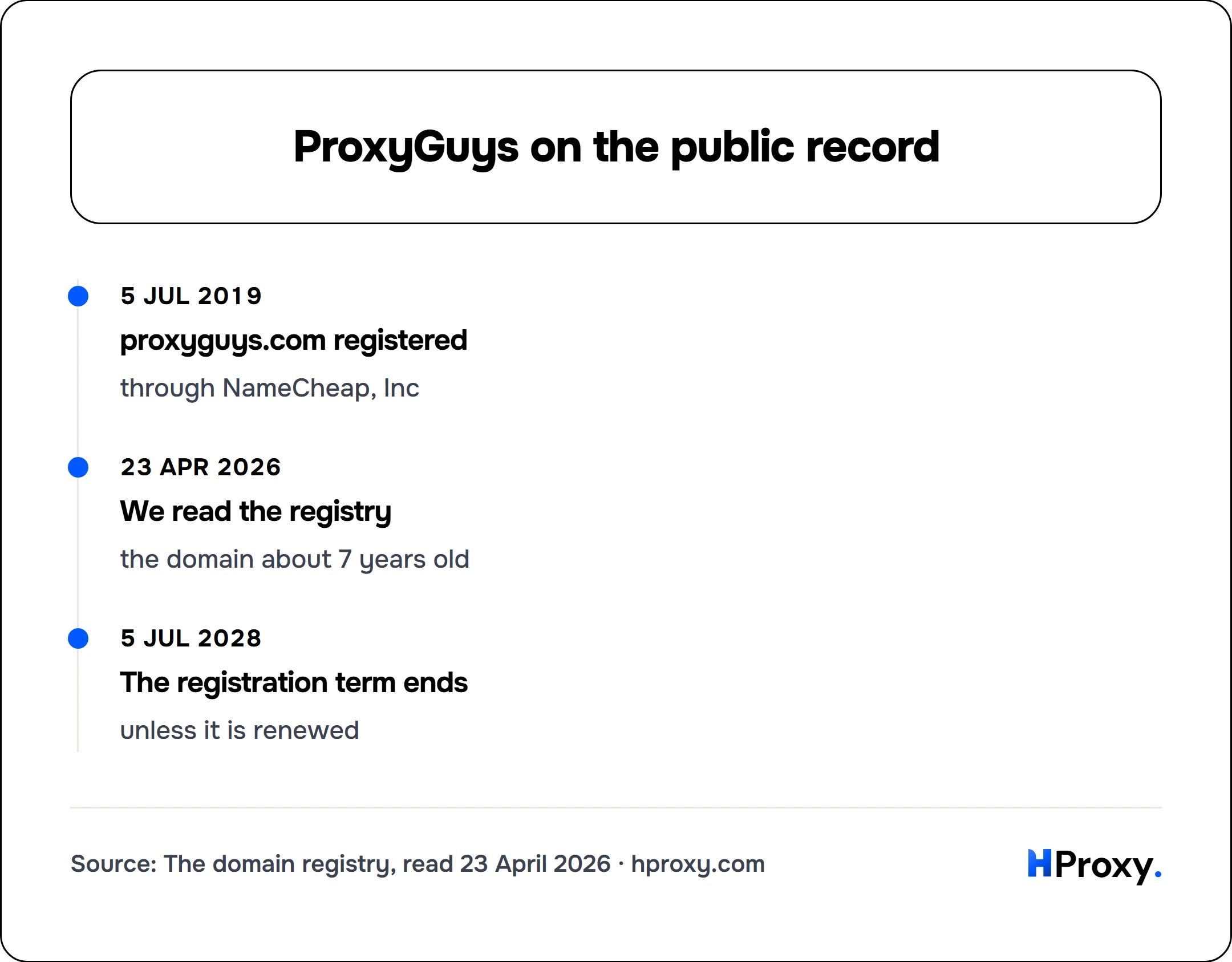
5 Jul 2019
proxyguys.com registered
through NameCheap, Inc
23 Apr 2026
We read the registry
the domain about 7 years old
5 Jul 2028
The registration term ends
unless it is renewed
Age is not quality. A long registration does not make a network good, and a new one does not make it bad. What it does rule out is the shortest-lived pattern in this market, which is a site that appears, sells, and is gone inside a year.
The questions ProxyGuys gets asked
Google reports 10 searches a month worldwide across the terms carrying this brand: 10 a month for a review of them. Figures read from Google Keyword Planner on 9 September 2026.
Most of that demand is people checking whether to trust it. That is what this page is written for, and it is why the sections above lead with what is published rather than with a verdict.
What the advertised numbers cannot tell you
The country total, and the country you use
Almost every provider claims almost every country. What differs is depth, and depth decides whether a single city or a single carrier is usable. No published figure tells you that.
Match the units before anything else
Residential is normally billed per gigabyte, datacenter and ISP per address, mobile per day or per port. Setting one against another produces a number that means nothing. Convert both sides into the unit your own workload consumes.
What happens when it breaks at two in the morning
Every provider works when nothing is wrong. The difference shows up on the day a subnet gets flagged or a gateway stops answering. Before committing volume, send one real question through the support channel and time the reply.
What separates them, in a table
The rows that matter, with our own answers stated plainly:
| Question to ask | ProxyGuys | HProxy |
|---|---|---|
| Entry price | Not verified by us, read their page | From $0.44/GB, pay as you go |
| Does unused balance expire? | Worth confirming in writing before you commit | Never |
| Minimum commitment | Not published clearly, ask before paying | None |
| Identity checks | On their own terms page | Card orders are screened, and verification is sometimes requested |
| Targeting | Their terms page answers this | Country, city and ISP |
| Free way to evaluate | Check the current terms, this one moves | Free proxy list and proxy checker |
Two notes on that table. The rows we left for you to check are not evasions: those terms change, and printing a stale figure is exactly the failure this page is trying to avoid. And no table can hold the number that should decide your purchase, which is the success rate on your own target.
How to settle it yourself in ten minutes
Run this before you commit any volume. It replaces every opinion on this page, including ours.
- Start with the smallest purchase each vendor allows, so the test costs less than the decision it replaces.
- Use your own scraper and your own target. A benchmark against a neutral site measures nothing you will experience.
- Measure what came back correctly and what it consumed, then divide the spend by the successes.
- Push a sample of exit addresses through an independent checker and confirm the country and connection type are what was advertised.
- Buy the one that won on your target, and diarise a re-test in three months.
Who else is in this bracket
The same treatment, applied to the providers most often weighed against this one:
- Aluvia alternatives
- Anonymitynetwork alternatives
- Anonymous Proxies alternatives
- AnonymousProxy alternatives
Our side of it
HProxy is pay as you go from $0.44 per GB on residential, with ISP, mobile and datacenter under one balance and no commitment attached to any of them. Run the test. If we lose on your target, we lose, and you have your answer.