GridPanel is trading at gridpanel.net. Its main product is a dedicated mobile proxy: one modem and SIM card for you alone, rented by the hour, week or month in the UK, the US, Germany or the Netherlands. A UK 4G proxy costs $1 an hour, $20 a week or $45 a month, with unlimited data. It also sells mobile and residential traffic by the gigabyte. The like-for-like prices are in the alternatives table.
Is GridPanel legit? The record in one table
| what we read on 27 September 2026 | |
|---|---|
| website | gridpanel.net answers normally, behind Cloudflare |
| company | Movil LTD, by its terms, with no address or company number given |
| products | dedicated 4G and 5G modems, mobile and residential by the GB, static and datacenter IPs, a scraping API |
| price | a dedicated UK 4G modem from $1 an hour or $45 a month; mobile by the GB from $4.25 |
| payment | card, or third-party providers listed on the site |
| refunds | the terms say all purchases are final; the FAQ offers a refund for faults not fixed within 24 hours |
| domain | registered 8 September 2022 |
| reviews | a 4-star rating from 70 Trustpilot reviews in a copy from November 2025; the live page could not be read |
The shop has sold dedicated mobile proxies since 2023. Prices show in US dollars by default, with pounds and euros in a selector.
What GridPanel sells, and what it costs
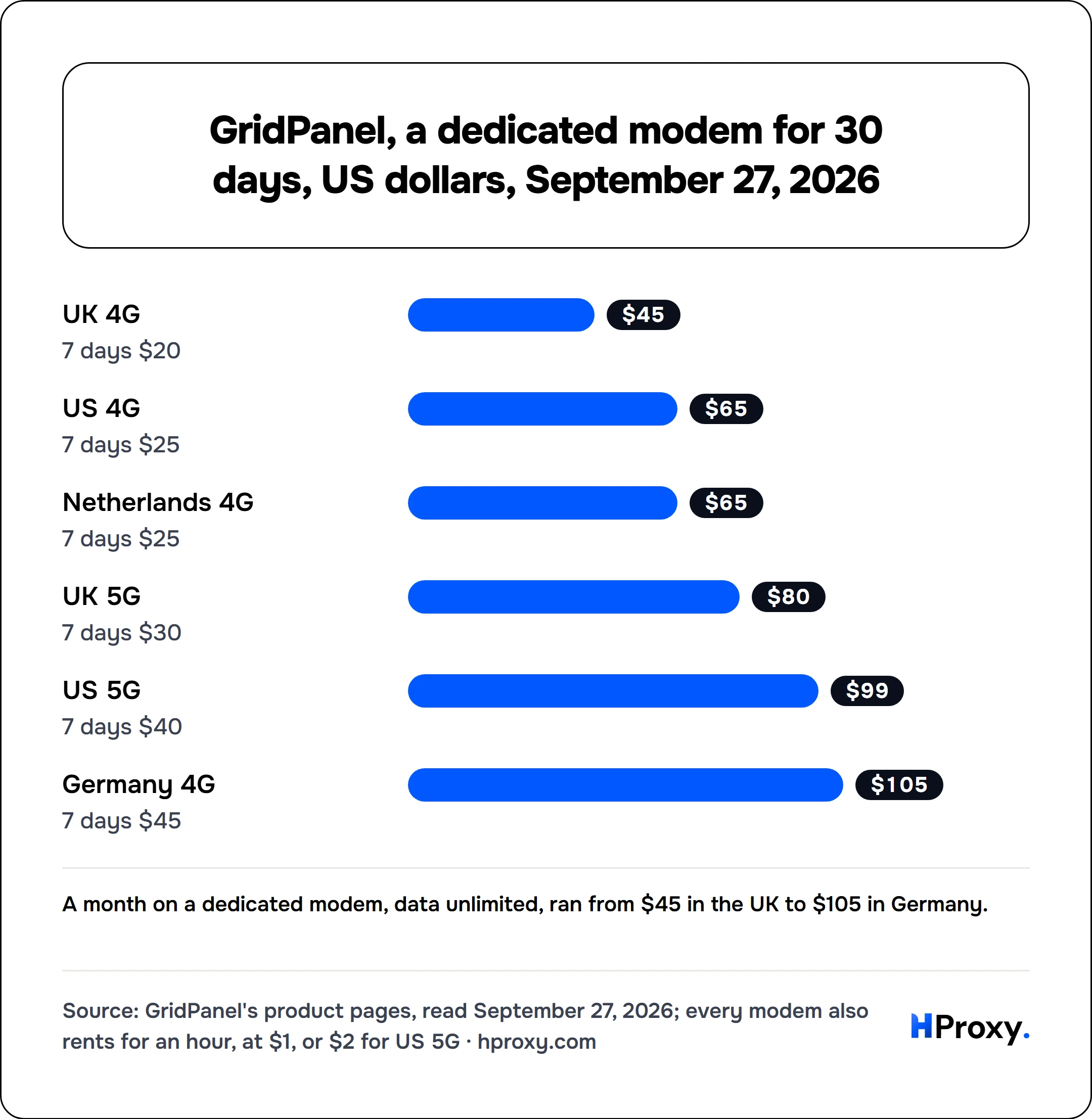
Prices come from its product pages, read on 27 September 2026. A dedicated proxy is rented by time, with unlimited data.
| dedicated modem | 1 hour | 7 days | 30 days |
|---|---|---|---|
| UK 4G | $1 | $20 | $45 |
| US 4G | $1 | $25 | $65 |
| Germany 4G | $1 | $45 | $105 |
| Netherlands 4G | $1 | $25 | $65 |
| UK 5G | $1 | $30 | $80 |
| US 5G | $2 | $40 | $99 |
Each order gets its own modem and SIM card. Data is unlimited, with 10 GB a day guaranteed on 4G and 15 GB on 5G. The IP rotates on a schedule or on demand through a link, and US 4G can be pinned to one of six states.
The other products are priced this way:
- Mobile by the gigabyte, on UK and US carriers: $4.25 a GB pay as you go, $3.45 a GB with 100 GB, or $2.55 a GB with 1 TB. The traffic never expires.
- Residential by the gigabyte: $3 pay as you go, $2.50 a GB with 100 GB, or $2 a GB with 1 TB.
- Eco residential, static ISP IPs: $0.50 for 24 hours, $1 a week or $3 a month per IP.
- Datacenter: $0.20 for 24 hours, $0.40 a week or $1 a month per IP.
The fine print that decides the cost
Purchases are final, by the terms. The terms say "All purchases are final and non-refundable". The FAQ promises a refund when proxies do not work as advertised and a fix takes more than 24 hours.
Unlimited, within reason. Data is unlimited as long as use is "bona fide", and the terms allow the service to end if use looks excessive.
Stock decides delivery. Orders arrive in minutes, or in up to 24 to 48 business hours when stock runs low.
The modem can change. The terms let GridPanel move you to another device for hardware or network reasons.
Eco residential is not for accounts. Its own page calls these IPs "Not suitable for account creation or management".
How gridpanel.net got here
| date | what the record shows |
|---|---|
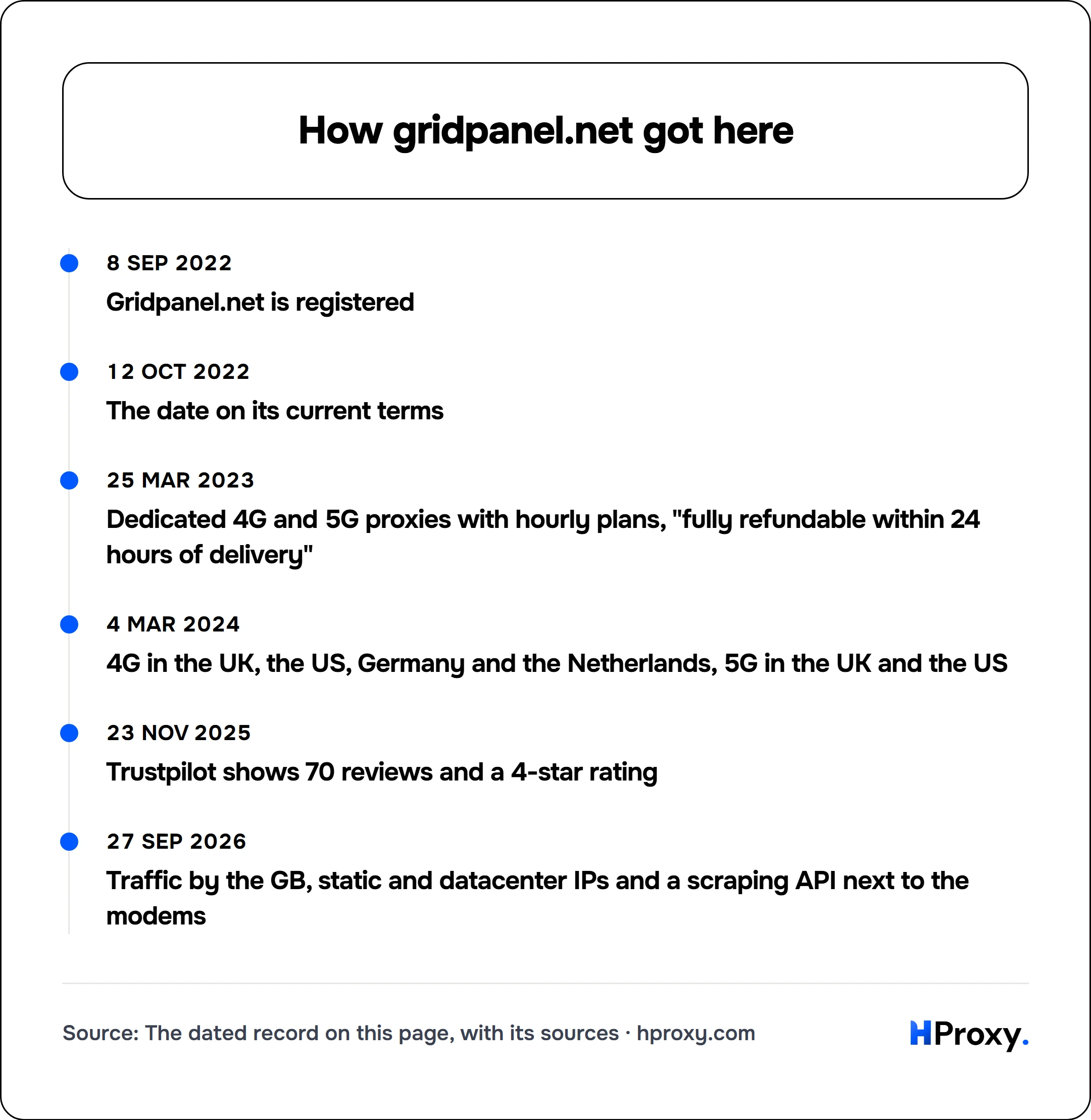
| 8 September 2022 | gridpanel.net is registered |
| 12 October 2022 | the date on its current terms |
| 25 March 2023 | dedicated 4G and 5G proxies with hourly plans, "fully refundable within 24 hours of delivery" |
| 4 March 2024 | 4G in the UK, the US, Germany and the Netherlands, 5G in the UK and the US |
| 23 November 2025 | Trustpilot shows 70 reviews and a 4-star rating |
| 27 September 2026 | traffic by the GB, static and datacenter IPs and a scraping API next to the modems |
8 Sep 2022
Gridpanel.net is registered
12 Oct 2022
The date on its current terms
25 Mar 2023
Dedicated 4G and 5G proxies with hourly plans, "fully refundable within 24 hours of delivery"
4 Mar 2024
4G in the UK, the US, Germany and the Netherlands, 5G in the UK and the US
23 Nov 2025
Trustpilot shows 70 reviews and a 4-star rating
27 Sep 2026
Traffic by the GB, static and datacenter IPs and a scraping API next to the modems
Sources: the domain registry, the Internet Archive and its own pages, read 27 September 2026.
GridPanel alternatives for mobile proxies
Mobile proxies are sold in two ways. One is a whole modem rented by time, the other is traffic from a shared pool billed by the gigabyte. GridPanel sells both. Other vendors were read on 27 September 2026 except Evomi, read a day earlier.
| provider | how it bills | smallest purchase | lowest rate printed |
|---|---|---|---|
| GridPanel, UK 4G modem | per modem, unlimited data | $1 for an hour | $45 for 30 days |
| Prestige Proxies, UK 4G modem | per modem, unlimited data | $79.99 for a month | $79.99 for a month |
| GridPanel, mobile by the GB | per GB | $4.25 for 1 GB | $2.55 a GB with 1 TB |
| Rainproxy | per GB | $3.10 for 1 GB | $2.00 a GB at 500 GB |
| Evomi | per GB | $3.98 a GB, pay as you go | $2.20 a GB on its largest plans |
| HProxy | per GB | $1.50/GB, from 1 GB | $1.50/GB, one flat rate |
Our mobile proxies are rotating carrier IPs from a shared pool, targeted by country, with no modem to rent. A modem with unlimited data suits heavy, steady traffic on one IP, while a price per gigabyte suits light or uneven jobs.
For residential traffic, GridPanel charges $3 a GB and $2 a GB with 1 TB. Our Residential Lite costs $0.50 per GB for the first gigabyte with country targeting, and Premium $1.49 per GB with state, city and ISP targeting. Both are on our residential price table.
Where GridPanel is the better buy
A modem of your own. Each order gets its own device and SIM card, with unlimited data and rotation on demand.
Short tests for a dollar. Most modems can be rented for one hour at $1.
US states on 4G. Its US 4G modems can be pinned to one of six states, where our mobile traffic is targeted by country only.
Where HProxy is the better fit
Light or uneven mobile traffic. Our mobile proxies cost $1.50/GB from the first gigabyte, with no modem to rent by the week or month.
Unspent money comes back. Our refund policy returns wallet top-ups you have not spent within 14 days, to the card or crypto wallet that paid. The GridPanel terms treat every purchase as final.
More ways to pay. Our payment options page lists cards, 32 crypto assets and networks, Alipay, Pix and more.
A company you can find. Our imprint names Obsidian UG in Herford, Germany, with its register number. The GridPanel terms name Movil LTD without an address or number.
Before you commit
Rent a GridPanel modem for an hour and buy a single gigabyte of our mobile traffic, then run the same job through both. Check the exits in our proxy checker first. Our free proxy list and the checker need no account.
The limits of this record
We did not test GridPanel, so nothing here grades speed or success. Its data is unlimited only within a fair-use check, and its terms and FAQ disagree on refunds. We could not tie Movil LTD to one register entry, and the live Trustpilot page could not be read. This page is due for a check by 27 December 2026.
Other providers we cover
More pages in this series: Anoproxy.online, HydraProxy.com, IParchitect.ru, iProxy.online, Keyproxy.net and Lteboost.com.
Sources
Every source below was read on 27 September 2026, except the Evomi pricing page, read a day earlier.
- GridPanel: homepage, the pages of its 4G, 5G, social media, mobile, residential, eco residential and datacenter proxies, terms of service and contact page.
- Verisign, the registry record for gridpanel.net.
- Internet Archive, captures of gridpanel.net from 21 December 2022 to 8 June 2026, and of its Trustpilot page from 23 November 2025.
- Prestige Proxies, Rainproxy and Evomi, pricing pages and order forms.
- HProxy, our own product catalog, price table, refund policy, payment options and imprint.