ProxyScan.io is gone as a proxy list. It ran a free list with a public API from January 2020 until August 2023. From October 2023 the site answered with gateway errors, through 2024 with redirects, and by December 2024 with a parking page. On 6 September 2026 the address forwards to whoer.io, an IP lookup service, with no explanation. About 140 people a month still search for the name (Keyword Planner, September 2026), and scripts written against its API still call an endpoint that answers with a redirect. This is the record, and what to call instead.
Every date below comes from the Internet Archive's captures, the .io registry, and requests we made ourselves on 6 September 2026. Where the record is silent, this page says so.
What ProxyScan was
The domain was registered on 22 November 2019 (registry record, read 6 September 2026). The first archived capture is dated 21 January 2020 and carries the title "Free Proxy List - ProxyScan". The page never changed its promise. In June 2021 and again in June 2023 it read: "All the proxies are subjected to a detailed check(every 10 minutes) before coming to the list."
The June 2023 capture shows what the list looked like in its last healthy year. The counters read "997 Total Proxies, 50 HTTP/S, 1030 SOCKS4/5, 973 Anonymous/Elite", as printed. Most of the list was SOCKS. Each row carried a ping, a type, an anonymity grade and an uptime percentage with the number of checks behind it, such as "96,7% (1238)". That last column was the site's best feature. A proxy that had answered 1,238 checks was a different thing from one that had answered once, and the list said so.
Around the list sat the tools that made ProxyScan a developer's site. The archived documentation from June 2023, titled "Online Proxy API - ProxyScan", lists a proxy checker, a proxy filter, a proxy scraper, the API, and a paid product called Mobile Rotating Proxy. The API was one GET at /api/proxy with five parameters: format (json or txt), level (transparent, anonymous, elite), type (http, https, socks4, socks5), last_check (seconds since the proxy was last checked) and port.
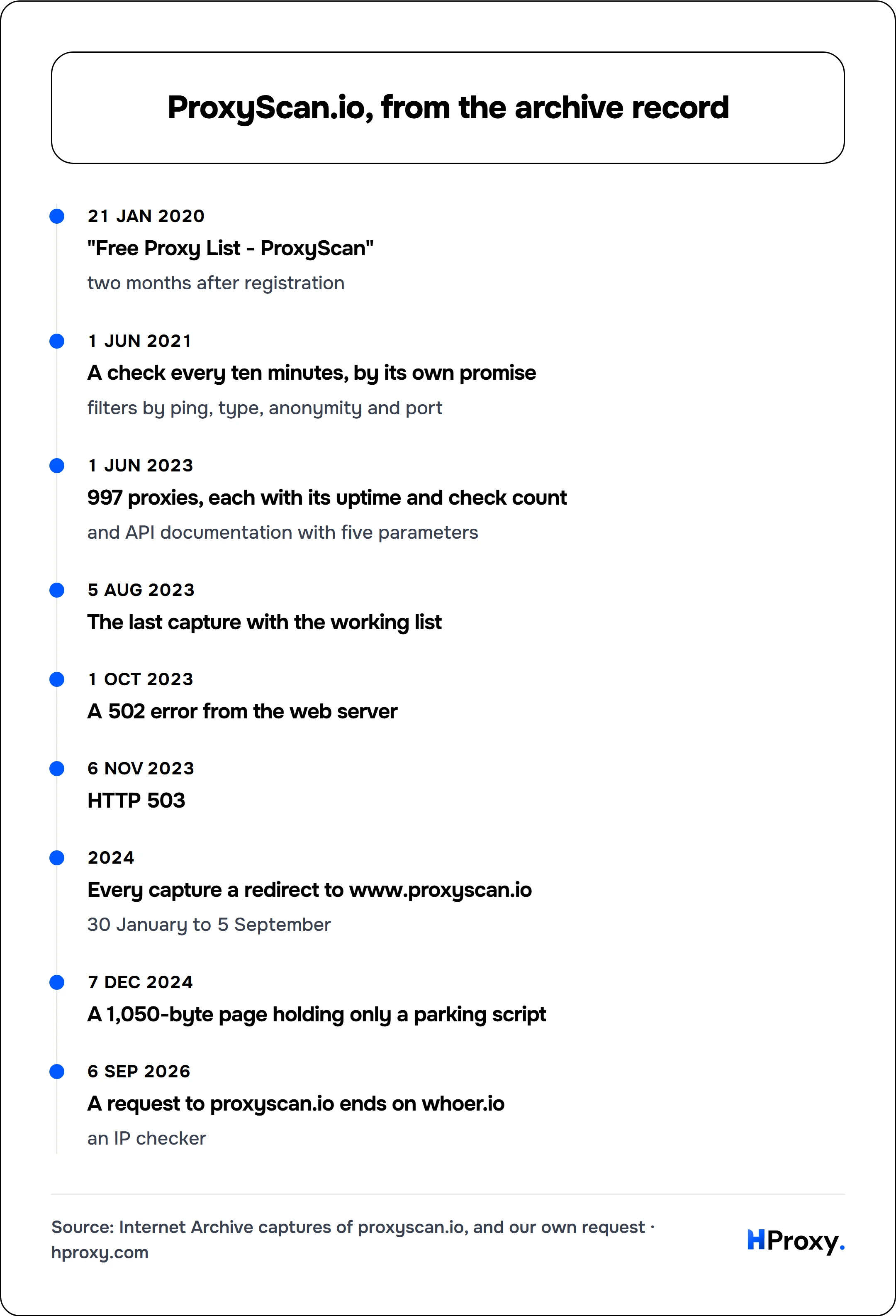
| Capture | What the archive shows |
|---|---|
| 21 January 2020 | "Free Proxy List - ProxyScan", two months after registration |
| 1 June 2021 | the ten-minute check promise, filters by ping, type, anonymity and port |
| 1 June 2023 | 997 proxies, per-row uptime with check counts; API documentation with five parameters |
| 5 August 2023 | the last capture with the working list |
| 1 October 2023 | "502 - Web server received an invalid response while acting as a gateway or proxy server" |
| 6 November 2023 | HTTP 503 |
| 30 January to 5 September 2024 | every capture a redirect to www.proxyscan.io |
| 7 December 2024 | a 1,050-byte page holding only a parking script |
| 6 September 2026 | a request to proxyscan.io ends on whoer.io |
21 Jan 2020
"Free Proxy List - ProxyScan"
two months after registration
1 Jun 2021
A check every ten minutes, by its own promise
filters by ping, type, anonymity and port
1 Jun 2023
997 proxies, each with its uptime and check count
and API documentation with five parameters
5 Aug 2023
The last capture with the working list
1 Oct 2023
A 502 error from the web server
6 Nov 2023
HTTP 503
2024
Every capture a redirect to www.proxyscan.io
30 January to 5 September
7 Dec 2024
A 1,050-byte page holding only a parking script
6 Sep 2026
A request to proxyscan.io ends on whoer.io
an IP checker
Source for every row: the Internet Archive capture of that date, and our own request on 6 September 2026.
When it died, from the archive record
The Internet Archive holds 42 monthly captures of proxyscan.io, from 21 January 2020 to 8 March 2026. The chart shows the months captured per year, and it shows the shape of a short life: five months in 2020, ten in 2021 and 2022, nine in 2023, six redirects in 2024, nothing at all in 2025.
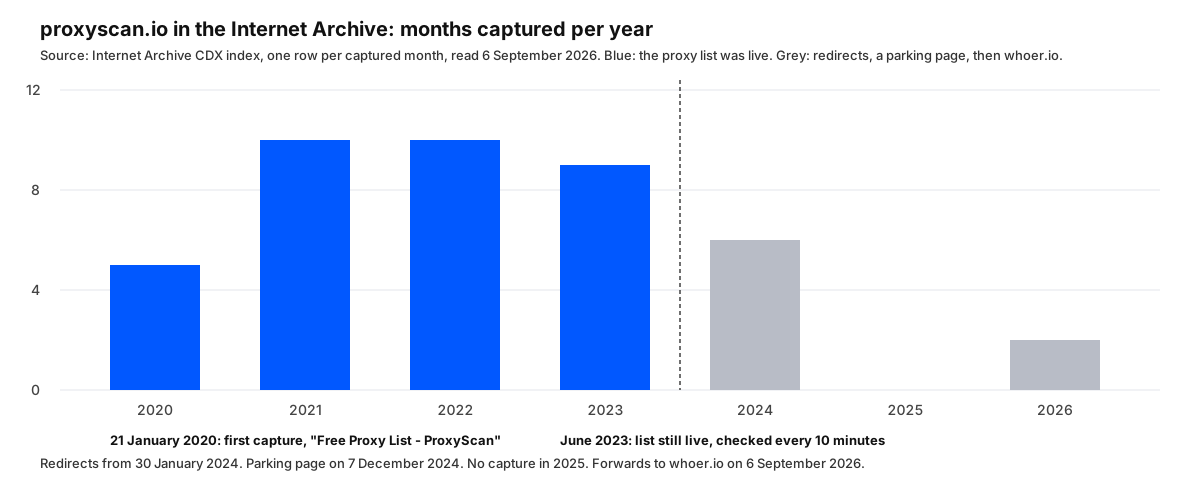
The end has a clear shape. The capture of 5 August 2023 still shows the list. The next capture, on 9 September 2023, failed. On 1 October 2023 the page is a 502 error from the web server's own gateway, and on 6 November 2023 a 503. The 1 December 2023 capture is an empty page. So the list stopped working between 5 August and 1 October 2023, and nobody fixed it.
The domain did not go anywhere. Every 2024 capture through September is a redirect to www.proxyscan.io, and the 7 December 2024 capture of that address is a parking page. The registry record read on 6 September 2026 shows the same registration since 22 November 2019, at NameCheap, expiring 22 November 2026, with the registrant withheld by a privacy service. The record was last changed on 12 August 2026. Three weeks later, our request to proxyscan.io ended on whoer.io.
What the record does not say
No capture carries an announcement. The site did not say it was closing, and it did not say where its users should go. Whether whoer.io bought the domain or only receives its visitors is not in the registry, because the registrant is withheld and the registration never changed hands on paper. Whether the paid Mobile Rotating Proxy ever had customers is unknown. The ten-minute check was the site's own claim, which we never measured. What the record does show is a site that broke in the autumn of 2023 and was left broken for a year before being parked.
The API that scripts still call
This is the part that matters if you wrote code. ProxyScan's API was popular because it was simple: one GET, five parameters, plain text or JSON back. A script that calls it today gets a redirect to an IP checker and, depending on how it parses the response, either an empty list or an error. The table maps each parameter to the HProxy free proxy API, which is one GET at /api/proxy-list with no key and no signup.
| ProxyScan parameter (archived docs, June 2023) | HProxy free API today |
|---|---|
| format=json or format=txt | format=json, format=txt or format=csv |
| level=transparent, anonymous or elite | anonymity=transparent, anonymous or elite |
| type=http, https, socks4 or socks5 | protocol=http, https, socks4 or socks5 |
| last_check=seconds since the last check | no equivalent: the list holds only proxies alive on their last check; recent=true widens it to the 48-hour window |
| port=number | port=number |
| not offered | country=US, network (ASN), a /24 subnet, limit and offset |
The call that replaces the most common ProxyScan request, elite HTTP proxies as text, is:
curl "https://hproxy.com/api/proxy-list?format=txt&protocol=http&anonymity=elite"
Every response carries an X-Total-Available header with the exact count matching the filter, so a script can tell whether it received everything.
What to use instead
The honest replacement for a free proxy list is a free proxy list that proves its entries answer. On 6 September 2026 we fetched every free list that was still alive and took up to 200 entries from each. Each entry had to relay a real request and come back with an exit address that was not ours.
| List | Entries tested | Relayed a request |
|---|---|---|
| free-proxy-list.net | 200 | 86 |
| monosans proxy-list (GitHub) | 200 | 62 |
| iplocate free-proxy-list (GitHub) | 200 | 51 |
| proxifly free-proxy-list (GitHub) | 200 | 36 |
| geonode free list | 200 | 15 |
| hide.mn list | 64 | 0 |
No list relayed more than half of what it published. That is the base rate of free proxies, not a fault of any one site, and it is why ProxyScan printed the number of checks next to every uptime. Whatever list you pick, check an entry before you use it.
Our own free proxy list was part of the same test, and the same hour showed us something we had to fix. Our verifier had been accepting decoy servers that answer every request and forward nothing, and they made up most of our live HTTP set. Since that day a proxy is marked alive only when our own test request came back through it, carrying a code we sent, on every protocol. The list is re-verifying under that rule as you read this. The proxy checker applies the same test to any list you paste in.
Free lists have a ceiling that no amount of checking removes. Every address on them is public, shared with everyone who found the same list, and already known to the sites people most want to reach. When a job needs an exit that stays up, keeps a session and has not been handed around, that is a paid proxy, billed by the gigabyte. The free list stays the place to test first.
Sources
- Internet Archive captures of proxyscan.io dated 21 January 2020, 1 June 2021, 1 June 2023, 5 August 2023, 1 October 2023, 6 November 2023, 1 December 2023, 30 January 2024 and 7 December 2024, and of www.proxyscan.io/api dated June 2023, read on 6 September 2026.
- Internet Archive CDX index for proxyscan.io, one row per captured month, read on 6 September 2026.
- The .io registry record for proxyscan.io (whois and RDAP, Identity Digital), read on 6 September 2026.
- Google Ads Keyword Planner, monthly searches for "proxyscan", September 2026.
- HProxy measurements on 6 September 2026: one request to proxyscan.io following redirects, and the same-hour relay test of alive free lists.
- HProxy free proxy API documentation at hproxy.com/docs/free-proxy-list.