Proxies for Airbnb route your traffic through many different IP addresses so Airbnb sees a spread of ordinary travelers instead of one machine pulling thousands of pages a minute. People use them to collect short-term-rental data at scale: listing details, nightly prices and availability across dates, host profiles, and review text and volume, refreshed on a schedule and read from the market's own currency and language. Point a scraper at Airbnb from one office IP and it holds briefly, then the pages come back empty or wrapped in a "confirm you are human" challenge, and the address stops seeing real data.
We run a proxy network, so we see both ends of this: what people buy to scrape travel and rental sites, and what comes back as a support ticket once a setup starts eating challenges. This is the practical version, and it starts with an unusual fact for a site this big: Airbnb has no public API you can just sign up for, so almost all of this work runs against the public pages. For the collection fundamentals underneath the rest, our web scraping guide covers the ground this builds on, and travel fare aggregation is the closest cousin for the geo-priced side.
What proxies are best for Airbnb?
Rotating residential proxies, matched to the country whose listings and prices you want, with enough bandwidth to spread requests so no single IP looks like a robot. Airbnb reads residential IPs as ordinary travelers and flags datacenter ranges quickly, and because prices and currency follow the visitor's country, an in-market residential exit is also what returns the numbers a local guest actually sees. Datacenter is fine only for light, non-localized checks. ISP (static residential) fits any flow that runs through a logged-in account. Mobile is the heavyweight tier for the most defended runs and is rarely needed.
Why Airbnb work needs proxies
Airbnb sits behind a closed door, and that shapes everything. Its official API is partner-only and invite-based, handed to channel managers and property-management systems rather than opened to developers, and new applications have been paused (Koombea, Airbnb API guide). If you are a host studying your market, an investor sizing a neighborhood, or a researcher tracking prices, there is no sanctioned data feed to call, so the work moves to the public pages. That is where proxies come in, and where Airbnb's terms of service apply too.
Once you are pulling public pages, it is a data-collection job with the usual structural weakness: bulk collection hits many search, listing, and review pages, on a cadence, from one place, which is the most detectable pattern in scraping. Airbnb is aggressively anti-bot and returns empty or partial pages to traffic it distrusts, which is the failure mode to design around: a 200 that carries no listings. Proxies spread the load across many IPs so no single one looks automated.
Geography is the second reason, and on Airbnb it is sharper than on most sites. Three jobs bring people here, and all three depend on the exit country:
- Price and availability monitoring. Airbnb sets currency by the visitor's location and localizes what you see, on top of its own demand-based pricing that moves nightly rates by date, season, and length of stay. To read the price a local guest sees, the request has to exit from that market.
- Host market research and comps. Hosts and investors pull nearby listings, their rates, and their open calendars to size occupancy and set their own price. That is many listings across a market, refreshed often, which is exactly the volume one IP cannot sustain.
- Review collection. Review text, volume, and dates feed sentiment and quality analysis, and reviews localize by market and language. They also attach to real reviewer identities, so this is the job to keep most carefully to public, non-personal use.
How Airbnb blocks you
Airbnb's defenses decide which proxy type survives, so understand them before you buy. Airbnb is reported to sit behind DataDome-class bot management, and it does not publish which vendor it uses, so this page describes the class rather than confirming the product. What a run against the site actually shows is commercial-grade bot management: at scale you hit CAPTCHAs, rate limits, and IP bans even when a request returns HTTP 200, because the response is wrapped in the detection layer rather than carrying real listing data. Datacenter IPs are the first to get skeleton pages with no data.
Two structural details matter for how you build the scraper. First, Airbnb embeds much of its listing data as JSON inside the page HTML, so once you fetch a page you can pull fields directly instead of fighting fragile CSS selectors, which you can confirm by searching a saved page for the JSON block. Second, the initial HTML is mostly placeholders and the listings render dynamically after load, so a naive fetch of the raw HTML can come back empty and you often need a real browser or the right embedded-data path.
Under the hood the standard signals drive the block: the IP's type and reputation (hosting ranges distrusted on sight), the TLS handshake fingerprint (the JA3/JA4 signature read before any HTTP is sent), the HTTP header order, browser-fingerprint and behavioral checks, and pacing. The full signal set is in how websites detect proxies. A residential IP clears the reputation layer, but it has to be paired with a real browser fingerprint and human-like pacing to get past the rest.
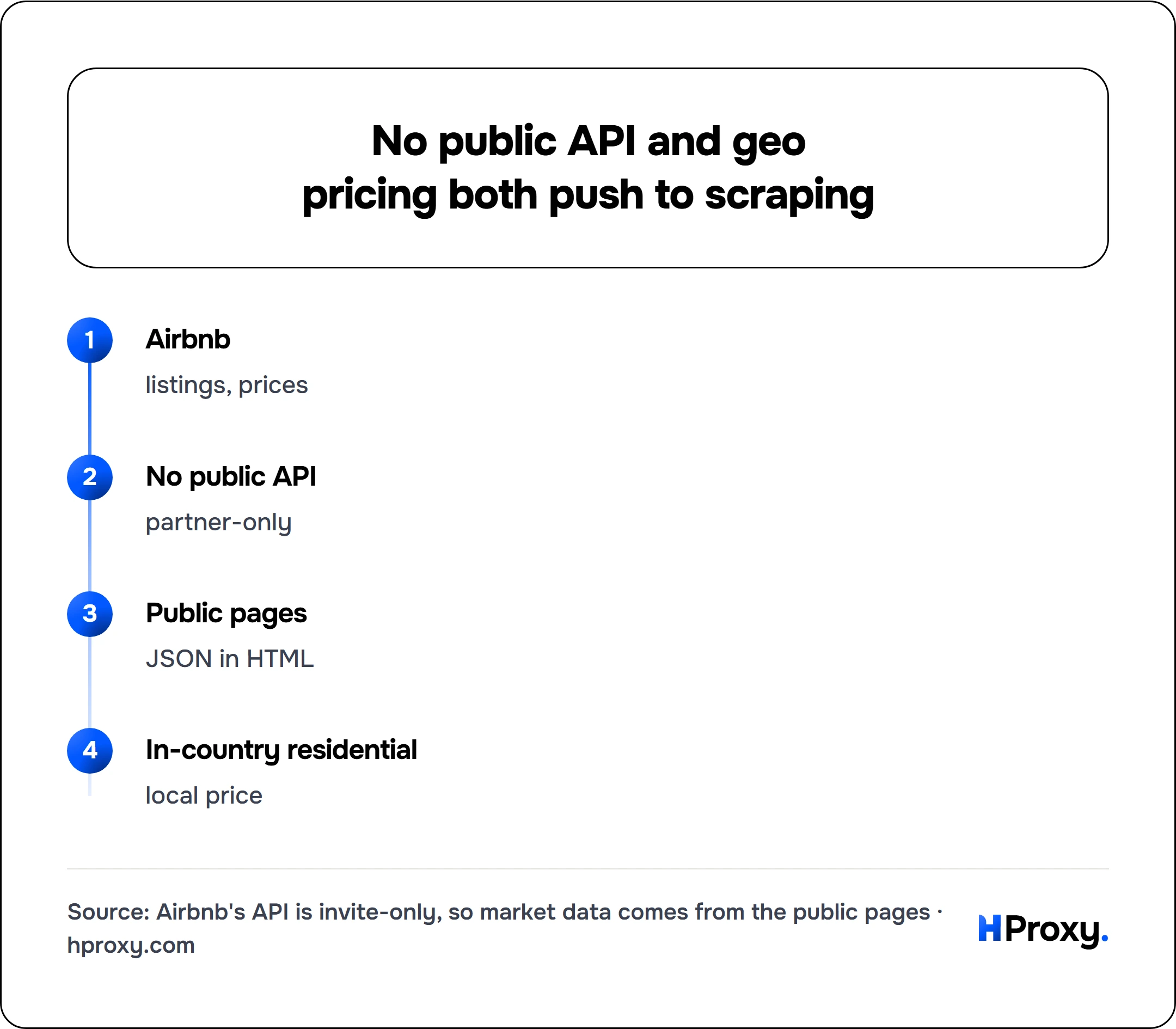
Airbnb
listings, prices
No public API
partner-only
Public pages
JSON in HTML
In-country residential
local price
Which proxy type fits: residential, datacenter, ISP, or mobile
Four types show up, and the most expensive one is not automatically right.
Datacenter proxies from hosting providers are fast and cheap, and Airbnb flags those ranges quickly and serves them skeleton pages, so they only suit light, low-volume checks on a handful of listings.
Rotating residential proxies are real home connections from a large pool, handing out a fresh IP per request or short sticky window, and pinnable to a country. They read as ordinary travelers, clear the reputation checks that stop datacenter, and match the market whose prices and content you want. This is the workhorse for Airbnb scraping (new to it? see what is a residential proxy). Billing is by the gigabyte and home lines vary in speed.
ISP proxies are static residential IPs, residential-registered but on datacenter-grade hardware, so they are fast and always on. Reach for these when a flow runs through a logged-in account where one identity should persist.
Mobile proxies are carrier IPs shared by many handsets: the heavyweight tier for the most defended runs, at the highest price, and rarely needed here.
Match the type to the task:
| Airbnb task | Proxy type | Why |
|---|---|---|
| Price and availability monitoring | Rotating residential, country-matched | Prices and currency follow the visitor's country |
| Host market research and comps | Rotating residential | High volume across many listings and markets |
| Review-text and volume collection | Rotating residential, market-matched | Volume, and reviews localize by market and language |
| Logged-in account flows | ISP (static residential) | Session must persist on one identity |
| Light one-off checks | Datacenter | Cheapest where Airbnb tolerates it |
Free versus paid for Airbnb
Free proxy lists are almost entirely datacenter IPs that die within minutes, with only a small fraction alive at once, so Airbnb's bot management flags most of them before you read a listing and hands back empty or partial pages. A one-off manual look is fine. Scraping is not, and a pipeline on free IPs returns mostly challenges and skeleton data.
Free still has a place in testing. Our free proxy list re-checks and refreshes every few minutes across 100+ countries and every common protocol, so it is handy for confirming your parser reads Airbnb's embedded JSON and your rotation logic fires before you pay for bandwidth, and the free proxy checker confirms an exit is alive and in the country you expect, which matters here because currency and price follow the exit's country. The safety angle is in are free proxies safe. When the job is sustained, paid residential is the floor, and ours starts at $0.44/GB pay-as-you-go, with no identity checks for standard top-ups, so a small run costs cents.
Setup, sizing, and staying unblocked
Setup is short and the discipline around it is what keeps IPs clean.
- Pick rotating residential, matched to the country whose prices and content you want, and use that market's Airbnb domain and currency so the data is the local traveler's view.
- Render or read the embedded data. Because the raw HTML is mostly placeholders, drive a headless browser (Playwright or Puppeteer) behind the proxy for the pages that need it, or pull the JSON Airbnb embeds in the page when it is present and stable.
- Look like a browser. Send a current, realistic user-agent and a normal header set, keep cookies within a session, and make the exit country match the Accept-Language and timezone you present, because a locale that disagrees with the IP is itself a flag.
- Test the IPs first with the proxy checker, and back off the moment CAPTCHAs or empty pages appear rather than hammering the same IP.
For sizing, count by request rate, not listing count. Find where one IP starts getting challenged, stay under it, and add IPs for throughput. Rotating residential absorbs that math by serving each request from a big pool, so you buy bandwidth instead of managing named addresses.
Sizing Airbnb scraping (rotating residential, size by request rate):
  find the pace where one IP starts getting CAPTCHAs or empty pages,
  stay under it, and add IPs to raise throughput, not pressure per IP.
  rotating residential pulls each request from a large pool,
  so you buy bandwidth instead of managing named IPs.
The habits that keep you unblocked are the usual ones, covered in full in avoiding IP bans while scraping: pace with jitter, residential not datacenter, a real browser fingerprint, match geo to the target market, never reuse burned public IPs, and log your challenge rate so a rising number warns you before Airbnb cuts you off. Our pricing is pay-as-you-go with a balance that does not expire, which suits a scrape that runs in bursts.
The limits worth knowing up front
A proxy is one input, not the whole machine. Clean, country-matched residential IPs make your requests look like separate, legitimate, local travelers, and they solve IP reputation and geography well, which for price and availability work is most of the accuracy problem. They do not fix a scraper that ships an obvious library user-agent, discards cookies, or carries a fingerprint that reads as automation, and against Airbnb's browser-fingerprint and behavioral checks a bare script fails even from a clean residential IP. A scraped nightly price is also a snapshot, not a guarantee, and can differ from what is bookable at checkout once fees, taxes, and host rules apply. Any provider claiming their proxies alone beat a defended rental site is overselling, and scraping Airbnb runs against its terms of service, which is why the API is invite-only, so keep collection to public, non-personal data and take proper advice for anything commercial. Reviews attach to real reviewer identities, so be careful with anything that identifies individuals.
What good proxies do is give your setup a fair, unflagged shot where there is no API to call. For learning and testing, start with our free proxy list and verify exits with the free checker. When the job is sustained, rotating residential at $0.44/GB pay-as-you-go, matched to each market, is what holds against Airbnb. Match the geo, drive a real browser, read the embedded JSON, pace it like a person, and Airbnb becomes a data problem instead of a wall of challenges.
Rates and availability move by the hour, so if you are ready to start collecting, our Airbnb proxies page covers the tiers and what each one costs.
Sources
- Koombea, Airbnb API guide (the official API is partner-only and invite-based, not open to independent developers, with new applications paused): koombea.com
- The listing JSON embedded in the page HTML, the placeholder-only initial markup, the currency and language following the IP's country, and the CAPTCHAs and rate limits that arrive at volume are all observable from the site itself rather than documented by Airbnb, and that is how this page treats them.
- Airbnb does not publish which bot-management vendor it uses, and DataDome does not publish its customer list. The DataDome attribution here is reported rather than confirmed, which is why the page names the class of defense and not the product.