Travel fare aggregation means pulling flight, hotel and car prices from airlines, online travel agencies and metasearch engines, then normalizing them into one comparable feed. It is one of the harder scraping jobs on the web, because the prices move constantly, differ by country and currency, and sit behind some of the most aggressive anti-bot defenses anywhere. Proxies for travel fare scraping are what make the pipeline survivable: they spread your requests so you are not rate-limited, and they place each request in the country whose fare you actually want to read.
We run a proxy network and see this workload often, so here is the practical version without the marketing gloss: why fares differ by market, why airline and GDS sites fight scrapers so hard, how to rotate and hold sessions through a booking funnel, how to deal with prices that only appear after JavaScript runs, and how the whole thing scales when you go from one route to thousands. If you want the fundamentals first, our web scraping guide covers the groundwork this builds on, and price monitoring is the closest cousin to this job.
Why do travel fare sites need proxies?
Because airline and OTA prices change by country, currency and device, and the sites defend hard against automated searching. Proxies spread requests across many IPs so you are not rate-limited, and geo-located residential exits let you read the real fare a traveler in each market sees, not one generic price.
Fares change by country, currency and time
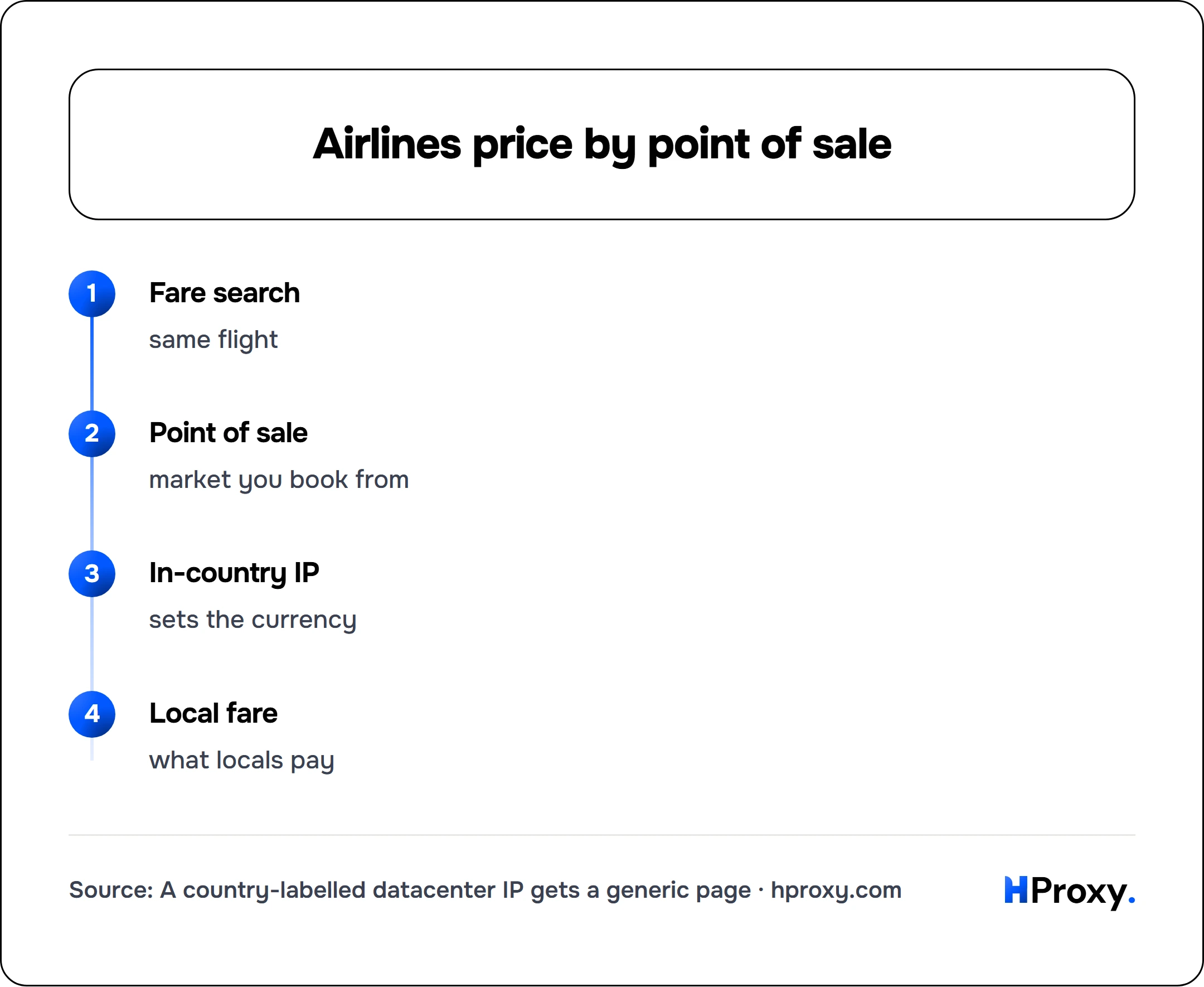
Airline and OTA pricing is not one number. Airlines file fares by point of sale, the market a request appears to book from, so the same seat on the same flight can cost noticeably more or less depending on the country the request comes from, and it is quoted in that market's currency. On top of that, revenue-management systems reprice inventory throughout the day as seats sell and departure nears, and some sites hold back app-only or device-specific promotions.
The practical consequence is direct: to capture the fare a traveler in a given market actually sees, your request has to originate there. A datacenter address wearing a country label usually collects a generic page quoting the wrong currency, because the airline or OTA weighs where the network truly sits over the tag attached to it. Fares only become real numbers when the request leaves from a residential exit planted inside each target market. This is the same geo-accuracy problem we cover for retail in price monitoring, turned up a notch, because travel prices move faster and split by market more finely.
Fare search
same flight
Point of sale
market you book from
In-country IP
sets the currency
Local fare
what locals pay
The anti-bot problem is unusually severe here
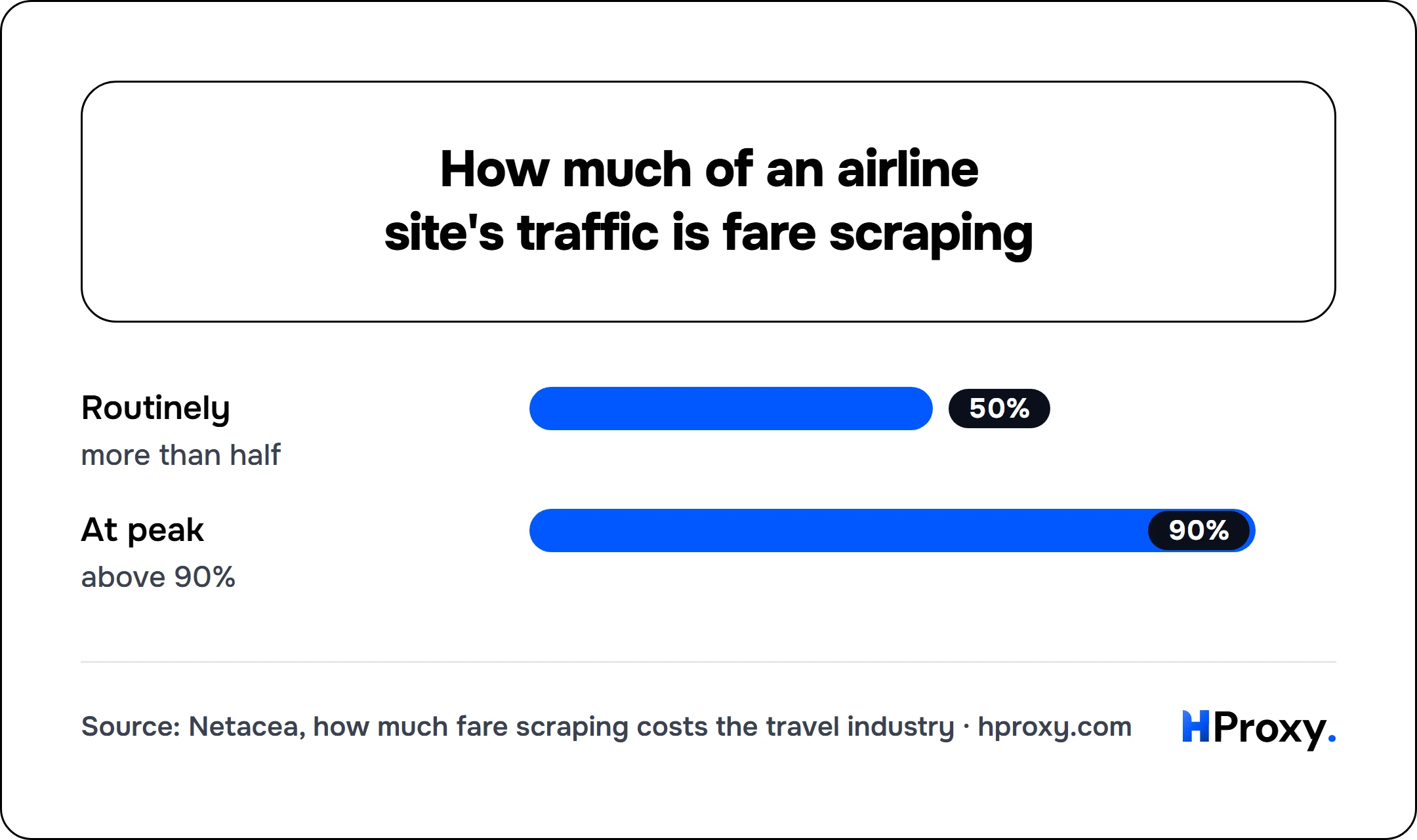
Airline and GDS-backed booking sites fight scrapers harder than almost anything else, for a reason most guides skip: money. Behind many airline and OTA searches sit Global Distribution Systems, and those searches cost the seller real money per query. A scraper that searches a thousand times and books nothing hurts the look-to-book ratio the industry watches closely, so airlines and their partners invest heavily in stopping automated searching that will never convert. The scale is not small: security vendors report that automated fare scraping routinely makes up more than half of the traffic on airline sites, and can peak above 90%, and each of those searches can carry a real GDS or booking-API fee, which is exactly why the industry treats the look-to-book ratio as a cost line rather than a vanity metric.
The imbalance is stark: on many airline sites the automated traffic outweighs the human shoppers.
In practice you meet the full stack. Akamai, DataDome, Imperva, PerimeterX, Cloudflare, plus reCAPTCHA and hCaptcha challenges, often layered on a single funnel. Spreading requests across many residential IPs is necessary but not sufficient: the IP is one signal among several, and plausible headers, cookies carried from step to step and lifelike pacing decide whether strong exits survive. Our checklist on avoiding IP bans while scraping is the prevention half that residential quality alone does not cover.
Rotation and sticky sessions for booking flows
The naive approach, a fresh IP per request, works for a stateless calendar scrape but breaks the moment you progress a booking. A real fare check is multi-step: search, results, select a flight, enter passenger details, and only then does the site confirm the actual bookable price, which frequently differs from the teaser fare on the results page. That whole flow sets cookies and a server-side session. Change IP in the middle and you either get logged out of the cart or hand the bot detector an obvious tell, a session that jumps between countries mid-checkout.
So match rotation to the job. For independent searches, take a fresh IP per request, since no one address should pile up the activity that betrays a monitor. For anything that walks through the funnel, hold a sticky session, a single exit pinned for the few minutes the flow needs. Our rotating vs static residential explainer covers exactly when to pin an exit and for how long. When a flow has to stay stable for longer stretches, a static residential or ISP IP is steadier than a sticky window on a rotating pool.
Handling dynamic and JavaScript-rendered pricing
Modern airline and OTA sites are single-page apps: the initial HTML is a shell, and the fare arrives a moment later through a background XHR or GraphQL call. A raw HTTP fetch sees no price and your dataset fills with nulls. There are two workable paths, the same as elsewhere but sharper here. Drive a headless browser (Playwright or Puppeteer) behind your residential proxy so the page runs its scripts and calls its pricing API exactly as a traveler's browser would. Or identify the underlying pricing endpoint the page calls and request it directly, which is lighter when the site allows it and its payloads stay stable.
Travel sites lean heavily on the browser route, because their funnels and anti-bot checks assume a real browser environment: a JavaScript runtime, a plausible TLS fingerprint, cookies that persist across steps. Expect to run headless more often than on a simple retail scrape, and budget the bandwidth that comes with it, since a rendered page pulls far more than a lean HTTP request.
Scaling across routes, dates and passengers
Travel data explodes combinatorially. A single origin-destination pair is nothing; a real aggregator wants many routes, a rolling window of departure and return dates, several cabins and passenger counts, refreshed often because fares keep moving. That is quickly millions of query combinations, and the number of requests, not the number of routes, is what sizes your proxy pool. Estimate the requests a single refresh cycle demands, divide by what one IP can handle safely in your window, and pad it for retries and headless overhead.
A few disciplines keep it sane. Refresh volatile routes (busy, near-term, high-demand) more frequently than settled ones, rather than hammering the whole set on one schedule. Stagger start times so your queries are not all firing in the same minute. Cache the things that do not move, such as airport lists and route metadata, even though the fares themselves cannot be cached for long. Rotating residential absorbs most of the pool arithmetic by serving every request from one big shared pool, which is why aggregators at scale prefer it to nursing a fixed IP list by hand.
Matching proxy type to travel target
| Target | Proxy type | Why |
|---|---|---|
| Metasearch (Google Flights, Skyscanner, Kayak) | Rotating residential, country-targeted | Heavy anti-bot, and results vary by market |
| Airline sites, booked direct | Rotating residential, country-targeted | Point-of-sale pricing plus aggressive defenses |
| OTAs (Expedia, Booking) | Rotating residential, country-targeted | Price and currency shift by visitor location |
| Multi-step booking or fare confirmation | Static residential / ISP, or a sticky session | The session must survive to reach the bookable price |
| The most bot-hostile funnels | Mobile | Carrier-shared IPs that sites are reluctant to block |
The money-saver embedded in that table: pick the cheapest exit a target will stomach, and climb higher only when blocks or wrong-market fares make you. The difference from ordinary scraping is that very few travel targets tolerate datacenter IPs at all, so here residential is usually the floor, not the upgrade.
Where free ends and paid begins
Residential proxies are not a free lunch, and no one benefits when a guide pretends they are. Billing is by the gigabyte, and travel scraping burns through it, since single-page funnels driven by a headless browser haul down far more data than a lean retail crawl. Treat that as a standing operating cost, not a one-off outlay. When a fare crawl can run through a few fixed identities, our unmetered ISP and datacenter plans move that cost off the gigabyte entirely.
A scraped fare is a snapshot, not a promise. Prices change between your search and a real booking, and a cheaper point-of-sale fare may not even be purchasable from another market once payment-card-country or residency checks apply. Present fares as observed-at-a-time, not guaranteed. Remember too that heavy searching without booking is the exact pattern these sites are built to punish, so pacing, caching and restrained volume are not just anti-ban hygiene here, they keep your footprint defensible. Exit coverage also runs thin in less-traveled origin countries, so a minor departure market may list fewer IPs than a big hub. And airline and OTA terms of service usually restrict automated access: a proxy is a technical tool, not a legal shield, so keep commercial and personal-data use inside advice you have actually taken.
The mental model to hold is that the proxy makes your request believable and puts it in the right market, while disciplined rotation, sessions, rendering and pacing keep the fares clean across thousands of route-and-date combinations. For most travel work the default we would point you at is rotating residential with country targeting, escalating to sticky or static exits for the booking funnel and to mobile only for the worst offenders. Our pricing is pay-as-you-go with a balance that does not expire, which suits a fare pipeline that ramps around seasons and pauses between them without burning prepaid credit. Nail the geo and the session first, keep your cadence steady, and travel fare aggregation settles back into a data problem rather than a standoff with anti-bot walls.
Sources
- Netacea, how much fare scraping costs the travel industry (the share of airline traffic that is automated, and the look-to-book cost behind the defenses): netacea.com