Choosing a proxy provider on price alone is the most common and most expensive mistake in this market, because a cheap request that fails costs more than a dearer one that works. That framing runs through the whole page.
The published numbers
Read from their own public pricing pages on 10 August 2026, and stated as advertised rather than as verified by us:
- ISP: $1.95 per IP on unpublished, page states a range but never states the qualifying volume.
- Mobile: from $8 per GB with no commitment, falling to $1 per GB on not reachable self-serve, custom quote, required volume never published.
- Residential: from $4 per GB with no commitment, falling to $0.30 per GB on NO RESIDENTIAL PLAN REACHES THIS. Advertised as Residential IPs from $0.3 per GB in the Products and Pricing nav dropdown; the figure is really their Shared Datacenter rate (2000GB, $599)..
Every one of those is a published rate rather than a measured outcome. That is not a criticism of Infatica: our own page is built from the same material. It is the reason the rest of this comparison is about what published rates leave out.
Their own description, read this week
Their homepage title, read on 9 September 2026: "Infatica , Web Data Provider, Proxies and Scraping APIs at Scale". The blurb under their search result reads: "Collect reliable web data through 45M+ ethically sourced proxies and scraping APIs across 195+ countries. 4× ISO-certified infrastructure. 99.9% success rate."
Reading the same page for the things buyers actually ask about:
The product lines named on that page are residential, datacenter, SOCKS5, IPv6 and a scraping or SERP API. They advertise 195 countries or locations. Payment methods mentioned: cards. The page offers some form of free trial. Support is advertised as around the clock. Their pricing page is titled "Residential and Mobile Proxies Price - Buy The Cheapest Proxy, Infatica".
All of the above is their copy, not our finding. A dated quotation is the weakest kind of evidence that is still evidence.
How far back the record goes
The domain was registered on 8 October 2018, through Tucows Domains Inc, which makes it about 7 years old. Checked against the registry on 23 April 2026. The registration currently runs to 8 October 2029.
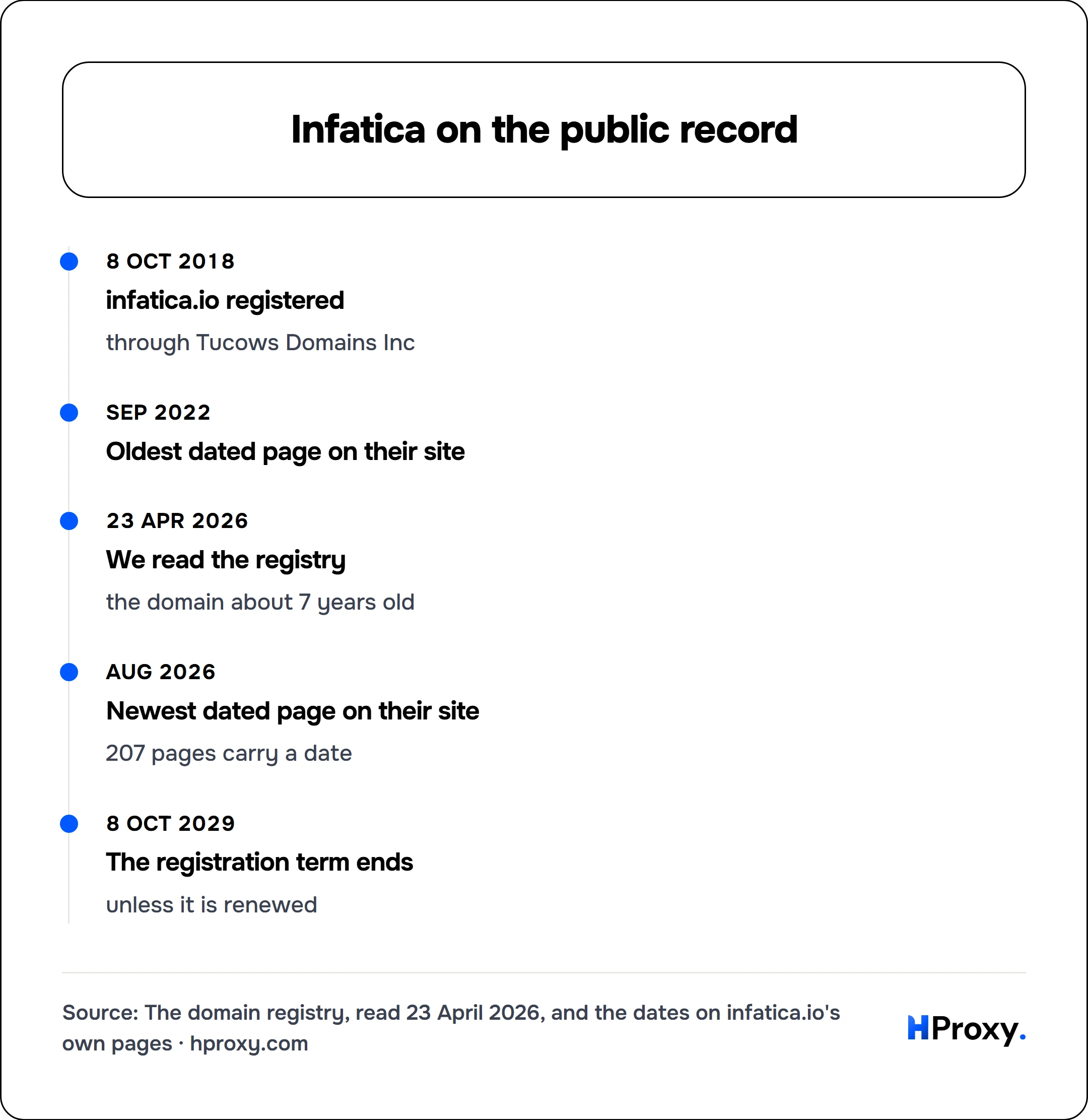
8 Oct 2018
infatica.io registered
through Tucows Domains Inc
Sep 2022
Oldest dated page on their site
23 Apr 2026
We read the registry
the domain about 7 years old
Aug 2026
Newest dated page on their site
207 pages carry a date
8 Oct 2029
The registration term ends
unless it is renewed
This proves nothing about the product. It is a cheap check against the one failure mode that costs buyers real money in this market, which is paying a provider that will not exist in six months.
On the record about the company itself: Founded 2019 by Vladimir Fomenko, Singapore entity; Linked to the Fomenko (Die$el) operator cluster.
What our crawl found
A crawl of 207 pages returned 1 pricing page and 114 location pages.
The number is not a compliment or a criticism. It describes how much of their effort goes into being found, which is worth knowing when you are weighing a marketing claim against a measurement.
How recently the site moved
Our crawl of their site found 207 pages carrying a date. The oldest is from September 2022 and the newest from August 2026. 73 of them carry a date inside the last twelve months.
Read that as a liveness check rather than a review. It says the lights are on, and nothing about whether the proxies work on your target.
What people actually search about Infatica
Search volume around the name runs to 10 a month, split as 10 a month for a review of them. Figures read from Google Keyword Planner on 9 September 2026.
The biggest slice is people checking whether to trust it, so the useful thing to hand a reader is evidence rather than an opinion.
Advertisers bid up to $26.29 for one of those clicks, which is a useful proxy for what a customer in this market is worth and for how hard the results page is fought over.
What a pricing page leaves out
Why a cheap address is often a used one
Ask how many accounts can sit on one address at once. Where the answer is unlimited or unspecified, price the plan as shared regardless of what the product is called.
What a blocked response costs you
Some vendors bill every request, some bill only successful ones, and the difference is the whole comparison once a target starts blocking. A cheap rate with a fifty percent success rate is twice its advertised price.
Concurrency limits decide throughput
Bandwidth is rarely the constraint on a real workload. Concurrent connections, requests per second and per-session caps are, and they are frequently buried in the documentation rather than the pricing page.
The rows that decide it
Set the two side by side on the questions that decide the outcome, rather than on feature counts:
| Question to ask | Infatica | HProxy |
|---|---|---|
| Entry price | Published, see above, dated 10 August 2026 | From $0.44/GB, pay as you go |
| Does unused balance expire? | Not published clearly, ask before paying | Never |
| Minimum commitment | Lower rates require one, see above | None |
| Identity checks | Read their current terms | Card orders are screened, and verification is sometimes requested |
| Targeting | Worth confirming in writing before you commit | Country, city and ISP |
| Free way to evaluate | Read their current terms | Free proxy list and proxy checker |
The useful part of that table is the left column. Take those six questions to any provider in this market and the answers will sort them faster than any review.
The measurement that outranks every review
This costs less than a coffee and produces the only evidence that applies to your workload.
- Put a few dollars on each account. Trials are fine for a first look, but paid traffic is what you will actually be buying.
- Run them against the site you actually care about, using the code you actually run, within the same hour.
- Record the success rate and the data consumed for the identical batch on each side.
- Check some of the addresses yourself for country, ASN and type before you trust the label on the plan.
- Choose on the measurement, not the marketing, and expect the answer to change within a year.
Where else buyers look
If this one does not fit, these are the nearest comparable providers we have written up, each on the same terms as this page.
- Ltesocks alternatives
- Luminati Networks alternatives
- Lumiproxy alternatives
- LuxProxy alternatives
- LuxSocks alternatives
- luxurysocks.net alternatives
Where we fit
The offer, stated once: residential from $0.44 per GB, pay per gigabyte, no subscription, balance does not expire, and free tools that stay usable without an account. Everything above this paragraph applies whether or not you choose us.