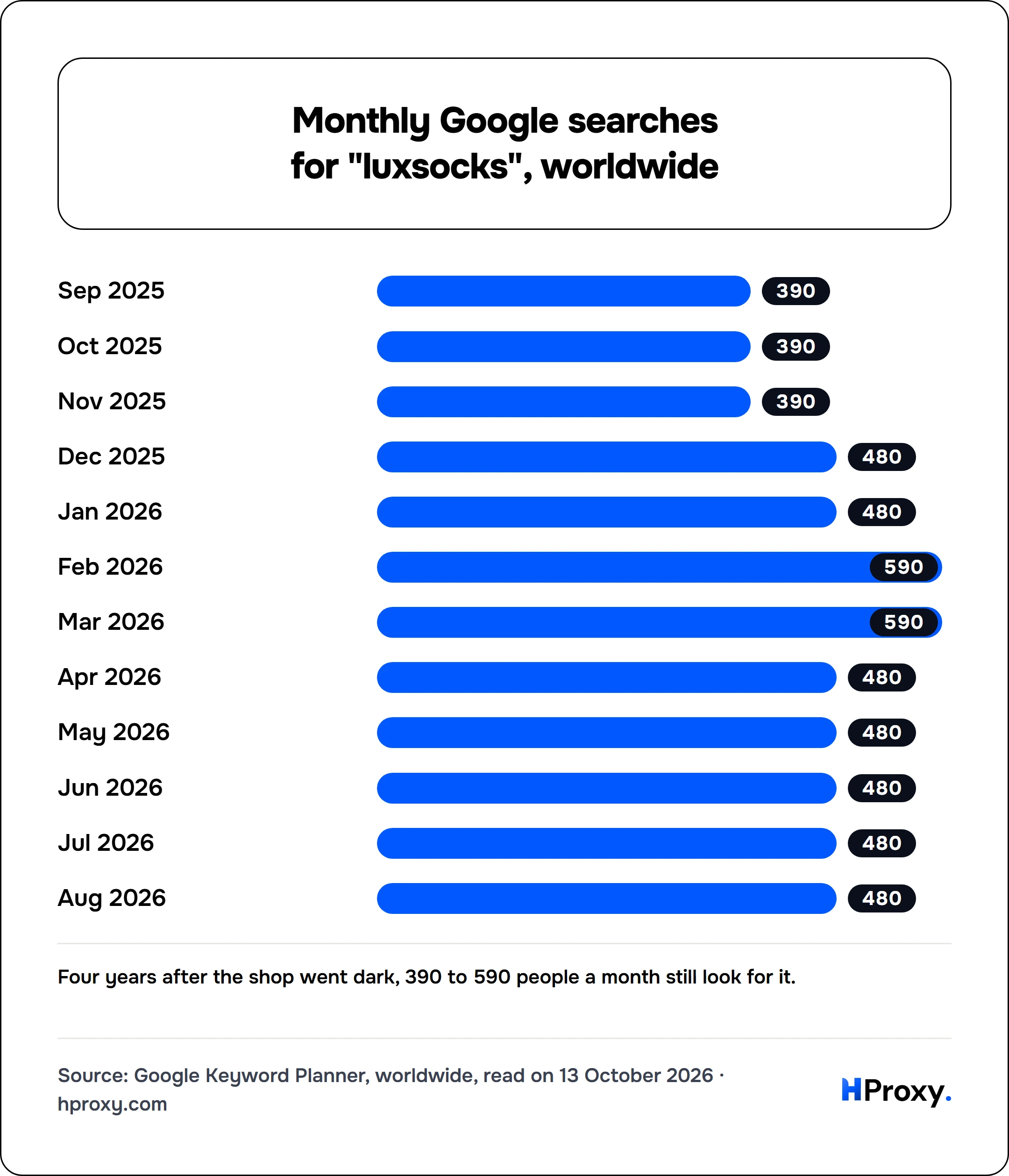
LuxSocks (luxsocks.ru), which called itself LuxurySocks, sold access to SOCKS proxies behind a login, with support by Jabber and no public price list. Copies in the Internet Archive show its login page from 2016 to 2021. In March 2022 the site refused visitors, from June 2022 it showed a DNS host's placeholder, and on 13 October 2026 it served an empty parking page. About 480 people a month still search for it. Those who need SOCKS5 proxies today will find current sellers below.
What the record shows
luxsocks.ru over ten years
| When | What luxsocks.ru showed |
|---|---|
| February 2016 | "LuxurySocks - Home": a login and registration form |
| July 2019 | The same login, with support by Jabber |
| November 2020 to May 2021 | A redirect to its login page |
| December 2021 | Still answering, with a redirect |
| March and April 2022 | Refused (HTTP 403) |
| June 2022 to 2023 | A ClouDNS placeholder for a parked domain |
| August 2025 | An empty page |
| 13 October 2026 | An empty parking page; name servers of SNPARKING |
The Internet Archive's copies of luxsocks.ru, and our own request from our server on 13 October 2026
The shop ran on two domains. luxsocks.su showed the same login page in 2019, answered 403 in March 2022 and turned into the same ClouDNS placeholder that June. On 13 October 2026 the .su name no longer resolved to any address, and luxsocks.ru answered over plain HTTP only, with a page of 1.6 KB whose tags name SNPARKING.
A different shop, at luxurysocks.net, carried the title "LuxSocks" in October 2024 and sells single SOCKS proxies today. Its support account uses the LuxSocks name, and that name is the only link we found to the old shop; our luxurysocks.net page covers it.
No archived copy of luxsocks.ru shows a price, a term of service or a company. The home page was a login and nothing more, and support ran over Jabber. Our database had noted a sign-up fee of about $2 and payment by Bitcoin, but no page we could read confirms either.
What other pages say about it
NaProxy published several pages about LuxSocks on 19 March 2025, three years after it went dark. One calls "Luxsocks ru" "a popular choice known for its high-quality" proxies, and another says luxsocks.ru "offers access to a wide range of residential and mobile IP addresses". Coronium's guide of April 2026 says plainly that LuxSocks is closed. None of them shows a price or a page of the shop itself.
Where to buy SOCKS5 proxies now
Sellers that list SOCKS5, October 2026
| Seller | SOCKS5 on | From |
|---|---|---|
| Proxy6 | Datacenter IPv4 and IPv6 | $1.50 an IPv4 address a month |
| AstroProxy | Residential, mobile, datacenter | $7.30 a GB plus a port fee |
| Rayobyte | Premium Residential | $3.50 a GB up to 49 GB |
proxy6.net, astroproxy.com and rayobyte.com, read from our server on 12 October 2026
Proxy6 rents single datacenter addresses that work over "HTTPS / SOCKS5", at $1.50 an IPv4 address a month below 100 and less for IPv6. AstroProxy's rotating residential, mobile and datacenter proxies support "HTTP(S) and SOCKS5", with a port fee on top of the traffic and identity checks for every client. Rayobyte's Premium Residential adds SOCKS5 and UDP, at $3.50 a GB for small orders. Our pages on Proxy6 and AstroProxy cover their rules in full.
Where HProxy fits
We sell residential and datacenter proxies that work over SOCKS5. Residential traffic starts at $0.44 per GB, and Premium adds UDP and sticky sessions of up to 24 hours from $1.00 per GB. Datacenter addresses cost $1.58 per IP a month, with HTTP, HTTPS and SOCKS5 on every proxy. Our free proxy list is there for a quick test.
Which one to pick
- Proxy6 for a few fixed datacenter addresses over SOCKS5, by the month.
- AstroProxy or Rayobyte for rotating residential traffic over SOCKS5, if their checks suit you.
- A free list only for a throwaway test, never for a login.
What we could not find out
We do not know who ran LuxSocks, what it charged, where its addresses came from, or why it stopped; its pages never said. The archive's copies are snapshots, so the closure can only be dated to between December 2021 and March 2022. The note of a $2 fee and Bitcoin payment in our own database has no source we could check. We will look at both domains again by 13 January 2027.
Sources
- The Internet Archive's copies of luxsocks.ru and luxsocks.su, from 2015 to 2025.
- Our own requests to luxsocks.ru and luxsocks.su from our server, and their name servers, 13 October 2026.
- Pages about LuxSocks by NaProxy (19 March 2025) and Coronium (30 April 2026), read 13 October 2026.
- The price pages of Proxy6, AstroProxy and Rayobyte, read from our server on 12 October 2026.
- Search counts for LuxSocks and SOCKS5 proxies from Google Keyword Planner, worldwide, 13 October 2026.
- HProxy's residential and datacenter prices, rendered from our live price data.